Computer Science

Dipankar Dasgupta - IEEE Fellow, NAI Fellow

Dr. Dasgupta will be delivering a talk on "Adaptive Multi-Factor Authentication & Cyber Identity" in the Distinguished Speaker Webinar Series jointly hosted by the Center for Cyber Security Research (C2SR), the Artificial Intelligence Research (AIR) Initiative, and the School of Electrical Engineering and Computer Science (SEECS) at the University of North Dakota College of Engineering & Mines with support from University of Minnesota, North Dakota State University, University of Miami, Texas A&M Kingsville, University of Connecticut and West Virginia University.

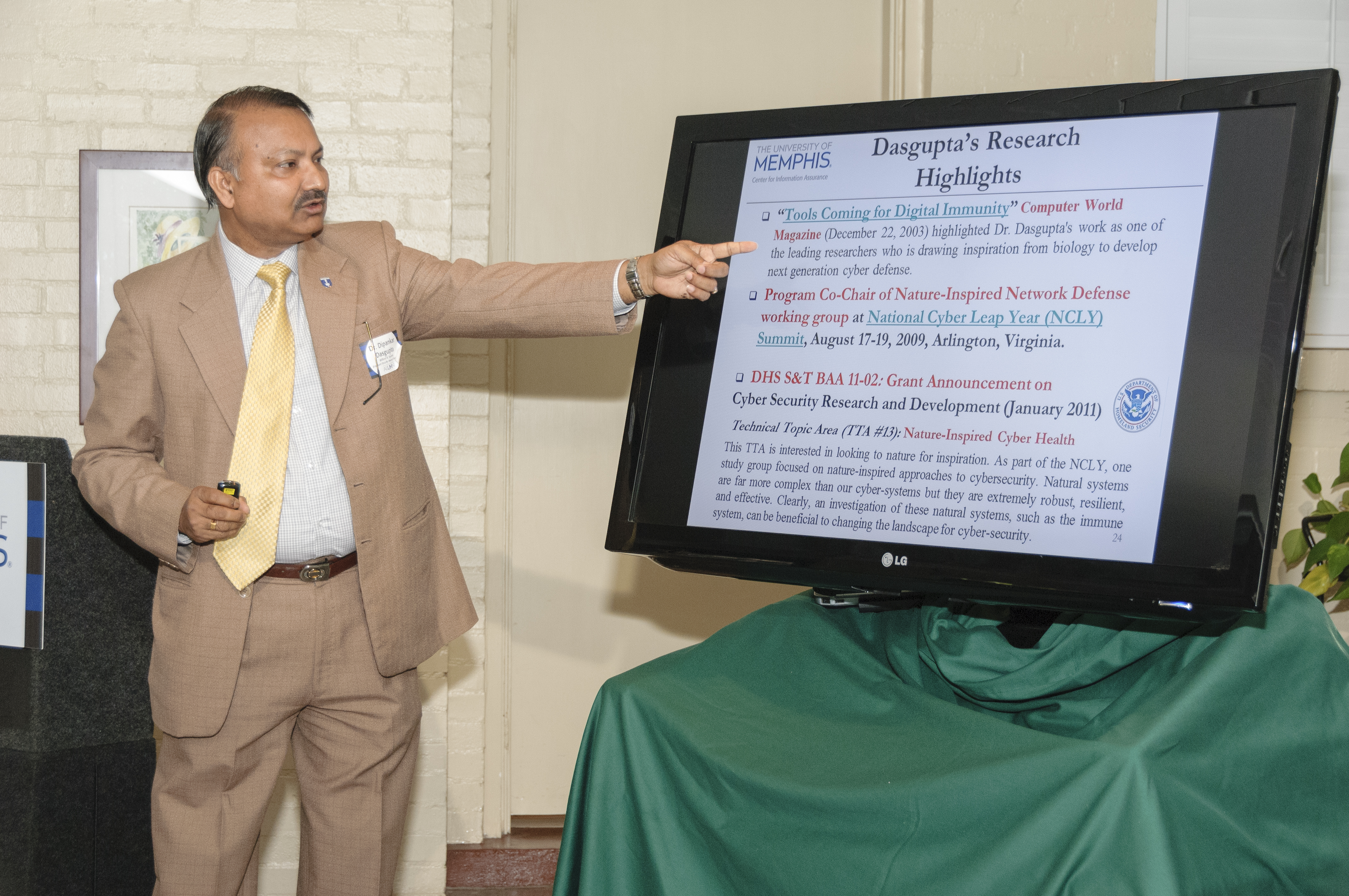
Dr. Dasgupta is listed among the top computer scientists whose h-index is above 59 (available at UCLA site ), thus, influencing the research community. One of his current researches is applying Computational Intelligence techniques in Network and Internet Security. For more information, please click here .


The Biological immune system is a highly parallel, distributed, and adaptive system. It uses learning, memory, and associative retrieval to solve recognition and classification tasks. In particular, it learns to recognize relevant patterns, remember patterns that have been seen previously, and use combinatorics to construct pattern detectors efficiently. These remarkable information processing abilities of the immune system provide important aspects in the field of computation. This emerging field is sometimes referred to as Immunological Computation, Immunocomputing, or Artificial Immune Systems (AIS). Although it is still relatively new, AIS, having a strong relationship with other biology-inspired computing models, and computational biology, is establishing its uniqueness and effectiveness through the zealous efforts of researchers around the world.

Books on Artificial Immune Systems:

Evolutionary Computation

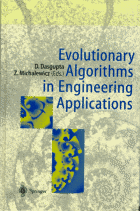
Book: Evolutionary Algorithms in Engineering Applications

Structured Genetic Algorithms (st. GA)

The field of biological evolution brought a new age in adaptive computation (AC). Among different evolutionary computation approaches, Genetic Algorithms (GA) are receiving much attention both in academic and industries. Genetic algorithms are general-purpose search procedures based on the mechanisms of natural selection and population genetics. Genetic algorithm-based tools have started growing impact in companies - predicting financial market, in factories - job scheduling etc. with their power of search, optimization, adaptation and learning. For the users of diversified fields, genetic algorithms are appealing because of their simplicity, easy to interface and ease to extensibility.

Despite their generally robust character, as the application increases, there found many domains where formal GAs perform poorly. Several modifications have been suggested to alleviate the difficulties both in the manipulation of encoded information and the ways of representing problem spaces. A number of different models, namely, Messy GAs and Genetic Programmings developed recently which addressed the representation issue of GAs.

Dipankar Dasgupta has been involved in the investigation of a more biologically motivated genetic search model - called the Structured Genetic Algorithm (sGA). The model uses some complex mechanisms of biological systems for developing a more efficient genetic search technique. Specifically, this model incorporates redundant genetic material and a gene activation mechanism which utilizes multi-layered genomic structures for the chromosome. The additional genetic material has many advantages in search and optimization. It mainly serves two purposes: primarily, it can maintain genetic diversity at all time during the search process, where the expected variability largely depends on the amount of redundancy incorporated in the encoding.

The following paragraphs summarize some aspects and advantages of Structured Genetic Algorithms:

  • A chromosome is represented by a set of substrings which act as different levels to establish a kind of switch, controlling the expression of down stream genes. These during reproduction are modified by the genetic operators - crossover and mutation etc. - exactly as in simple GAs.
  • In decoding to the phenotype, a chromosome is interpreted as a hierarchical genomic structure of the genetic material. Only those genes currently {\em active} in the chromosome contribute to the fitness of the phenotype. The {\em passive} genes are apparently neutral and carried along as redundant genetic material during the evolutionary process.
  • Genetic operations altering high-level genes result in changes to the active elements of the genomic structures. Particularly, the role of mutation is twofold: it changes the allele value of any gene, but when it occurs at a higher level it acts as a dominance operator and changes the expression of a set of gene values at the lower level.
  • Even when a population converges to its phenotypic space, genotypic diversity still exists which is a unique characteristic of the model. In most other formal genetic models, phenotypic convergence implies genotypic convergence with consequent impoverishment of diversity within the population.
  • It can maintain a balance between exploration and exploitation resulting in efficient searching of potential areas of the phenotypic space. Being trapped at a local optimum which causes premature convergence can be avoided.
  • The sGA provides a long-term mechanism for preserving and retrieving alternative solutions or previously-expressed building blocks within the chromosomal structures. In non-stationary optimizations, a sGA provides a means of rapid long jump adaptation; whereas a simple GA with the dominance and diploidy used so far can store or retrieve one allele independently, and thus may provide only a short-term preservation.
  • Co-evolution can also occur easily among species by simultaneously sampling and preserving different areas of search space in a multi-global fitness landscape. In effect, it can retain multiple optional solutions (or parameter spaces) in function optimization.
  • It can achieve optimization of multi-stage problems by defining search spaces in its different layers and can explore and exploit them in a single evolutionary process.

One school of thought (Darwinian) believes that evolutionary changes are gradual; another (Punctuated Equilibria) postulates that evolutionary changes go in sudden bursts, punctuating long periods of stasis when very small evolutionary changes take place in a given lineage. The new model provides a good framework for carrying out studies that could bridge these two theories.

Structured GA's results to date are very encouraging, though there remain many issues for further investigation. It appears to an enhancement of the formal genetic model with a number of practical advantages. This approach has also received favorable attention in the field of evolutionary computation. However, the studies on structured GAs done so far are only the first step toward the broader goal of developing a more efficient genetic search. Further research to understand the behavior of the model and to determine its search properties is in progress.

AI Cyber Security

Among different research areas Negative Authentication, Adaption Multi-Factor Authentication, Smart-Grid Security are the current focus. Also Game Theory and Cyber Security (GTCS) group conducts cutting-edge research to explore how they can apply game theoretic approaches to address network security issues. Current projects that students are working on include Game Theory Inspired Defense Architecture (GIDA), and AVOIDIT: A Cyber Attack Taxonomy.

Artificial Immune Systems/Immunilogical Computation

This emerging field is sometimes referred to as Immunological Computation, Immunocomputing, or Artificial Immune Systems (AIS). Although it is still relatively new, AIS, having a strong relationship with other biology-inspired computing models, and computational biology, is establishing its uniqueness and effectiveness through the zealous efforts of researchers around the world.

Evolutionary Computation/Evogenerative AI

Dipankar Dasgupta has been involved in the investigation of a more biologically motivated genetic search model - called the Structured Genetic Algorithm (sGA). The model uses some complex mechanisms of biological systems for developing a more efficient genetic search technique. Specifically, this model incorporates redundant genetic material and a gene activation mechanism which utilizes multi-layered genomic structures for the chromosome. The additional genetic material has many advantages in search and optimization. It mainly serves two purposes: primarily, it can maintain genetic diversity at all time during the search process, where the expected variability largely depends on the amount of redundancy incorporated in the encoding.

Dr. Dipankar Dasgupta published more than 292 research papers in book chapters, journals, and international conferences. He authored several books, published two edited volumes and co-edited several conference proceedings over the last 20 years. A search for "Dipankar Dasgupta" on Google Scholar shows a total count: 19,210+ citations. To get the current list of his publications from Google Scholar click here.


World Scientist Ranking:


1060


Google Scholar Entry:


(h-index: 68)


Scopus Entry:


162 co-authors


Editorial Board of journals

  • Evolutionary Intelligence, Springer-Verlag
  • Evolutionary Optimization, Polish Academy of Science.
  • Recent Patents on Computer Science, online journal Bentham Science Publishers Ltd.
  • Swarm and Evolutionary Computing - Elsevier Press

His work on "Password Immunizer" (based on Negative Authentication System) was submitted for patent. A demo illustrating the concept is available here.

His published books include:


Advances in User Authentication Immunological Computation Artificial Immune Systems and their applications artificial immune systems in russian Evolutionary Algorithms in Engineering Applications


If you are interested in any of the above mentioned research areas, contact the Computer Science Department for graduate programs.


Academic / Honorary Positions


  2018-Present
William Hill Professor in Cybersecurity

The University of Memphis

  2014-2019
Dr. Pat E. Burlison professorship

The University of Memphis

  2011-2012
Willard R. Sparks Eminent Faculty

The University of Memphis

  2007-2010
Dunavant Professorship

The University of Memphis

  2004-Present
Full Professor

Computer Science, The University of Memphis

  2003-2004
Visiting Scientist (Sabbatical Position)

NSA Ames Research Lab, California

  2001- 2004
Associate Professor

Computer Science, The University of Memphis

  1997- 2001
Assistant Professor

Computer Science, The University of Memphis

  1995-1996
Visiting Assistant Professor

Computer Science, University of Missouri, St. Louis

  1994-1995
Post Doctoral Research Associate

Computer Science, University of New Mexico, Albuquerque