
School of Public Health
Faculty Spotlight - Dr. Onoja Matthew Akpa
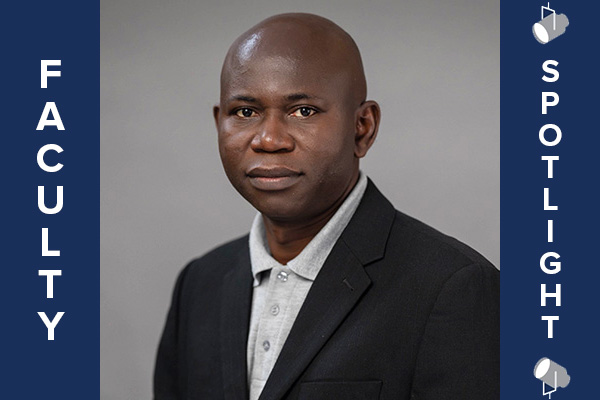
Q&A with Onoja Matthew Akpa, MS, PhD
Associate Professor, Epidemiology, Biostatistics and Enviornmental Health
- What brought you to the U of M School of Public Health?
I was drawn to the University of Memphis School of Public Health because of its strong commitment to teaching excellence, student mentorship, and applied public-health training. The opportunity to contribute to developing the next generation of public-health professionals (biostatistician, population data scientists and Epidemiologist) was central to my decision to join the School. - What is the broad focus of your research?
My research integrates advanced biostatistical methods with large-scale population health studies, particularly in cardiovascular disease, stroke, hypertension and obesity. I work extensively with multi-site cohorts by analyzing harmonized data to understand risk factors and improve prevention strategies in diverse populations, especially in African and US populations. - What inspired you to pursue this particular area of research?
Early in my career, I became fascinated by how rigorous statistical modeling could translate complex and independently collected health datasets into actionable public-health information. Seeing firsthand the burden of cardiovascular disease in resource-limited settings motivated me to focus my work on harmonizing independently acquired datasets to enhance findings that can guide prevention and policy. - What is the most exciting project you are currently working on?
I am currently involved in a large, international cardiovascular and stroke research collaborations that examine genetic, behavioral, and environmental determinants of disease across populations in Africa. - How does your research impact or benefit the broader community or public health field?
How do you envision your research evolving in the next few years?
My work has helped identify major modifiable risk factors for stroke, hypertension and obesity across diverse populations, informing prevention strategies and population-level interventions in Africa and beyond. In the coming years, I plan to expand my research through the application of spatial analytical techniques for place-based public-health research in the United States. - What is the coolest training or program you've been a part of, or your favorite conference
you've attended?
Participating in international cardiovascular research consortia and specialized modeling programs across the United States, Africa, and Asia has been especially formative. In particular, the annual consortium meeting of the H3Africa were very interesting and informative in my career. - What is your favorite self-authored manuscript?
One of my favorite papers is our Hypertension study examining “Regional Patterns and Association Between Obesity and Hypertension in Africa” (Akpa etc., 2020). This work brought together large, harmonized datasets from multiple countries across Africa and demonstrated how large participants’ data from different settings could be harmonized for a rigorous statistical analysis to uncover geographic disparities in cardiometabolic risk. - What kind of research would you like to do that you haven't yet had the opportunity
to do?
I am eager to further expand my work in spatial analytical techniques to population health in Tennessee and the United States at large. I want to apply place-based models that integrate environmental exposures, neighborhood context, and health-care access. This would support precision public-health strategies by identifying high-risk areas and informing place-based targeted interventions at the local and regional levels. - Are there any publications, awards, or recognitions you would like us to include in
the spotlight?
My work includes more than a hundred and fifty peer-reviewed publications in leading public-health, cardiovascular diseases, and epidemiologic journals. I have held visiting scholar award to the Harvard T. Chan School of Public Health in Boston, MA and the North Western University, Chicago. I have served in leadership roles within Academic department and major population-health research networks.