School of Public Health

Master of Health Administration (Executive Track Online)

decorative image

First CAHME-accredited program in TN

Logo CAHME

Logo AUPHA


About the Program

The program is designed for mid-to-senior level professionals who are already working in healthcare or related fields and wish to advance their careers in healthcare systems at the executive level by gaining advanced skills in strategic leadership, financial management, and organizational transformation. Professionals in the executive MHA program will enhance their leadership and management skills, and gain insights in healthcare policy, governance, crisis management, and data-driven decision-making to lead healthcare organizations through change and innovation. The online modality affords accessibility and flexibility to complete the program at different paces and schedules 

The MHA program, located in the University of Memphis CEPH-accredited School of Public Health, is a full graduate member of the Association of University Programs in Health Administration (AUPHA), and belongs to ACHE's Higher Education Network (HEN).

Program Flyer - PDFRequest InformationInformation Sessions


Academic and Career Advising

You will have a dedicated one-on-one academic advisor to guide you through your learning experience, and a faculty advisor to work with you to develop your career plan. The Office of Experiential Learning and Career Readiness will support you in identifying opportunities and professional and workplace skills. 

Briana McNeil, M.Ed.  
Recruitment and Admissions Coordinator 
sphadmissions@memphis.edu 
Phone: (901) 678-3740 


Career Outcomes

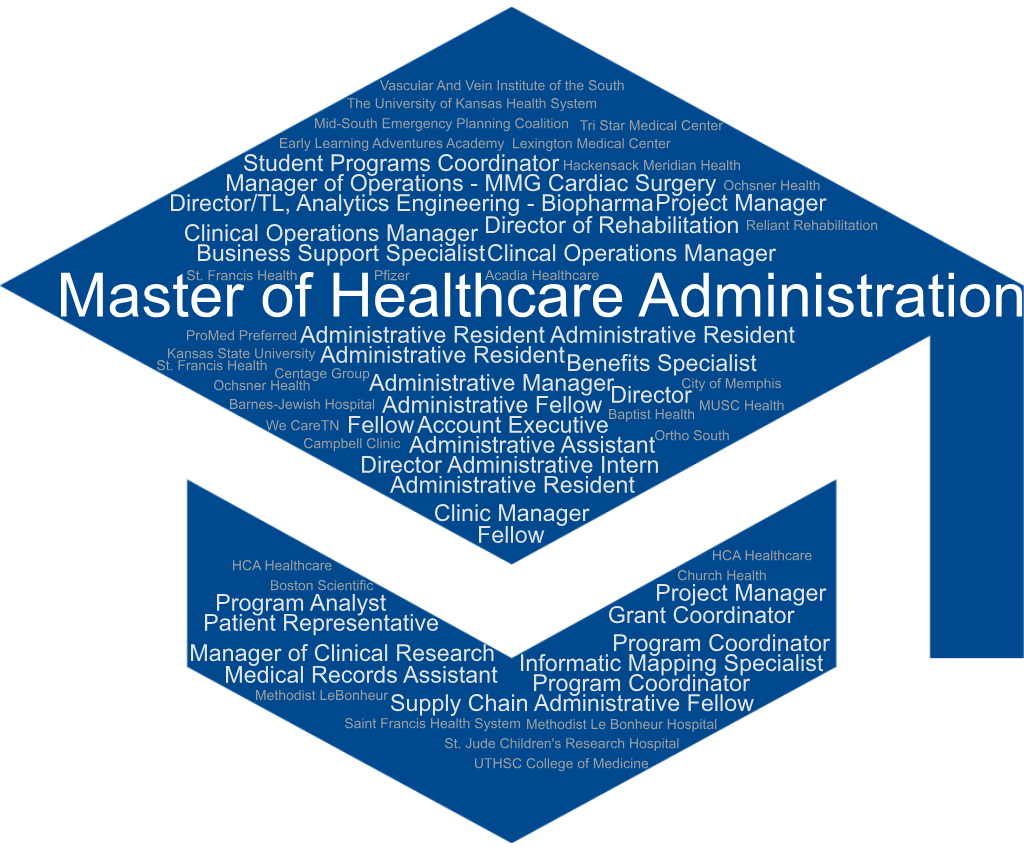
Graduates of the MHA program oversee healthcare operations in prominent medical, healthcare delivery and insurance organizations, in public health departments and healthcare consulting firms in Memphis and nationally. 


Pathways Opportunities

Students can enhance their skills through graduate certificates in one of the following areas, or create their own plan in consultation with the academic advisor: 

  • Health systems leadership
  • Health analytics
  • Population health informatics
  • Population health 


How to Apply

Deadlines 

International applicants should plan to have their applications by May 15 for Fall Semester and October 15 for Spring Semester to ensure sufficient time to receive your Form I-20 and visa. 

  • Fall Semester – August 15(a)
  • Spring Semester – January 15(a) 

Degree Requirements

The program requires forty-two (42) credit hours of core courses and three (3) credit hours of internship. 
Core Courses (42 credit hours) 

  • HADM 7100 Day One (0 credit hours)
  • HADM 7101 Day One (0 credit hours)
  • HADM 7102 Healthcare Law
  • HADM 7103 Health Planning
  • HADM 7105 Health Policy & the Org. of Health Services
  • HADM 7108 Health Care Finance I
  • HADM 7109 Health Administration Information Systems
  • HADM 7110 Leadership & Organizational Change
  • HADM 7116 Administration of Health Services Orgs
  • HADM 7140 Population Health Management
  • HADM 7204 Healthcare Quality & Outcomes Mgmt.
  • HADM 7208 Health Care Finance II
  • HADM 7209 Quantitative Methods in Health Services
  • HADM 7210 Comprehensive Experience in Healthcare Mgmt.
  • HADM 7605 Human Resources Administration
  • PUBH 7710 Health Economics

Internship (3 credit hours) 

  • HADM 7190 Practicum/Field Experience  

Graduate students must maintain a minimum of a 3.0 GPA ("B"). Grades of "D" and "F" will not apply toward any graduate degree but will be computed in the GPA. No more than 7 hours of "C-," "C" or "C+" will be applied towards meeting degree requirements. 


Skills

The students will be able to address: 

Leadership

  • Articulate, model, and reward professional values and ethics
  • Understand and model stewardship of organizational resources
  • Know, support, and use team development methods
  • Use system and strategic thinking models and methods to make decisions and solve problems
  • Understand and apply models and methods of organizational change and innovation

Communication

  • Write clearly and effectively
  • Speak clearly and effectively before individuals and groups, in formal and informal settings
  • Display effective listening and communication skills
  • Listen, hear, and respond effectively to the ideas and thoughts of others
  • Develop, organize, synthesize, and articulate ideas and information

Critical Thinking

  • Learn from mistakes
  • Ask the right questions when making decisions

Finance/Analysis

  • Understand the structure and conduct of quantitative and analytical methods, including economic and financial evaluation, linear regression analysis, and forecasting methods
  • Monitor data and identify deviations for both internal processes and procedures and for external trends
  • Evaluate testable hypotheses commonly arising in a management setting, selecting and applying appropriate quantitative methods
  • Examine qualitative and quantitative data to determine patterns and trends

Management

  • Work effectively with other professionals
  • Understand, demonstrate, and reward cultural sensitivity and competence
  • Understand and apply basic concepts and tools that are integral to strategic thinking, planning, and management