
Curiosity leads Evan Main to Herff and PhD in Biomedical Engineering
May 22, 2026
Dr. Evan Main, PhD, didn’t know the first thing about biomedical engineering when he decided to join the graduate program at the Herff College of Engineering.
With the aid of a Bonner scholarship, a service-to-community-based financial aid for students, Main came to Memphis from his hometown of St. Louis to study physics at Rhodes College. His interests shifted when he began looking at graduate programs and came across the work of Dr. Gary Bowlin, Chair of Herff’s Department of Biomedical Engineering.
“I was like, this has nothing to do with what I’m doing right now. I have almost a pure physics background. I hadn’t taken biology since my freshman year of high school. But I was just really enthralled by what was going on with tissue engineering. I had never heard of it or regenerative medicine and all of that,” Main said.
Despite lacking a formal biomedical background, Main took a chance and reached out to Dr. Bowlin to see if he would accept him as a PhD student. Dr. Bowlin wrote back, welcoming Main with open arms.
“He took a chance on me even though I had never held a pipe before, didn’t know probably three-quarters of the words he was saying,” Main said.
Though he was unfamiliar with the field in theory, he had practical experience with the results of biomedical engineers. Being a Type 1 diabetic, Main had been using equipment created by biomedical engineers his entire life. He immediately saw an opportunity to combine his love of science with engineering in a way that could make a positive impact.
“I wanted to do engineering, but I also wanted to sleep at night,” Main said. “I wanted to, at the end of my life, be able to look back and say I did more good than harm. Even if it’s just a small drop in the ocean, if it has the capacity to help people, I wanted to do that.”
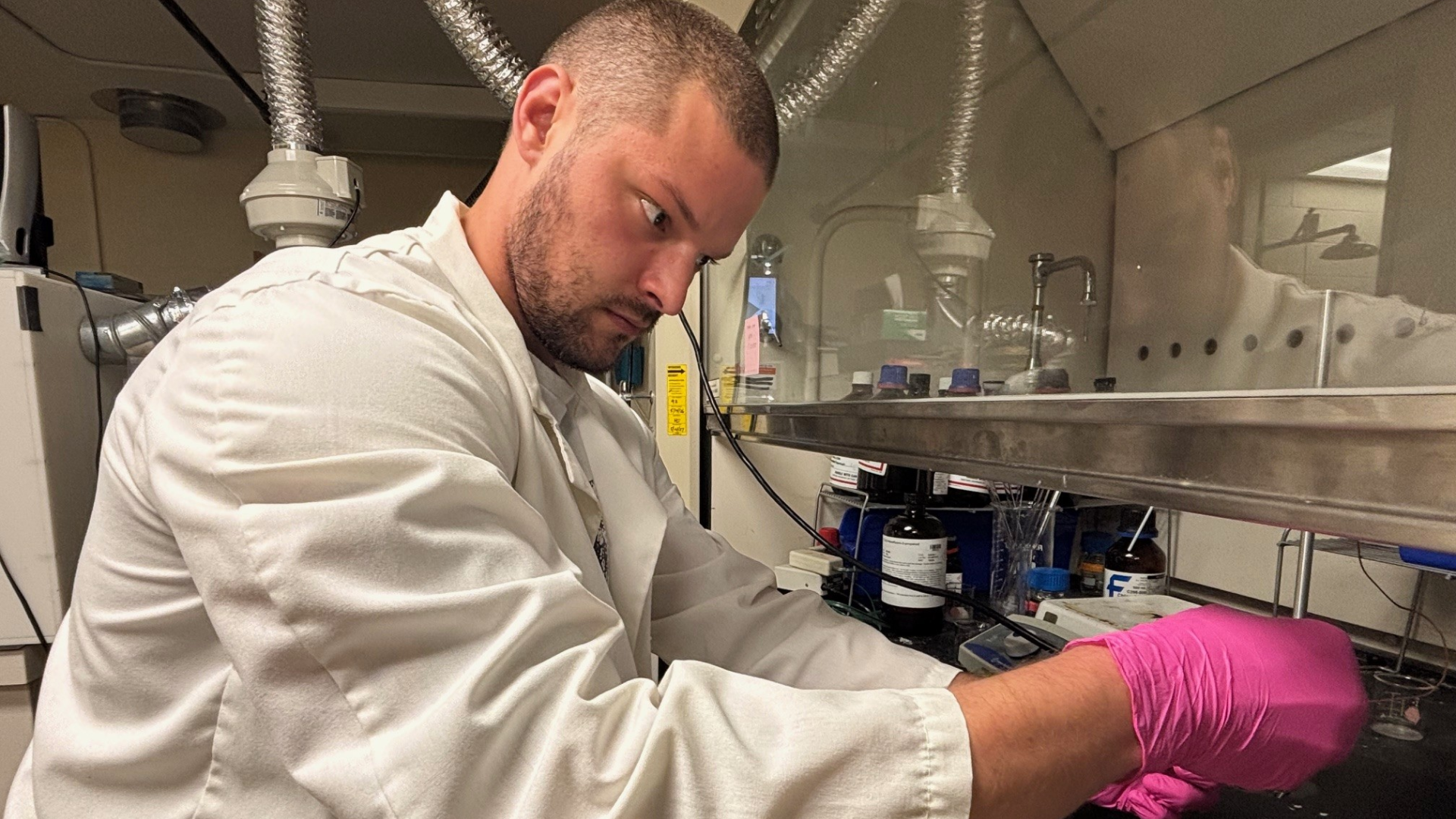
Herff’s newest Biomedical Engineering PhD student went home and immediately began googling words and phrases related to his new field of interest. He successfully defended his PhD dissertation in May 2026, under the guidance of Dr. Bowlin, while overseeing the Tissue Template Engineering and Regeneration Laboratory.
“What that means is, our research is giving your body the structural support, the chemical cues and the right environment for it to be able to heal on its own… Anything below the elbow, below the knee, the actual vasculature that feeds your heart muscles the oxygen that it needs to pump, there’s not really any off-the-shelf synthetic options for that. If you need any sort of bypass grafting for those, you just have to kind of hope that they can take healthy tissue from somewhere else in your body, donor tissue. So, your options are really limited and they all come with different drawbacks. We’re trying to just give your body what it needs to heal itself,” Main said.
The problem lies in the introduction of artificial arteries and veins into the human body. When that happens, the body may immediately start attempting to rid itself of the foreign material. If the first cells react harshly to the material, other cells will follow suit. Main likened the process to a barroom brawl where a misunderstanding between two people leads to a group fight.
“If the cells get to the scene and they’re like, ‘Oh, we need to get this out,’ they’re going to try to degrade it. They’re going to start releasing a bunch of signals saying, ‘Hey guys, let’s take care of this.’ Then all of the other cells get to that place and are basically primed and anticipating a fight. You end up with this feedback loop where your initial cells call for backup and then backup comes,” Main said.
While waiting for his graduation in August, Main oversees the work of PhD candidates such as Faith Smith and Alexandra Snyder, who received an NSF Fellowship as an undergraduate, and he also works with undergraduate students who, like him a few years earlier, are learning biomedical engineering for the first time.
“I learn from them as much, if not more, than they learn from me,” Main said. “I may have seniority in the lab. I may have been there longer, but I can think of a time with most of the students in there right now when I was trying to show them how to do something and they were like, “Well, have you ever tried doing it like this?’ and I said, ‘Oh, wait. No, we haven’t. That’s such a good idea.’”
It's a valuable experience for Main as he seeks to continue his academic career. He said he plans to use the months between his successful dissertation defense and graduation to address some unanswered questions in his dissertation and find the right postdoctoral position.
Main’s spirit of service and dedication to community brought him to Memphis. Wherever he goes next, he plans to bring those same qualities with him.
“I’d be living a much shorter, more difficult life if it wasn’t for a lot of biomedical engineers putting their heads together and coming up with ways for me to live my life,” Main said. “Maybe I can, hopefully, one day repay the favor.”