
How the VIP program and academic opportunities at the Herff College of Engineering helped David Adaway focus his passion and excel in research
March 27, 2026
David Adaway knew he wanted to pursue a career in computer engineering before he ever graduated from Marion High School in Crittenden County, Arkansas, and he knew he didn't need to go far to find a college that would help him achieve that goal.
"They had the computer engineering program," Adaway said of why he chose to enroll in the Herff College of Engineering at the University of Memphis. "That was what I wanted to get into. I wanted to learn about how computers, software and hardware work... I knew their engineering was more involved, especially because I wanted to do hands-on work, working on hardware, circuit boards, microprocessors, and things, which I did get to learn about here. I wanted hands-on work. I didn't really get anything like that in high school. So, I wanted something that would be different in college, more stimulating."
Adaway, who immediately enrolled in the honor's college, which he credits with enriching and supporting his research, set out to push himself and his education further before he ever set foot on campus. With that mindset, his intrigue peaked when he received an email about Herff's Vertically Integrated Projects (VIP) program. The VIP program allows students to engage in research while earning technical elective credit towards their degrees and enables tiered mentoring from students at all academic years, providing opportunities for role modeling from upper-level undergraduate and graduate students, as well as faculty. That role model for David, who joined the program as a freshman, has been Dr. Chrysanthe Preza, Professor of Electrical and Computer Engineering and founding Director of the VIP program.
"She's been the biggest supporter of my research," Adaway said. "I've been in her lab since I was a freshman, since I started VIP. So, even after I did my four semesters there, I stuck around because I liked doing research and she wanted me there.. I think she may have been the biggest factor in my success at research. She genuinely wants you to succeed and if you're willing to try, she'll help you. If you're going to get into research, you want to find a professor who wants you to succeed even more than you do."
Over the years, Adaway said the VIP program introduced him to different engineering topics, such as signal processing, and exposed him to different software, like ImageJ and MATLAB. Perhaps equally important, the VIP program offered Adaway a sense of community and support he didn't experience in high school.
"I wasn't the most sociable person in high school. I didn't really have like a big social network. So, VIP was a way to get to know people who shared my interest and learn about working collaboratively," Adaway said.
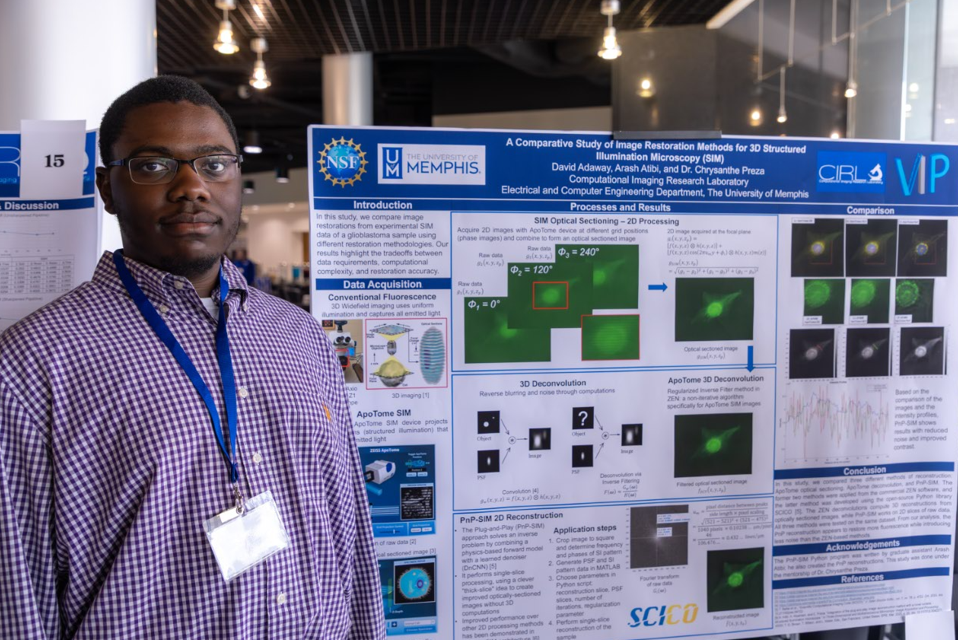
As a senior, Adaway's research revolves around computational imaging, the process of looking at images, typically a biological sample, and researching different ways to enhance them so that the images better resemble the subjects that they're depicting. Adaway's role in that process includes using a microscope and software to acquire images of different samples, like cancer cell samples. While Adaway studies the technique inside the Computational Imaging Research Laboratory at Herff, this type of work plays a vital role in examining and identifying organisms in nature.
"When you take images from a microscope, they often come out in a degraded quality," Adaway explained. "They appear blurry. They appear noisy. They don't really resemble the sample we're trying to depict. Obviously, we can't see the sample with our own eyes because it's so small. So, in order to mitigate that, we take an image with the microscope and reconstruct the image so that we remove that blur and noise and, through that process, the image will appear closer to the sample's true appearance...If you're going to examine some small organism, you need to take images of it with a microscope because you can't see it otherwise. In order to properly examine it, you need accurate images to do that. That's what my research is focused on: getting those accurate images so that other researchers can do further examination of the subject. My research allows people to see what small organisms actually look like."
That research keeps Adaway busy, even when he's not in the lab. Twice in March he presented his research: once at the American Society for Engineering Education Southeast 2026 Conference at the University of Memphis, where he won second place in the conference's undergraduate poster competition with his presentation "A Comparative Study of Image Restoration Methods for 3D Structured Illumination Microscopy," and again a couple of weeks later at the National Society of Black Engineers in Baltimore, Maryland. He finished the month by presenting his research at the Student Research Forum at the University of Memphis. Earlier in the year, he presented in the National Conference on Undergraduate Research.
Adaway said numerous presentations during his college career have helped him simplify his research and focus on showcasing the final results of his work.
"I think the more I do it, the more confident I get in it," Adaway said. "Presenting is less about how much you know about the subject and more about how well you can present that to other people... Of course, we include images of the microscope and techniques that we're using, but most of it is taken up by images of the sample and the result. I point at an image and say, 'Here's the original and here's the result.' I think people are really amazed by that. They can't imagine how you could go from this image to that image."
Adaway envisions himself working in a research laboratory one day, a future he's developed a strong foundation for through his time at the Herff College of Engineering. But first he plans on earning a graduate degree through Herff. Participating in the Accelerated Bachelor's to Master's program, Adaway already earns up to 12 credit hours toward his eventual graduate degree as a senior.
"I know that I like doing research here," Adaway said. "I like learning new things and I like teaching other people about the things I'm learning. A graduate program will allow me to continue doing that."
By participating in the VIP program, presenting his research at conferences across the country and aggressively pursuing a graduate degree, Adaway has grasped every opportunity he's been presented with, leaving him with a full academic plate. Still, he encourages anybody seeking to take their education to the next level to follow a similar path.
"Don't be afraid to try new things and make the most of the opportunities that you're given," Adaway said. "All that I'm doing here, it kind of happened on a whim... You never know what could happen if you take an opportunity and from there you can form connections with others. From my experience here, I've become more sociable, more patient and more optimistic. Of course, it's a lot of hard work. I'm doing stuff pretty much every day, but it does feel rewarding to share what I'm doing with someone else and have someone else learn from that. I think that shows that I'm making an impact."
Adaway conducted research during the academic year through the VIP program and over the summer funded by an Honors Summer Fellowship in 2024 and a VIP Summer Fellowship in 2025. He is currently a VIP peer-mentor and continues his research under Dr. Preza’s supervision. He published his research in QuaesitUM (vol. 10 in 2023 and in vol. 12 in 2025), for which he received the "Outstanding Paper Award."
He will graduate in May 2026 with "University Honors with Thesis" and the "Undergraduate Research Scholar" designations. He will also receive the “Outstanding Senior in Computer Engineering” award.