
The mystery of the steel structure outside the Herff College of Engineering
June 3, 2026
Several historic engineering achievements still baffle modern-day researchers: the Great Pyramids, Stonehenge and the mysterious steel structure that sits outside of the Herff College of Engineering.
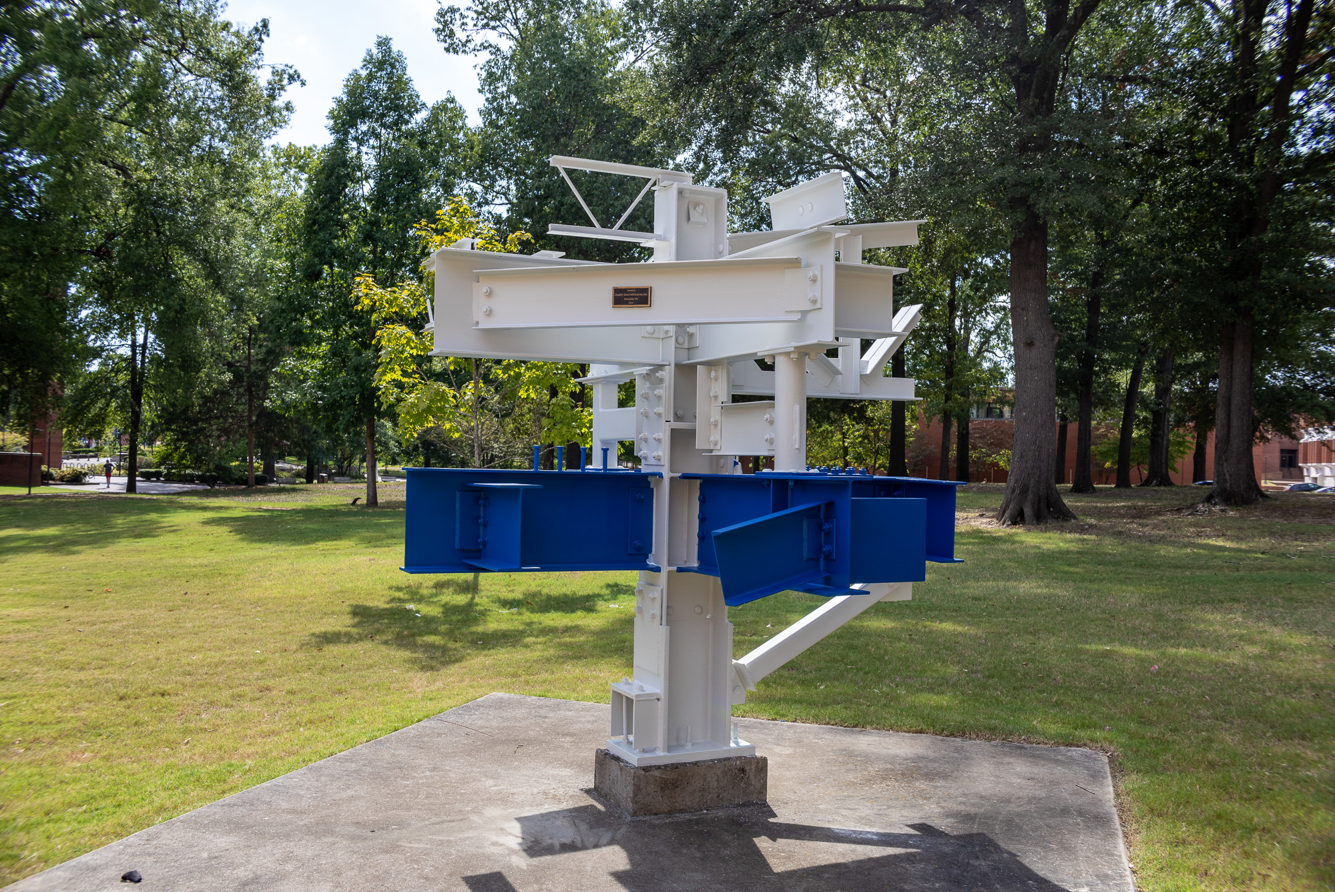
A hodgepodge of steel beams, the blue-and-white structure welcomes visitors to the Herff College of Engineering. But who welcomed the structure itself, and what purpose does it serve? Speaking with students as you walk down the Herff hallways reveals conspiracy theories rooted deeper than the structure itself.
Did aliens place it here as a homing beacon for when they return to Earth? Is it used to harness the power of electricity to create some type of “Frankenstein’s Monster” or worse? Is it a ruin left by the ancient Mayans or Aztecs?
The Herff College of Engineering Marketing and Communications team set out for answers. Setting out from our office in Engineering Administration, our quest for truth took us literally dozens of feet away to the Engineering Science building. There, we found Dr. Charles Camp, professor of Structural Engineering in the Department of Civil, Construction and Environmental Engineering, and a story that dates back decades, starting in the Florida swamps and spanning across our entire country.
“I guess it could attract electricity, and if you look at the spring equinox, the sun may shine on it just right to be connected to Stonehenge,” Dr. Camp said, not completely dispelling the rumors. “But no. It’s a teaching aid, supposedly.”
Dr. Camp examined his bookshelf, eventually selecting and dusting off an ancient scroll: “Connecting Steel Members: A Teaching Guide,” published by a secret society called the American Institute of Steel Construction, Inc. (AISC). Its contents provide the origin story for the steel sculpture. To understand it, we must first travel more than 700 miles south to Gainesville, Florida, where, in 1986, Professor of Structural Design Duane Ellifritt conceived and designed the original.
Ellifritt felt that the topic of connections was brushed aside and not given enough credence, a stance that drew the support of the AISC.
“Connections are the glue that holds a structure together, and, standardized and routine as many of them are, it is very important for a structural engineer to understand their behavior,” the AISC wrote in Connecting Steel Members: A Teaching Guide. “Historically, most major structural failures have been due to some kind of connection failure. Connections are always designed as planar, two-dimensional elements, even though they have definite three-dimensional behavior. Students who have never been around construction sites to see steel being erected have a difficult time visualizing this three-dimensional character.”
Dr. Camp uses the steel sculpture to teach students about pin and fixed connections. Pin connections are simpler and cheaper but less sturdy. Fixed connections may consist of 5,000 bolts and extra plates but cost more.
“Students in the classroom doing calculations love pin connections because they’re the easiest connection there is. Well, there’s really no such thing in a structure. And then there’s one set you could look at and say, ‘Well, holy cow. There are 5,000 bolts there, and they’re welded, and there are extra plates. That would be a fixed connection. They’re much stronger, and there’s much, much, much more support in that connection. When you look at what it takes to make a fixed connection, it’s very labor-intensive and very costly. So, make sure if you really need a fixed connection, don’t just randomly put them in there because they do make the structure stronger, typically, but there’s always a factor with cost,” Dr. Camp said.
Herff’s steel structure dates back 22 years. Inspired by Ellifritt’s design at the University of Florida, the AISC began promoting the teaching aid and encouraging engineering colleges around the country to acquire similar designs. As of today, at least 200 can be found at colleges across the country.
The University of Memphis (UofM) chapter of the AISC followed suit and began looking at ways to get one on campus, but they ran up against a familiar roadblock: cost.
That all changed when Herff alum Scott Polsen joined Quality Iron Fabricators Inc. as a structural engineer.
“He had a relationship with the steel company and he talked to them. Maybe because he was giving them a lot of work, they decided that they could help him out, literally help us out. So, they made it and built it for us and then brought it to campus,” Dr. Camp said.
With the structure built, more alums
helped set it in place. They built and designed the slab it sits on and technicians at the UofM picked it up with a forklift, placed it on the pedestal and bolted it down.
And there it sat for decades, connected beams coated in gray primer. Within the past two years, that primer started to rust. It wasn’t until recently that the structure was painted blue and white, but the painting itself sparked its own debate and mystery.
Dr. Camp began working with Herff technicians to get it repainted. When he reached out to university officials for the color code “Memphis Blue,” Dr. Camp found himself in a gray area.
“The campus architect got involved, and the physical plant got involved. Everybody was kind of slowing us down. It turns out that that area out there is called the University Sculpture Garden. Well, this was considered a sculpture, and the architect was saying that it’s the university’s property and that we didn’t necessarily have the authority to paint it. So, we were going back and forth and had pretty much hit a roadblock.”
In sticking with the other great engineering wonders of the world, its finishing touches remain a mystery.
“We weren’t getting anywhere and I went home on a Friday afternoon,” Dr. Camp said. “My son goes to University School, and we walk that way every day. I came back Monday morning and walked that way. It had been painted over the weekend. I don’t know who painted it.”