
Herff students finish second, claim $5K in international SICK LiDAR competition
May 1, 2026
A group of students from the Herff College of Engineering finished second in an international competition hosted by SICK Inc., claiming the $5,000 second-place prize.
Only 15 teams from the United States and Canada were chosen to compete in the competition. SICK Inc. supplied those teams with a compact but powerful 2D LiDAR (picoScan150) and accessories, and tasked them with using the technology to solve a real-world problem in their communities.
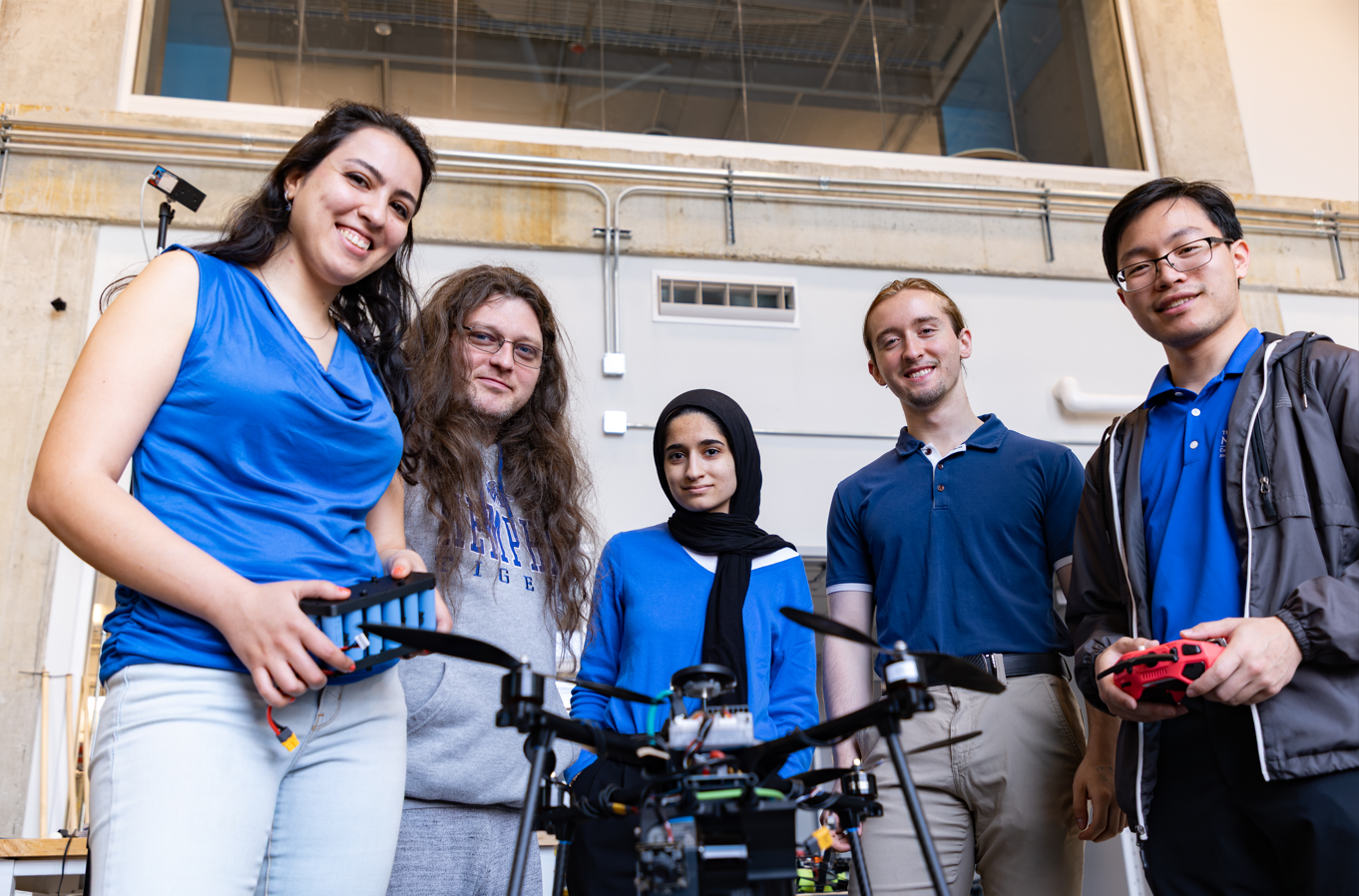
Ph.D. student Parisa Daj, Ph.D. student Peter Le, Electrical and Computer Engineering (EECE) junior Lucas Poloni and EECE sophomores Kevin Fiedl and Jumana Tuffaha made up Herff's team. The group, under the supervision of Dr. Eddie Jacobs, used LiDAR equipment to create StreamEye, a drone-based device that uses AI to survey streams, reducing the manpower and cost required. The Clean Water Act requires states to regularly assess and report on stream health, but many waterways remain physically inaccessible, leaving significant gaps in environmental data collection. By combining drone and LiDAR technologies, StreamEye flies over streams, geolocating each point as it passes, and generates a 3D map of the waterway, autonomously detecting trash, pipe outfalls, bank erosion, and vegetation overhang without requiring any physical access to the waterway.
“There’s a large number of data points to collect and, previously, they all had to be collected by hand,” Friedl said. “They had about 14 people knee-deep in the stream. We would need about two people to be near the site.”
The group field-validated StreamEye by using it on Memphis’ Nonconnah Creek. It completed the surveying task nine times faster than a manual survey while reducing cost by more than 26 percent.
It's a project with a special meaning to Daj, who led the team and whose research through the Center for Applied Earth Science and Engineering Research inspired the device.
“It’s underappreciated,” Daj said of the project’s environmental impact. “We need to pay attention to this field and we are not. It’s like the least priority for anyone, and it’s a higher priority for our future to be able to survive. So, it’s very valuable to me to be able to bring my interest in robotics into something that means something to my society.”
Two of the original 15 groups dropped out of the competition. The remaining teams all submitted a five-minute video demonstration and a written report detailing their project.
Northeastern University in Boston took first place in the competition. The University of Memphis placed ahead of teams from the University of Minnesota (third place), Purdue University, the University of Pennsylvania, Boston University, Texas A&M University, Arizona State University, Illinois State University and Randolph Community College.