
From the field to the lab: How a life of cattle and football prepared Dr. Hayden Carlton for a career as a professor in biomedical engineering
June 24, 2026
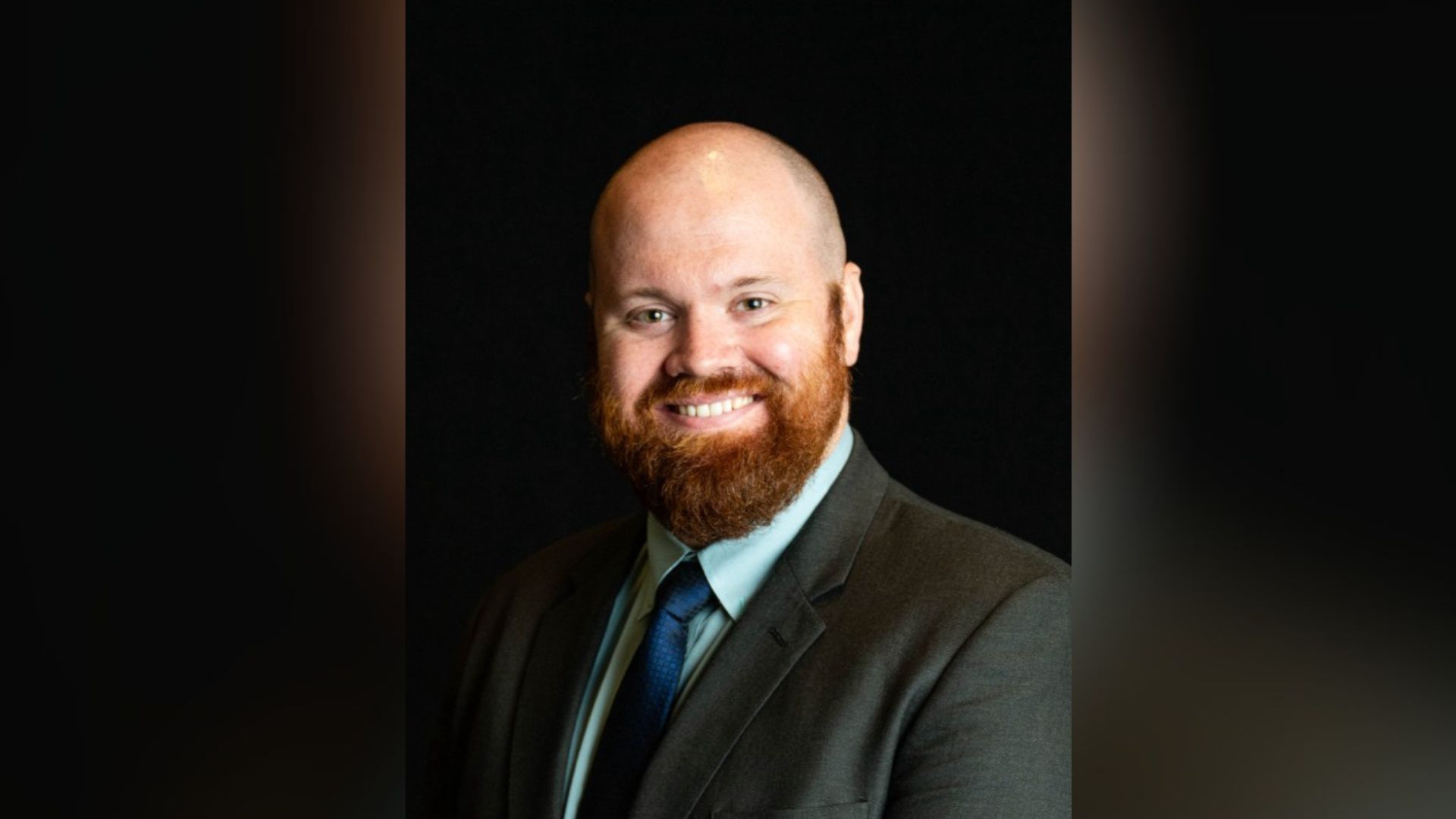
Growing up on an Arkansas cattle farm and playing high school football, Dr. Hayden Carlton became very familiar with heat. Now, at age 30, he teaches students in the Herff College of Engineering Department of Biomedical Engineering about heat transfer.
“We feel our bodies trying to cool ourselves off. We drink water. We perspire. We pant. We breathe harder. All of these are active ways that the body manages heat, but my research specifically deals with the biomedical side of things, not only studying the way the body manages heat, but how that impacts medical procedures,” Carlton said.
Carlton joined the Herff College of Engineering at the University of Memphis as an assistant professor in August 2025, putting him just 240 miles away from his hometown of Ozone, Arkansas, an unincorporated community of less than 200 people.
He said the goal for most people in his senior class of around 50 students at nearby Lamar High School was simply to get into college. His skills on the football field, coupled with a budding interest in engineering, proved to be his ticket.
“I got a football scholarship to go play at Arkansas Tech just down the road in Russellville, because they were the only place that had an accredited engineering program of the places that I was looking at, and they were really close. I didn’t really want to go far away,” Carlton said.
Though football helped him get to college, he did far more during his time as an undergraduate than just live on the gridiron. He studied mechanical engineering and soon discovered his passion for heat transfer and thermodynamics.
“I always disliked the kind of stereotypes that came with people in sports, like being a dumb jock and that football is the only way you can get a degree. It kind of puts you into some imaginary box. Like, ‘Oh, I can’t achieve any further than the limitations that you’ve provided.’ So yeah, I played college football because it was available. I enjoyed football. I’m big. I was good at it, and it put me in a scenario that pushed me academically,” Carlton said.
Staying true to that academic pursuit, Carlton took his college advisor’s advice and enrolled in graduate school at the University of Arkansas, using the same drive and determination that brought him success in football to earn a PhD in mechanical engineering in 2021.
“Eighty percent of it is just getting in the lab and doing it and having the drive, having the discipline,” Carlton said. “Intelligence helps you as far as coming up with an idea, formulating the concept and being able to visualize it, but that’s only like 20 percent of the work. The majority of it is just getting into the lab, being methodical, being organized, being able to do the same thing over and over and over and over again to build up statistical significance, to make sure the results that you’re seeing actually make sense and that they are real, rigorous and reproducible.”.
“I’m no genius, but one thing I did learn as a kid growing up on a farm and growing up where I did is that you have to keep trying, you have to keep pushing as long as you have the discipline to pursue and try to find the answers to those problems.”
Carlton’s football career ended in college, but he left school as a professional researcher. Through his study of nanomaterials and particles, Carlton connected with a researcher at Johns Hopkins School of Medicine. That relationship led him to join a research group for his postdoc at the prestigious university, where Carlton once again found himself surrounded by people of equal, if not greater, talent.
“Johns Hopkins definitely upped my game by surrounding myself with people who are a lot smarter than I am. All I could do is put my head down and work and learn as much as I possibly could… I would encourage young people to always put themselves in environments that make them uncomfortable, because creativity dies in environments where we are comfortable. We’re not challenged. We’re not solving problems. We’re not reading new material. We’re not around folks who are smarter than us or better than us at particular activities, tasks or procedures,” Carlton said.
After nearly four years at Johns Hopkins, Carlton brought that humility with him to his role as an assistant professor at the Herff College of Engineering.
“It puts you in a better position to mentor students, tell yourself that it’s okay not to know something and then you gain expertise in what you’re trying to teach them, rather than me just coming straight out of my PhD thinking that I know everything and then, all of a sudden, I’m mentoring students and I realize very quickly that I do not,” Carlton said.
Now less than a four-hour drive from his hometown, Carlton and his wife Emma, an occupational therapist, find themselves much closer to Carlton’s roots as they look to start a family. And though his journey has taken him hundreds of miles and to professional heights he had never imagined, he wants students in Ozone, Arkansas and small towns like it across the country to know that the path really isn’t that hard to travel.
“The problem I had was kind of being confined to these make-believe boxes you put yourself in where you think, ‘That’s all I have to do, graduate high school and go to college.’ I think being able to think beyond that and say, ‘I want to be a doctor. I want to be a lawyer. What are the steps I need to take to accomplish those goals?’ And yeah, a lot of rural high schools aren’t going to have the resources to provide much one-on-one interaction, as much as you might get at a larger high school. But just be proactive and say, ‘This is my dream. This is what I want to do.’ Just because you go to a small high school or live in a rural area doesn’t mean that you’re precluded from doing that. A lot of it is just hard work and dedication and there are a lot of scholarship opportunities for kids who grow up in rural areas that may not have some of the resources that some of the larger schools have,” Carlton said.