
Department of Physics and Materials Science
PRESS RELEASE | HELMSMAN ARTICLE
Biography
EDUCATION AND RESEARCH
|
I graduated from the University of Memphis with a BSEE and a BS in physics, as well
as an MS in Physics. While a UM undergraduate student I began doing solid state physics
research in the Department of Physics, which led to my first research publications
on irradiated thermoluminescent crystals.
After graduation with my BS, I moved to Maryland where my research shifted to advanced
optical signal processing techniques for DOD. This work led to a patent for an Optical
Adaptive Filter, the first real time optical feedback system. The invention and experimental
results have been included in two books on optical electronics. Still at DOD, I returned
to research begun at UM with irradiated crystals for applications in radiation dosimetry.
After several years of publishing in this field of research I returned to the University
of Memphis and completed my Master of Science degree in the Department of Physics.
|
 |
MY TEACHING and the BRIGGS EXELLENCE IN TEACHING AWARD
My interests shifted toward math and physics education in 1990 and I began teaching.
I have taught in the Dept. of Physics and/or the Dept. of Mathematics at several colleges
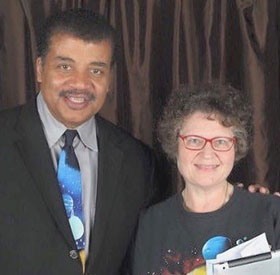
and universities in Memphis and in St. Louis. (photo to right is of me and Neil deGrasse
Tyson, taken in 2016). I have taught Gen Ed Survey of Astronomy and Gen Ed Physics
at the University of Memphis since 2009. This has been especially rewarding due to
my lifelong interest in both. At age 5 I received a Solar System bank which represented
the planets as balls of different sizes, and I was curious why people did not fall
off the bottom of those round planets. That was the beginning of my interest in gravity.
I have spoken about astronomy in general to groups from Pre-K age to nursing home
age, and given talks on the total solar eclipses in the U.S. in 2017 and 2024. I was
invited to speak at the Benjamin L Hooks Central Library and appeared on our local
NBC affiliate tv station.
Due to my lifelong interest in astronomy and physics, I have greatly enjoyed teaching
Gen Ed Survey of Astronomy and Gen Ed Physics at the University of Memphis since 2009. In
2016 I received an Excellence in Teaching Award given annually by the Briggs Foundation.
I have incorporated the use of technology into my classroom in ways which are intended
to improve the experience of students and teach them critical thinking skills. I have
developed an online course for Survey of Astronomy as well as a traditional course,
Astronomy II. I continue to enjoy sharing my passion about physics and astronomy with
my students and I place a high value on boosting science literacy in the process.
LOIS MCGLOTHLIN DONALDSON ENDOWED LECTURE IN PHYSICS Organizer (2016 - present)
I have organized the annual Lois McGlothlin Donaldson Endowed Lecture in Physics from 2016 to the present. These lectures have been on topics in physics presented by experts in the field, and
delivered with an emphasis on concepts.
This series of lectures is in memory of Lois McGlothlin Donaldson, who developed a
profound interest in astrophysics later in life. She found the concepts compelling
even without formal training in the field. This series aims to offer the same opportunity
to others in tribute to her curiosity, understanding, and inspiring hope for the future.
Most, if not all, recordings of past lectures are viewable on the website.
APOLLO MOON MISSION HISTORY / ARTEMIS MOON MISSIONS
In 2017 I discovered that we had an Apollo Flight Controller living near campus and
teaching mathematics at Southwest Community College. I'd been trying to reach him
to request a seminar, but my email was going to his spam folder. I finally discovered
that we went to the same veterinarian, and that allowed me to connect through a space
focused vet tech. Bill Weppner has spoken to my astronomy classes every semester since
that time, and has delivered multiple seminars in our department. I planned a public
event for the 50th anniversary of the Moon Landing that featured Bill and a screening of Apollo 11,
a documentary with newly released 50 year old Apollo 11 footage. At a time when college
students don't know when we went to the Moon, much less what it was like back then,
Bill has filled the gap and made an indelible impression on those who have heard him
speak. The last few years he has expertly made presentations comparing Moon missions
Apollo and Artemis, even after turning 90 and retiring from Southwest Community College.
In Fall 2025 I planned a public event featuring him and three other Apollo flight
controllers, as well as a screening of the film Mission Control: The Unsung Heroes of Apollo. We also celebrated Bill's 90th birthday and his retirement. The audience members continued to have questions for
the Apollo group until we had to close. The educational impact of presentations by
Bill and the other Apollo flight controllers has been priceless. I feel very fortunate
to have been able to create opportunities for people to hear Bill. We look forward
to the Artemis Moon missions with great hope and anticipation.
THE MEMPHIS VOYAGE SOLAR SYSTEM
While visiting the Smithsonian's National Air and Space Museum in the early 2000's,
I came upon a model of the SUN about the size of a large grapefruit. It was a part
of a 10 billion to 1 scale model of the Solar System and was located on the walkway
outside of the building entrance. I was amazed by the perspective gained from walking
the length of the model from the Sun to Pluto, 2000 feet away. I never forgot the
experience and how it transformed my comprehension of our Solar System and our place
in it on Earth.
More than 20 years later I found an opportunity to purchase a less expensive version
of the same sized Voyage Solar System model I had seen in Washington, D.C. I jumped
on the chance and immediately inquired about next steps. After receiving approval
to proceed with fundraising for it, the Department of Physics and Materials Science
at the University of Memphis was the first community, nationwide, to commit to purchasing
the new scale model . The first 10 communities to commit to the purchase received
a $5000 price reduction thanks to the generosity of Dr. Jeffrey Bennett via BigKidScience.com.
Dr. Bennett was the originator of the 10 billion to 1 scale model and built the first
one with students in 1986 at Boulder, CO. Since then the model has been professionally
designed and vetted for placement on the National Mall in Washington, D.C. where I
first encountered it.
After delay due to Covid closures, we finally received and installed the Memphis Voyage
Solar System on an existing north-south walkway on the Central campus. It crosses
no streets and stretches from the model Sun near the north end of campus to Pluto
near the railroad tracks at the south end. Dr. Bennett attended our grand opening
events on March 23-24, 2023, and gave a tour to our donors which he allowed us to
record. Each stop in the Memphis Voyage Solar System has a QR code that connects
to a short video of Dr. Bennett describing the notable features at that stop. Each
planet, belt, or dwarf planet is represented at a 10 billion to 1 scale model in size
and separation distance. Each has a storyboard with photographs and / or illustrations,
and description, and a campus map showing where the viewer is located and where all
other stops may be found.
By standing at any planet and observing the model Sun, you see it at the same size
one would see the Sun as if on the actual planet. From the model Earth you can observe
the angular size of the model Sun (less than a finger width at arm's length, and verify
that it appears the same size as when one looks at the real Sun from the real Earth
using eclipse glasses.
Our Memphis model has the fun addition of a robot that moves at the Speed of Light
(SOL) on the same 10 billion to 1 scale. If we start it at the model Sun, it arrives
at the model Earth 8 minutes later, just as real sunlight arrives at the real Earth. Joanne demonstrating SOL robot at the Sun of the Memphis Voyage Solar System.mov It is my hope that students and others on campus will gain a Cosmic perspective of
the Earth's place our in the Solar System and in the Universe. Memphis Voyage Solar System
Joanne demonstrating SOL robot at the Sun of the Memphis Voyage Solar System.mov It is my hope that students and others on campus will gain a Cosmic perspective of
the Earth's place our in the Solar System and in the Universe. Memphis Voyage Solar System
Joanne demonstrating SOL robot at the Sun of the Memphis Voyage Solar System.mov It is my hope that students and others on campus will gain a Cosmic perspective of
the Earth's place our in the Solar System and in the Universe. Memphis Voyage Solar SystemPRESERVATION of THE EINSTEIN CENTENNIAL video, MARCH 14-16, 1979
With an avid historical and current interest in the Department of Physics and Materials
Science, I located large format videotapes our department had made during the Einstein
Centennial, March 14-16, 1979. It was produced by Dr. Cecil "Pete" Shugart, Physics
Department Chair at that time. He partnered with Dr. Peter Barker from the Philosophy
Department to host a three day event involving scholars from around the world. The
City of Memphis and the Memphis City Schools contributed events to this three day
reflection on Einstein as well. At the Orpheum Theater there was a one man show of
an actor portraying Einstein. The Craigmont school opened their planetarium to the
public for the occasion. The keynote speaker and colleague of Einstein's, Dr. Daniel
Q Posin, gave a presentation on astrophysics to teachers from the Memphis City Schools.
Dr. Posin was quite a character in addition to being a physicist, Faculty member at
San Francisco University, and an Emmy winning teacher. He was an entertainer There
were sessions in physics, philosophy, and the humanities, and Dr. Shugart worked with
the Philosophy Department to make it happen. I attended it as a student and had conversations
with Dr. Shugart years later. We both expressed the desire that it be preserved in
a format that allowed viewing, as the large videotape format was no longer accessible.
The campus library was unable to convert it.
More years passed, and after I began teaching in the department in 2009 I found most
of the videos. One was missing- unfortunately it contained the keynote presentation
by Dr. Daniel Q Posin, a colleague of Einstein's. Dr. Posin and Dr. Einstein discussed
the need to educate the public about the dangers of radiation that accompanied nuclear
bombs. Dr. Posin traveled the country giving public talks about this and also hosted
an educational TV show about physics for which he won Emmys. Although I was disappointed
to be unable to include Dr. Posin's keynote address, I preserved what I could. He
did appear giving another lecture to teachers in the Memphis City School System, and
that one is part of what was saved. I borrowed the videos and had them digitized and
placed on DVD. Since then I put them in order as they had been delivered and identified
each speaker using both a program and book of papers offered for the event.
I placed more than 6 hours of video on Youtube, and included links to the start of
each paper and session. The Einstein Centennial at Memphis State University, Mar 14-16, 1979
PAST OUTREACH EVENTS AND LOOKING FORWARD
I organized the 2012 University of Memphis Centennial event held by the Physics Department and
also the observance of the 50th anniversary of the Physics Department in 2016. I have
conducted outreach events for Einstein's birthday and World Space Week, and held physics
film fests or other special film events with Q&A follow-up. The total solar eclipse
of 2017 afforded extra opportunity for community outreach. I handed out several thousand
pair of eclipse glasses while giving talks to groups of all sizes about eclipses.
The total solar eclipse in April of 2024 afforded another opportunity for people to
learn and to be in awe. I set up a booth for our department at ASU in Jonesboro, in
the path of totality, and next to their Voyage Solar System.
Next, we celebrate the 60th anniversary of our department July 1,1966.
It is my hope that UM will someday have an astronomical observatory with viewing nights
open to the public as well as the campus community. When photons of light travel from
distant objects into our eyes we each have the opportunity to gain a personal cosmic
perspective.
A favorite quote of mine is one I heard from Neil Degrasse Tyson, who refused to be
credited with it because Carl Sagan and many others, had expressed the same idea previously.
It is both figuratively true and is literally true because the atoms that make up
or bodies and our world either originated from the Big Bang or were manufactured in
the hot cores of stars, supernova explosions, or high energy collisions of dead stars
of the past.
We are in this Universe and this Universe is in us.✨🔭