
Polytechnic@UofM professors earn Applied Gen AI for Higher Ed Professionals certificates
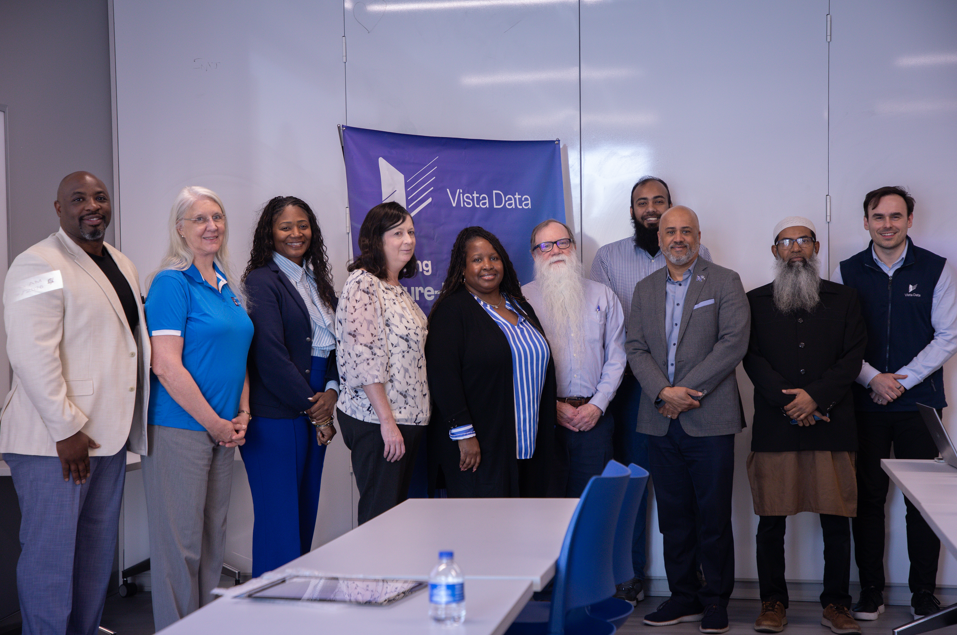
Groups of professors at the University of Memphis earned certificates in the use of artificial intelligence (AI) for higher education professionals, demonstrating different ways AI can be used to improve the University of Memphis and enhance education.
The certificates came from Vista Data, a tech workforce intermediary that connects employers, education partners, and learners through applied generative AI and data training. University of Memphis professors completed an eight-week course to obtain the certificates, culminating in the presentation of capstone projects where the professors used the skills they'd learned to build and present projects that solve real campus or departmental challenges.
Dr. Alfred Hall, Chair of the Department of Applied Technology, presented on behalf of his group, displaying a report created by AI that could take the University of Memphis' aviation program to new heights.
"We utilized those tools to address a new opportunity for our commercial aviation program," Dr. Hall said. "We were able to conduct research on accreditation opportunities, requirements and the standards that other commercial aviation programs have across the country. How can we make our program more competitive and marketable across the country for students who would be interested in this program? We were able to utilize those tools to identify gaps within our program, areas that we could improve. It identified those for us and we were also able to utilize the creative problem-solving strategies to address items within our curriculum, to address our business practices and to really align our program with nationally accredited standards to make sure that we're in a much better position than we were six months ago."
Dr. Faruk Ahmed, Assistant Professor of Engineering Technology, helped develop an AI system that will automatically take notes of lectures and aid students in their homework assignments. This program, he said, could serve as a vital study tool and allow students to rehash an entire lecture from the comfort of their own living rooms.
"The tool I developed, I will use as a backup tool to teach my students," Dr. Ahmed said. "In the classroom, many students don't pay attention or they are tired or they are not able to focus. So, they can go home and loop back what was taught today and they can refresh their mind in their own time. This will enhance their activities because they don't have to rely on me always. They can do some research on their own and I can see what they're learning because at the end of each topic and module, there are some questions for assessment. This keeps track of it. So, this is a really, really useful tool for me as an instructor."
Dr. Russell Deaton, Executive Director of the Polytechnic@UofM and Chair of the Department of Engineering Technology at the Herff College of Engineering, hopes that these AI tools will not only make life easier for current students and professors but also make higher education more accessible to people who may not have previously had the opportunity.
"We're not bending the mold. We're breaking it," Dr. Deaton said. "It's the amount of access to non-traditional learners, students who haven't had access in the past. I think that's where our advantage is. I think we've developed very powerful ways to grant credit for all sorts of learning experiences... These generative AI projects we did here, we're looking at improving programs, improving operations and being more efficient, but what we're really about is creating greater access to bachelor's-level education for students who, in the past, have not had that access. We're also about focusing our programs on education and skills that lead to good-paying jobs."