
Past Exhibitions
Fall 2018- Spring 2019
Fall 2019 Graphic Design Senior Show
Wait And See
December 12, 2019
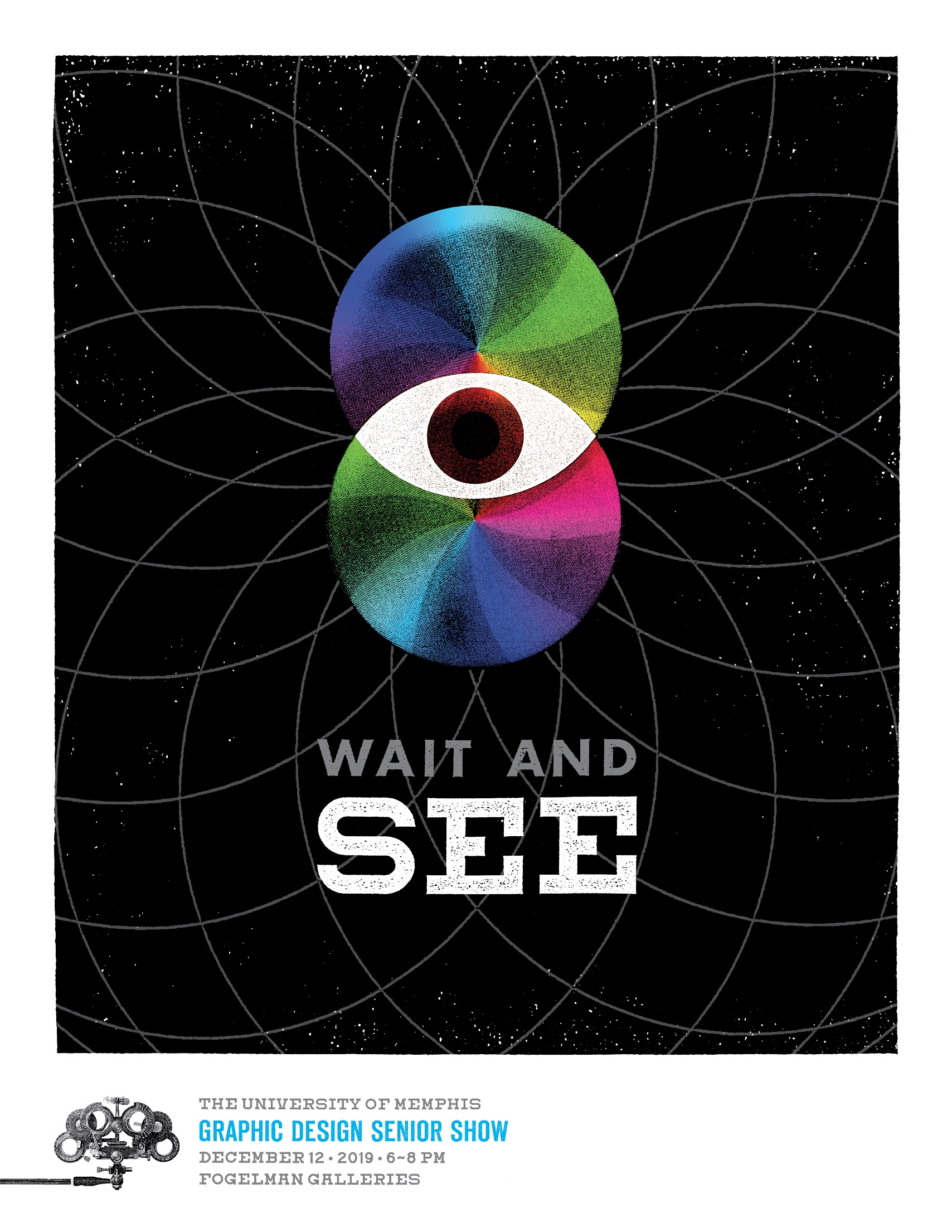
A one-night only exhibition of works by graduating University of Memphis Graphic Design students: Kristin Baltimore, Danielle Barron, Royale Davis, Thomas Davis, Cullen Jackson, Kala McCrosky, Lisa Miller, Breanna Parker, Kathryn Perkins, Meredith Simmons, Thomas Steele, Joseph Waterbury, Samantha Welch, and Tiara Wilson.
Fall 2019 BFA Thesis Exhibition
One Word
November 15 - December 6, 2019

One Word, Part II of the Fall 2019 BFA Thesis Exhibition, featuring the work of six graduating seniors of The University of Memphis Department of Art: Ashlyn Creagh-Martinez, Julie Darling, Emily Hogan, Colt Houston, Kayla Owens, and Kylon Wagner. The exhibition is a compilation of works in a variety of media including photography and sculpture. The presentation celebrates the completion of their undergraduate studies and the culmination of each student's artistic exploration and experiences.
The exhibition will be on view in The Martha and Robert Fogelman Galleries of Contemporary Art from November 15 - December 6, 2019. The students will discuss their work in gallery talks on November 19 at 11:30 am and November 21 at 11:30 am in the Fogelman Galleries. All events are free and open to the public.
Fall 2019 BFA Thesis Exhibition
Hold the Door
October 25 – November 8, 2019
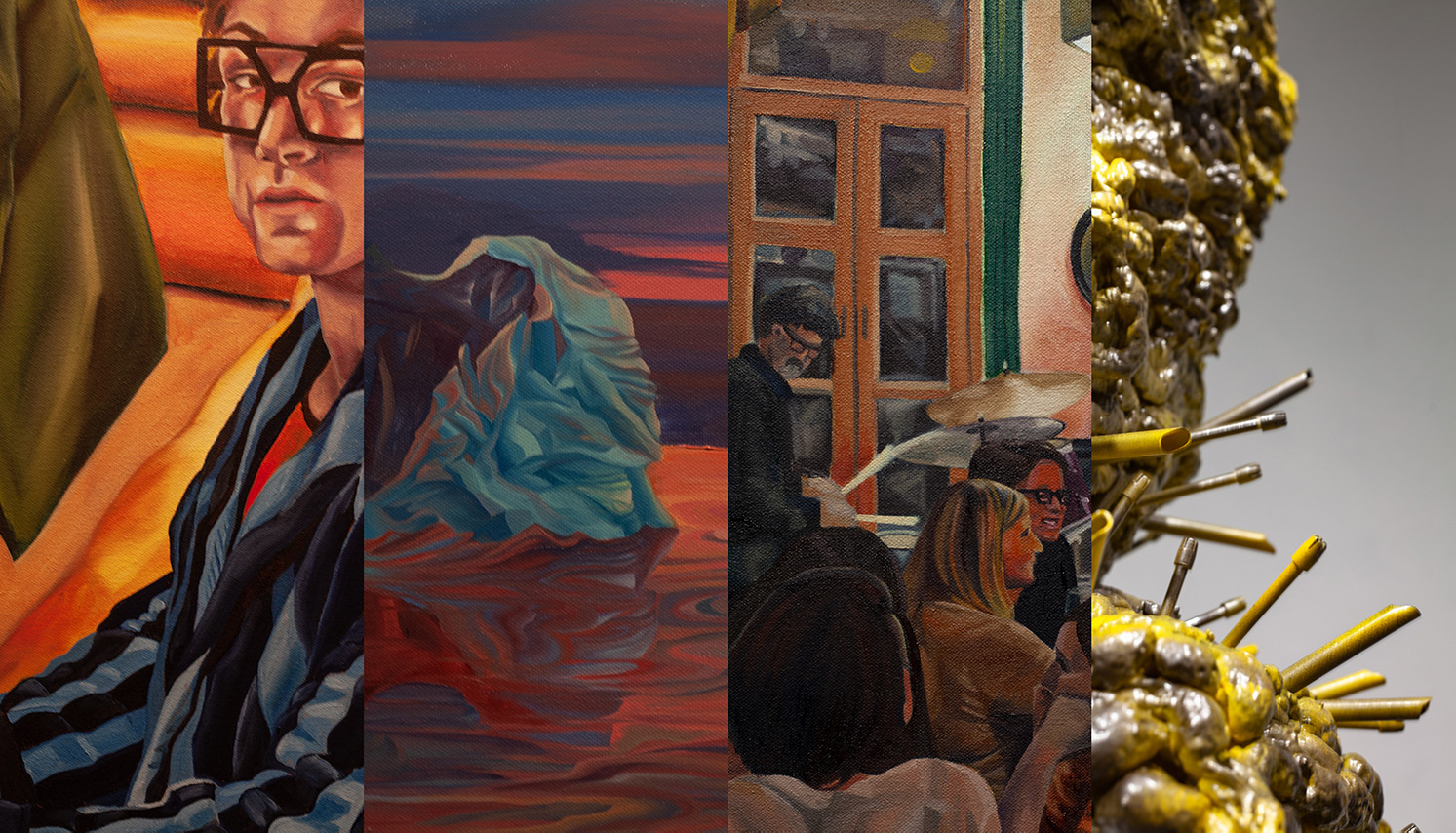
Join us for the opening reception of "Hold the Door," Part I of the Fall 2019 BFA Thesis Exhibition, features the work of four graduating seniors of The University of Memphis Department of Art: Ivy-Jade Edwards, Jeff Carter, Robert Fairchild IV, and Nicholas Svoboda. The exhibition is a compilation of works in a variety of media including painting and sculpture where color is paramount. The presentation celebrates the completion of their undergraduate studies and the culmination of each student's artistic exploration and experiences.
The exhibition will be on view in The Martha and Robert Fogelman Galleries of Contemporary Art from October 25th to November 8th. The students will discuss their work in a gallery talk on October 29th at 11:30 am. All events are free and open to the public.
Fall 2019 MFA Thesis Exhibition
Chatter in the Skull: Christopher Davis
October 25 – November 8, 2019
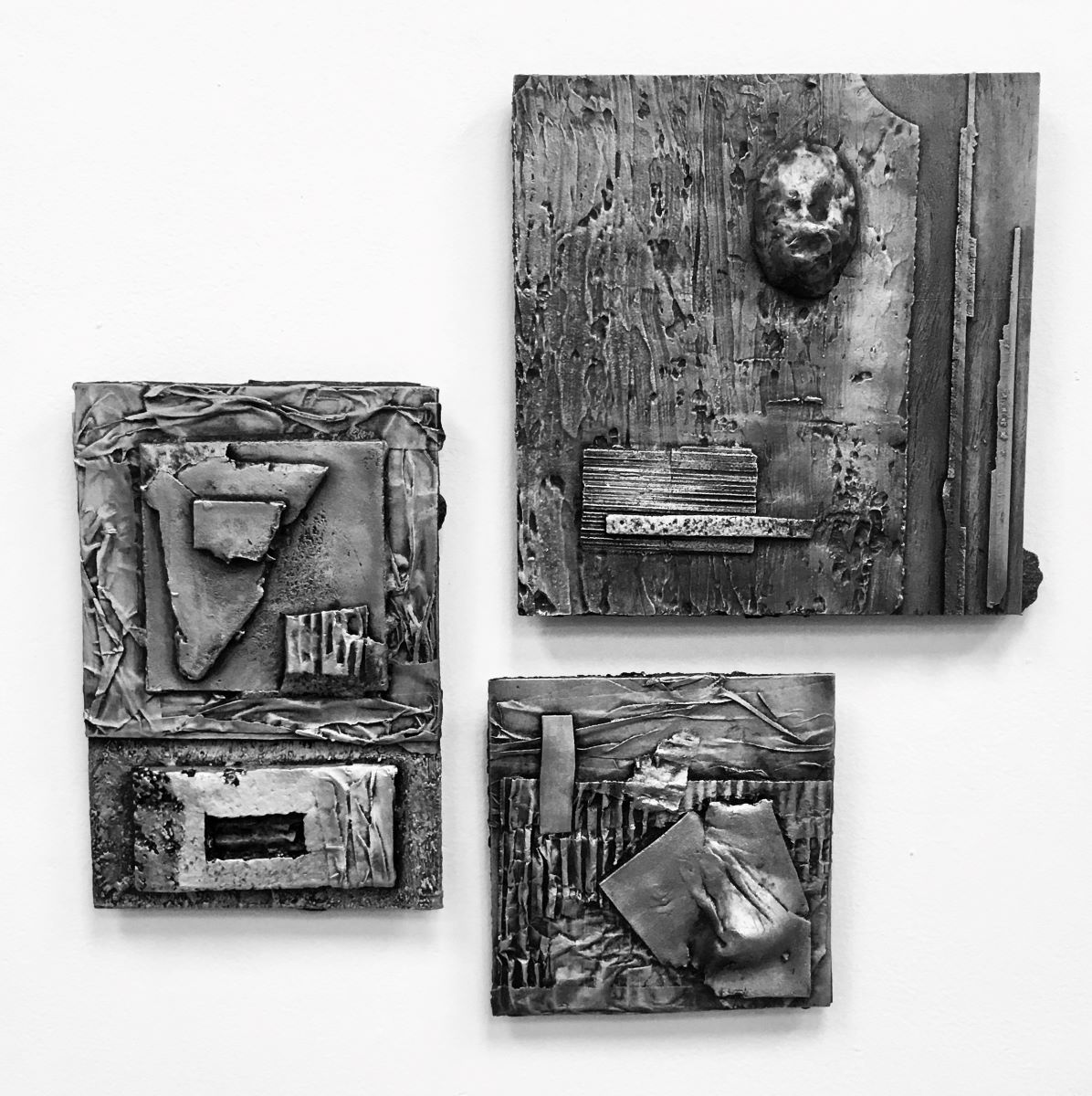
Image: Christopher Davis, The Navigator, The Pilot, Her Favorite, 2018. Cast aluminum. 24 x 24 in.
Chatter in the Skull, the MFA Thesis Exhibition of Christopher Davis, is a phrase used by philosopher Alan Watts in reference to over-thinking and its relationship to reality: "'Chatter in the skull'...perpetual and compulsive repetition of words...of reckoning and calculating." As an artist, Davis finds himself in this "perpetual and compulsive repetition of words." Many of the words and phrases in his visual vocabulary are borrowed from the unique landscape of Southern Illinois. He has been repeating some of these forms and phrases for the better part of two decades—assembling fragments of beauty into monuments, fetishes, markers, and relics. He constructs objects from humble, easily recognizable materials. Like the landmarks that inspire him, these markers engage the viewer with the truths found in the formal relationships between objects and materials. He presents the viewer a window to contemplate the beauty that compels him to keep looking.
The works in Chatter in the Skull include assemblages that have been cast to create relief sculptures and small totems, as well as larger totems/markers assembled from steel, cast objects, and wood. Smaller cast wall pieces draw the viewer for a more intimate experience while larger vertical pieces stand over the viewer, competing for dominance of the space.
Christopher Davis was born in a double-wide trailer in Southern Illinois. He was raised as a member of a religious fellowship where he also attended school through the twelfth grade. These early regional, economic, and philosophical influences have given him a unique lens through which he filters the world around him. He received a Bachelor of Fine Arts in sculpture from Southern Illinois University in 2004, a Master of Arts from Arkansas State University in 2012, and will graduate in December 2019 with a Master of Fine Arts from the University of Memphis.
Jean Koeller
Not Dead Wood
August 30 – October 4, 2019
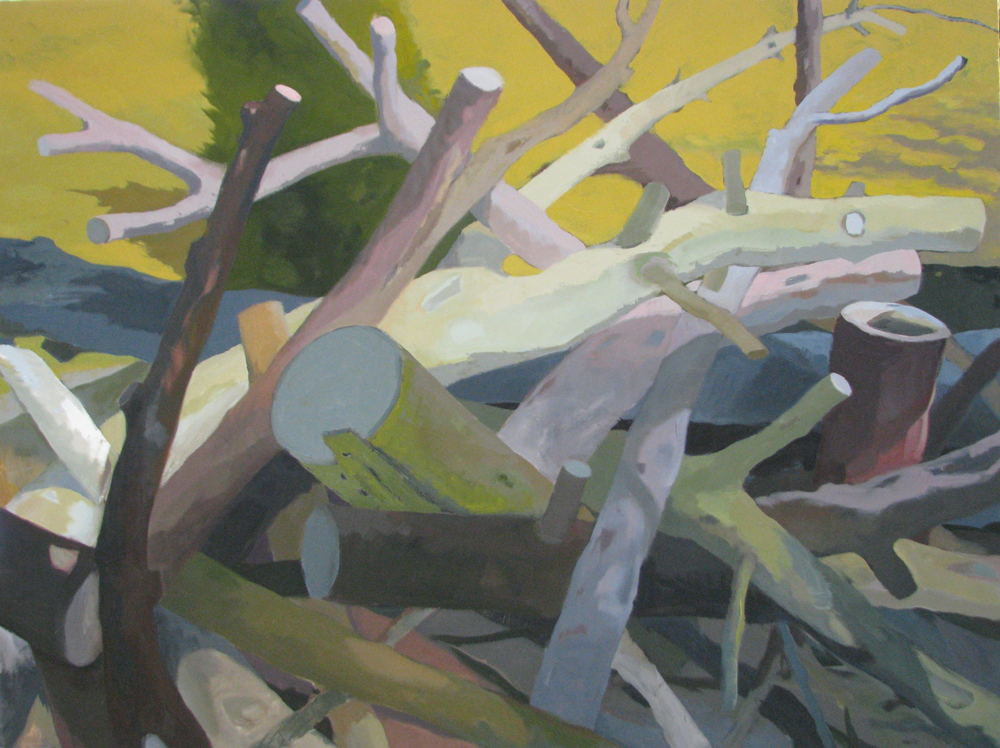
Image: Jean Koeller, Woodpile, Reaching, 2014-16. Oil on canvas, 36 x 48 in. Courtesy of the artist.
Working from both life and memory, Jean Koeller depicts ordinary, dense views that redefine the boundaries of landscape and beauty. Her work moves between experience and thought, representation and abstraction, distilling information through observation and memory. The paintings explore the tension between human perception of time and nature's rate of change, and the realities of chaos punctured by an illusion of order. She explores, physically and psychologically, the essence of life of the interior—the interior of the landscape, and the interior self.
The exhibition includes works from Koeller's recent series of woodpile paintings, as well as works on paper. Woodpiles formed from fallen trees have been a constant presence on the property on which she has lived for the past fourteen years. To the artist, man and nature, all those struggles are present in this pile. Koeller relates, "What the woodpile has done is educate me. I see, in my sadness, the loss of the trees, but by standing out there and working and observing the process of nature and its effect on the wood and its surroundings, the role the pile has played to fertilize the land, provide a haven for wildlife and insects, to see what else grows out of the logs and sticks, what birds do and feed from this wealth of food. The pile is anything but 'dead.' I don't feel compelled to narrate this literally but to put life in the subject with paint and color."
Jean Koeller was born in Columbus, Ohio, and currently lives and works in New Carlisle, Ohio. She received her BFA from Wright State University, her MFA from Parsons School of Art and Design, and is an alumna of the Skowhegan School of Painting and Sculpture. Her work is in numerous collections, including the Ohio Arts Council, Ohio Supreme Court, and Ohio Governor's Residence in Columbus, Ohio, Miami Valley Cultural District in Dayton, Ohio, and Kettering Hospital, in Kettering, Ohio. She has taught painting and drawing at various colleges and universities in Ohio, and worked as the Visual Resource Curator for the University of Dayton from 1992-2007.
Lawrence Jasud
Kulcher
September 6 – October 11, 2018
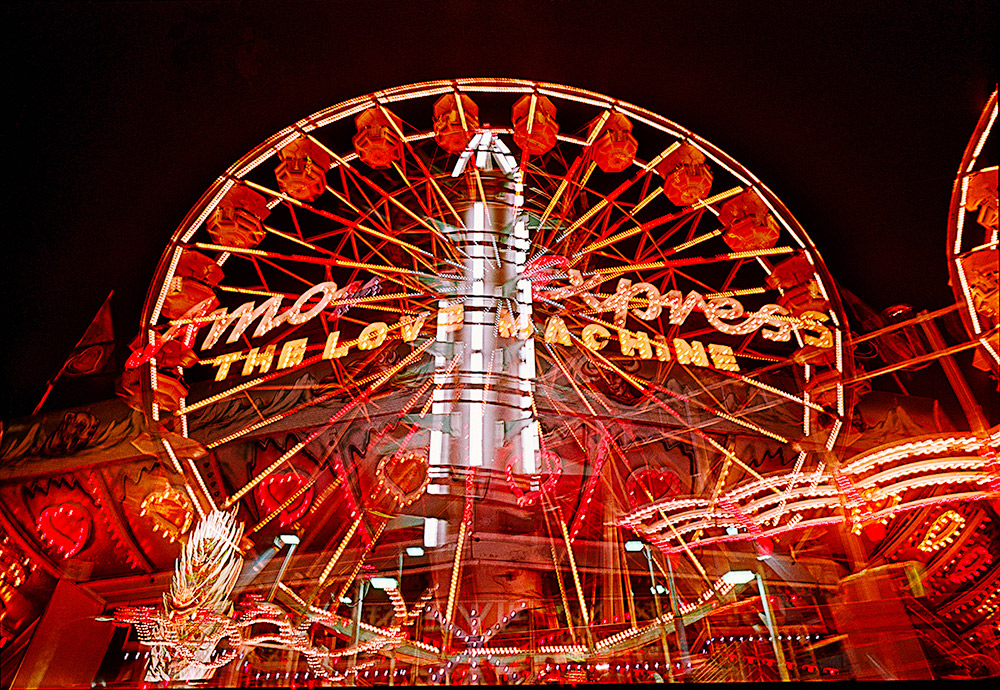
Image: Lawrence Jasud, The Love Machine, 1989. Archival pigment print. 16 x 20 in. Courtesy of the artist.
This retrospective exhibition is drawn from over three decades of photography by Lawrence Jasud. From amusement parks and carnivals to barbeque competitions, Jasud's work explores the interstices of American popular culture and its various subcultures. His visually dense photographs are an ongoing exploration of spectacle and excess, an investigation of places and the people that inhabit them. Jasud's position is one of ambivalence and enthusiasm—embracing and enticed by the people and places he shoots, but at times also dispirited and appalled. Inherent in the work is the confounding juxtaposition of kitsch and the near-spiritual aesthetic the artist creates in his compositions using long exposures, multiple exposures and other techniques.
Lawrence Jasud (American, born 1942) was born in Chicago. He received a B.S. from Southern Illinois University in 1969 and an M.A. from Ohio State University in 1980. Since 1981, Jasud has lived and worked in Memphis, Tennessee, where he taught at The University of Memphis from 1981 to 2015.
Jefferson Pinder
Thin Skin/ Shock Layer
January 18 – March 8, 2018
This exhibition explores the convergence of sound and the body in the work of Jefferson Pinder. From human beings to automobiles, the artist utilizes the body as a kind of medium and a physical space. Featuring Pinder's video and objects from the past two decades, the exhibition explores the slippages between human and machine, from the anthropomorphizing of cars to the physical force of the human body. Sound, from sampled music to garbled noise, plays a driving force in Pinder's videos as well as objects, ranging from quotidian to extraterrestrial.
For Pinder, the automobile is like a shell or skin—a kind of sanctuary. He has always been fascinated with cars and the connection between driver and vehicle as powerful metaphor for the body. It can serve as an extension of one's own body but also a formidable force to be controlled and exerted by its driver. In Sonic Boom (2018), the most recent performance video in his "Inertia Cycle" series, Pinder tests the limits of a red 77' Oldsmobile Delta 88 Royale once owned by a veteran. The performance is an extension of Pinder's interest in physicality, endurance, and exertion and the emotional and sometimes meditative response it elicits.
The exhibition title, Thin Skin/ Shock Layer, is drawn from a 2014 work in the exhibition by the same name. In this piece, Pinder utilizes salvaged street lines once used to demarcate lanes in the road to create a kind of textile. The lines peeled from the road bear signs of age and wear—having been driven over countless times—but also retain traces of their original reflective quality. Implicit in the work are references to racial trauma and deterioration, but also resilience. More obliquely, Pinder alludes to speed and sound—invoking theories relating to hypersonic aerodynamics and car design to describe the time-worn tapestry. The sound-based sculpture Funknik (2014), Pinder's refashioning of the Soviet-era satellite Sputnik I, similarly relies on found materials imbued with history and life. The orb-like object is faced in decorative tin from an old house in Baltimore and pulsates with layered sound coming from its embedded speakers. Like a relic of the Space Race that has fallen from the sky, Funknik, transmits Pinder's reflections on the past and fantasies of the future.
Image: Jefferson Pinder, Funknik, 2014. Tin from Baltimore house, steel, wood, speakers, and audio. 80 x 60 x 52 in.; 45 minutes. Courtesy of the artist.
Erin Harmon
Aggregate Optics of a Make-A-Do
January 18 – March 6, 2018
Erin Harmon's work dwells in the twilight zone between painting and sculpture. Filled with longing for places that do not actually exist, contradictions flourish with invocations of both the animated and the arrested, the joyful and the staid, the high and the low. Material and processes become sites for fantasy, illusion, and the interplay between flat and not-flat. The vibrant work in Aggregate Optics of Make-A-Do tinkers with scale to produce environments that we can project ourselves into as landscapes, even while confronting their qualities of un-nature.
Borne from Harmon's previous body of painted paper collages, her new work is influenced by techniques common to theatrical painters, a lineage of shapes and images become a trail of breadcrumbs from one idea to another. These materials are scoured, drawn, painted, cut, and recycled over time, one idea begetting another, endlessly self-generating. Whether it be through ceramic, painted muslin, or projection animation (a collaborative video in which Harmon's gouache-on-paper cut-outs have been animated by artist and musician Kyle Statham), the finished works encapsulate a romance with materials and processes.
Erin Harmon was raised in the suburbs of southern California. After graduating from San Diego State University with a BA in studio art, she earned her MFA in painting from Rhode Island School of Design. She has been featured in numerous group and solo exhibitions around the country including at LAUNCH Gallery, Los Angeles; Field Projects, New York; the Target Gallery at the Torpedo Art Center, Alexandria, VA; the Atlanta Artists Center & Gallery, GA; and the Memphis Brooks Museum of Art, TN. She is a founding member of Tiger Strikes Asteroid, Los Angeles. She lives and works in Memphis, TN, and is Associate Professor of Art and Art History at Rhodes College, where she served James F. Ruffin Chair of Art.
Image: Erin Harmon, Proscenium Hedgerow, 2018. Latex on three cut muslin panels, dowels. 10 ft. 4 in. x 9 ft. x 2 ft. Courtesy of the artist.
Spring 2019 BFA Thesis Exhibition
So yeah umm... ya know, but right?
March 29 – April 19, 2019
So yeah umm... ya know, but right?, the Spring 2019 BFA Thesis Exhibition, features the work of nine graduating seniors of The University of Memphis Department of Art: Amber Banks, Julius Berry, Lesley Diamond, Zahria Cook, Stephanie Curry, Megan Dukes, Jordan Fisher, Lizzie Gray, and Elise Mckenna Wilson. The exhibition is a compilation of works in a variety of media including painting, photography, sculpture, drawing, and ceramics. The presentation celebrates the completion of undergraduate studies and the culmination of each student's artistic exploration and experiences.
MFA Thesis Exhibition
Absorption: Kaitlyn Dunn
November 16 – December 7, 2018
Absorption, the MFA thesis exhibition of Kaitlyn Dunn, explores the psychology and physiology of architecture, light, and space. The installation is a multi-sensory environment of video projection, photography, audio, and light. Panoramic photographs present an unbroken view of the region outlying the city limits in the South.
Consisting of heavy shadows with bright spotlights of color, the photographs of decaying and overgrown landscapes are bejeweled with light, creating psychological tension. While there is little human presence in the images, evidence of humanity is displayed through traces left behind such as man-made buildings and the light trails of cars and planes. The use of night photography, high contrast, and vivid colors accentuate the sense of isolation and apprehension enhanced by humanity's innate fear of the dark.
Image: Kaitlyn Dunn, Untitled, from the "Absorption" series, 2018. Inkjet print on metallic paper mounted on sintra. Courtesy of the artist.
Natalie Eddings
Press
November 16 – December 7, 2018
 Press, the first solo exhibition of University of Memphis alumna Natalie Eddings (BFA,
2018), is a vicarious navigation of intergenerational racial trauma and minority stress—where
it comes from, what it looks like, and how, perhaps, we deal with it. The exhibition
observes the collisions of the term "press"—of the past and the present, formalized
in the bodies and souls of oppressed peoples featured in Eddings' layered photographic
portraits.
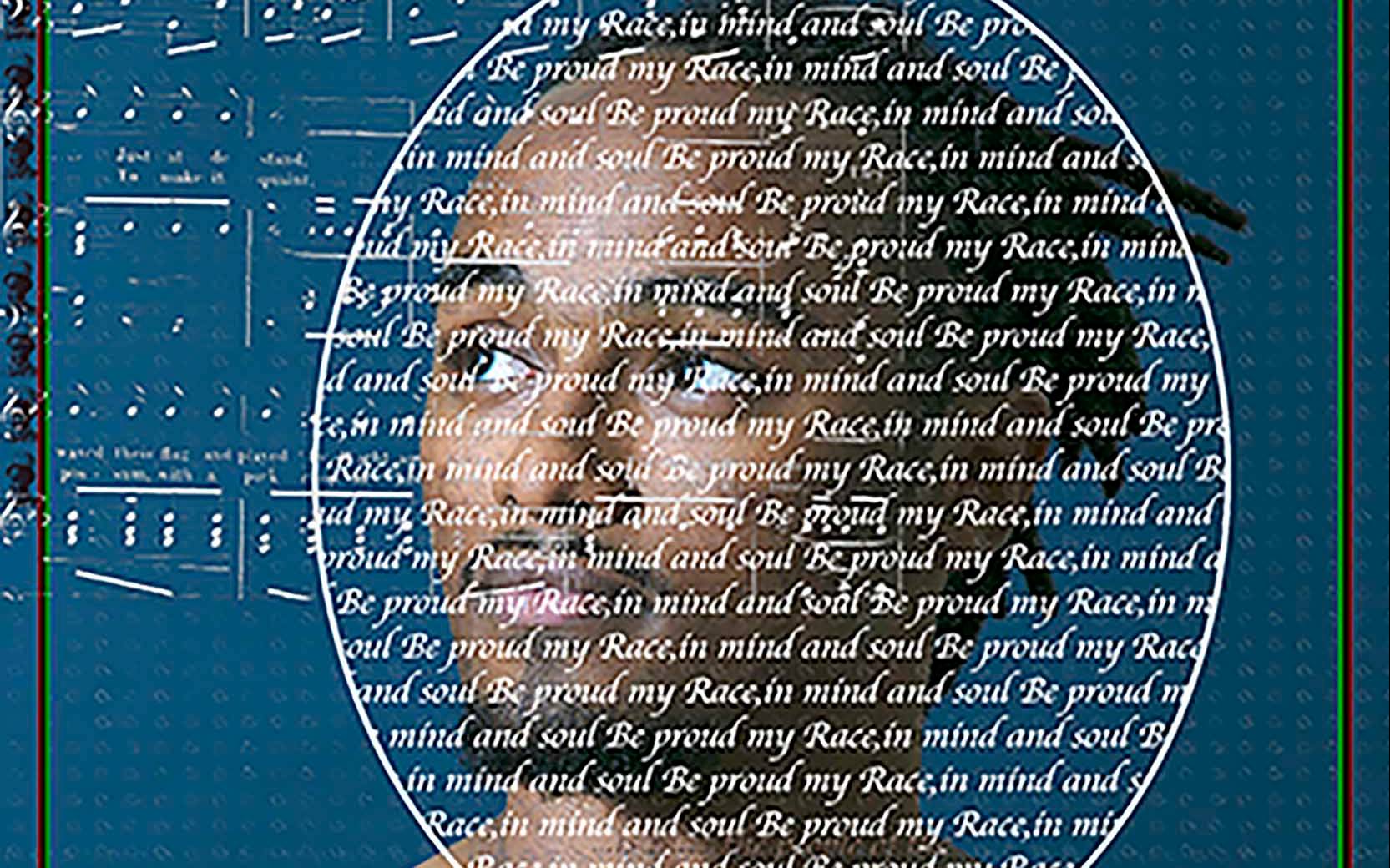
Press, the first solo exhibition of University of Memphis alumna Natalie Eddings (BFA,
2018), is a vicarious navigation of intergenerational racial trauma and minority stress—where
it comes from, what it looks like, and how, perhaps, we deal with it. The exhibition
observes the collisions of the term "press"—of the past and the present, formalized
in the bodies and souls of oppressed peoples featured in Eddings' layered photographic
portraits.
In the exhibition, Eddings creates a dichotomy of the word "press." On the one hand, she interprets it as the press, or media coverage, journalism, and the distribution of news. This understanding of "press" is described, in part, by the First Amendment of the Constitution. On the other hand, she considers "press" as a root word derived from the Latin pressare, which means to press down, hold fast or hold down, cover, crowd, compress. This is the basis for such words as impress, depress, oppress, suppress, repress, and others. She ascribes this understanding of the word to the essential nature of oppressed peoples.
Faculty in the UofM Department of Art selected Eddings from the Fall 2017 and Spring 2018 graduating Bachelor of Fine Arts classes for this prestigious solo exhibition. An annual tradition, this exhibition provides an outstanding graduate with the opportunity to present a body of work as well as develop and execute an exhibition concept with Fogelman Galleries staff.
Image: Natalie Eddings, Ode to Ethiopianism, 2018. Giclée photographic print, 36 x 24 in. Courtesy of the artist.
Here and Now: Printmaking and the Political Present
October 8 – November 9, 2018
Here and Now: Printmaking and the Political Present is an exhibition of prints by Memphis-based artists exploring social issues of our contemporary moment on local, national, and global levels. Artists include Maritza Dávila, Vanessa González-Hernández, Nelson Gutierrez, Lawrence Matthews, Carl Moore, Joel Parsons, Jennifer Sargent, and Yancy Villa-Calvo.
Master printmaker Maritza Dávila will lead artists in a series of workshops formulating concepts and producing the prints on view. Artists explore topics such as gentrification, climate change, gun violence, queer politics, immigration, education, and non-violent protest. The exhibition also contemplates the role of printmaking as a means of expression in our fast-paced, digital age.
The exhibition runs concurrently with the exhibition Freedom of the Press: Posters from Progressive Print Shops, 1960s - Present organized by the Center for the Study of Political Graphics in Los Angeles, California.
Image: Carl Moore, Save the People, Save the World, 2018. Screen print on paper, 30 x 22 in. Courtesy of the artist.
Freedom of the Press: Posters from Progressive Print Shops, 1960s - Present
October 8 – November 9
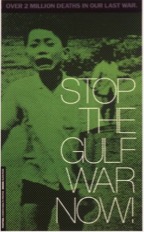 Image: "Stop the Gulf War Now!" Glenn Ruga; Common Wealth Printing Co. Inc./Aldebaron. Offset,1991. Massachusetts,
Hadley.
Image: "Stop the Gulf War Now!" Glenn Ruga; Common Wealth Printing Co. Inc./Aldebaron. Offset,1991. Massachusetts,
Hadley.
Oppositional presses have been challenging the status quo in the United States since Benjamin Franklin helped form the first printers' union in the colonial period. From Quaker broadsides against slavery to posters supporting affirmative action, printers have put ink to paper in the struggle for peace and justice. Political posters held a venerable position as one of the principal modes of dissent in the nineteenth century, and they were widespread during the 1930s and 1940s until the chilling atmosphere of McCarthyism in the 1950s stifled the voices of protest. Their popularity and importance in the United States was revived during the civil rights and anti-Vietnam War movements, and posters continue to enliven movements for social change today.
Produced by the Center for the Study of Political Graphics in conjunction with the Progressive Printers Network, this exhibition presents prints from printshops throughout the United States and Canada addressing issues ranging from women's rights to the anti-Apartheid movement. By focusing on the printshops, the exhibition examines a unique approach to organizing for social change through collective work.
Niles Wallace
A Retrospective
August 31 – September 28, 2018
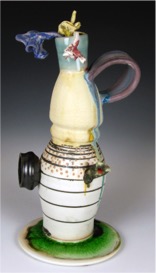 Image: Niles Wallace, Green Pool, 2018. Porcelain, 18 × 8 ½ × 6 in.
The Martha and Robert Fogelman Galleries of Contemporary Art presents a retrospective exhibition featuring the work of Niles Wallace. The exhibition celebrates the artist's 41-year career as a professor at the University of Memphis and includes a variety of three-dimensional works, ranging from ceramics to large-scale sculpture and installation.
Much of Wallace's work is imbued with a sense of nostalgia, domesticity, and often, the artist's wry sense of humor. With his parents divorcing when he was young, Wallace lived with his mother and grandparents. His grandfather, a barber, and his grandmother a seamstress, taught him what it meant to work and create with his hands. He was exposed to the realities of the working class—the frustrations and fruits of labor. Strong women, the motivation of faith, and the ability to work with what was available and waste nothing have been recurring influences in the artist's work.
Occupying both gallery spaces, the exhibition spans much of Wallace's five decades making art in a variety of mediums. Several works exhibited before in Memphis and beyond have been reconfigured for the present installation, imparting a sense of newness to once familiar works. The tactility of his materials—whether clay, plastic, or carpet—and its response to touch are central to the artist's work and process.
Memphis-based artist, Niles Wallace, was born in Western Pennsylvania in 1948. He received a BA in Art Education from Edinboro State University in 1970 and an MFA in Ceramics from Alfred University in 1974. He taught briefly at The Philadelphia College of Art and at The State University of New York at Albany before beginning his tenure as ceramics professor at the University of Memphis in 1976, where he retired in the spring of 2018. His work has been exhibited on a national level and can be found in numerous private and corporate collections.