
Artificial Grasping Hand Competition
Can you design a mechanical hand that mimics the capabilities of the human hand? In the Artificial Grasping Hand Challenge, students will engineer a functional hand capable of grasping, lifting, and transporting objects of different shapes, sizes, and weights. Teams will explore concepts used in biomedical engineering, prosthetics, robotics, and human anatomy while creating a device that balances dexterity, strength, and control.
Competition Overview
- Grade Levels: 3-8
- Team Size: 1-4 students
- Competition Time: 3-minute transport challenge
- Event Setting: Table-to-table object transfer course
- Materials Provided: Competition objects and transport stations
- For this competition, all competition entries must be completed before arrival at Engineering Day. Teams should arrive with their entry fully assembled and ready for inspection and competition.
- Skill Focus: Engineering design, biomechanics, problem solving, creativity, teamwork, and prototyping
The Challenge
Students will design and build a mechanical artificial hand capable of picking up and transporting a variety of objects from one location to another. The challenge simulates one of the real-world problems biomedical engineers and prosthetics designers face: creating devices that can perform everyday tasks using mechanical systems. Competitors must design a hand that can successfully grasp objects of varying sizes and weights while maintaining control during transport.
Teams will earn points by moving objects from one collection bin to a scoring bin within the allotted time. Different objects are worth different point values based on the level of difficulty required to grasp and transport them.
Design Requirements
Before competition:
- Design and build Artificial Grasping Hand.
Students are encouraged to:
- Study the structure of the human hand.
- Consider how tendons and joints work together.
- Design for both strength and dexterity.
- Test and refine their designs prior to competition day.
Creative approaches are encouraged as long as the device remains mechanical in nature.
Artificial Hand Specifications
The artificial hand must:
- Include fingers that bend at all three finger joints.
- Function as a mechanical device.
- Be operated without electrical, pneumatic, hydraulic, or motorized power sources.
- Demonstrate the ability to grasp and release objects using a student-controlled mechanism.
Materials Provided
Competition organizers will provide:
- A collection tub containing competition objects
- An empty scoring tub
- Tables positioned approximately 15 feet apart
- Official judges and timers
Competition objects may include:
- Ping pong balls
- Pencils
- Tennis balls
- Hockey pucks
Additional objects of similar size and difficulty may be included at the discretion of event organizers.
Competition Procedure
Two tubs will be placed on separate tables approximately 15 feet apart:
- Starting Tub: Contains all competition objects
- Scoring Tub: Receives transported objects
Competition Round
- The competitor begins at the starting tub.
- Using only the artificial hand, the competitor picks up one object at a time.
- The object is transported to the scoring tub.
- The object is released into the scoring tub.
- The competitor returns for the next object.
- The process continues until the 3-minute time limit expires.
Competition Rules:
During Competition:
- Objects must be transported using only the artificial hand.
- Objects must be moved one at a time.
- Competitors may not carry objects with their hands or bodies.
- No adjustments, repairs, or modifications may be made once the competition round begins.
- Teams may not replace broken components during the event.
If an object is dropped during transport:
- The object may not be picked up again.
- No points will be awarded for that object.
This encourages teams to design for both grip strength and reliability.
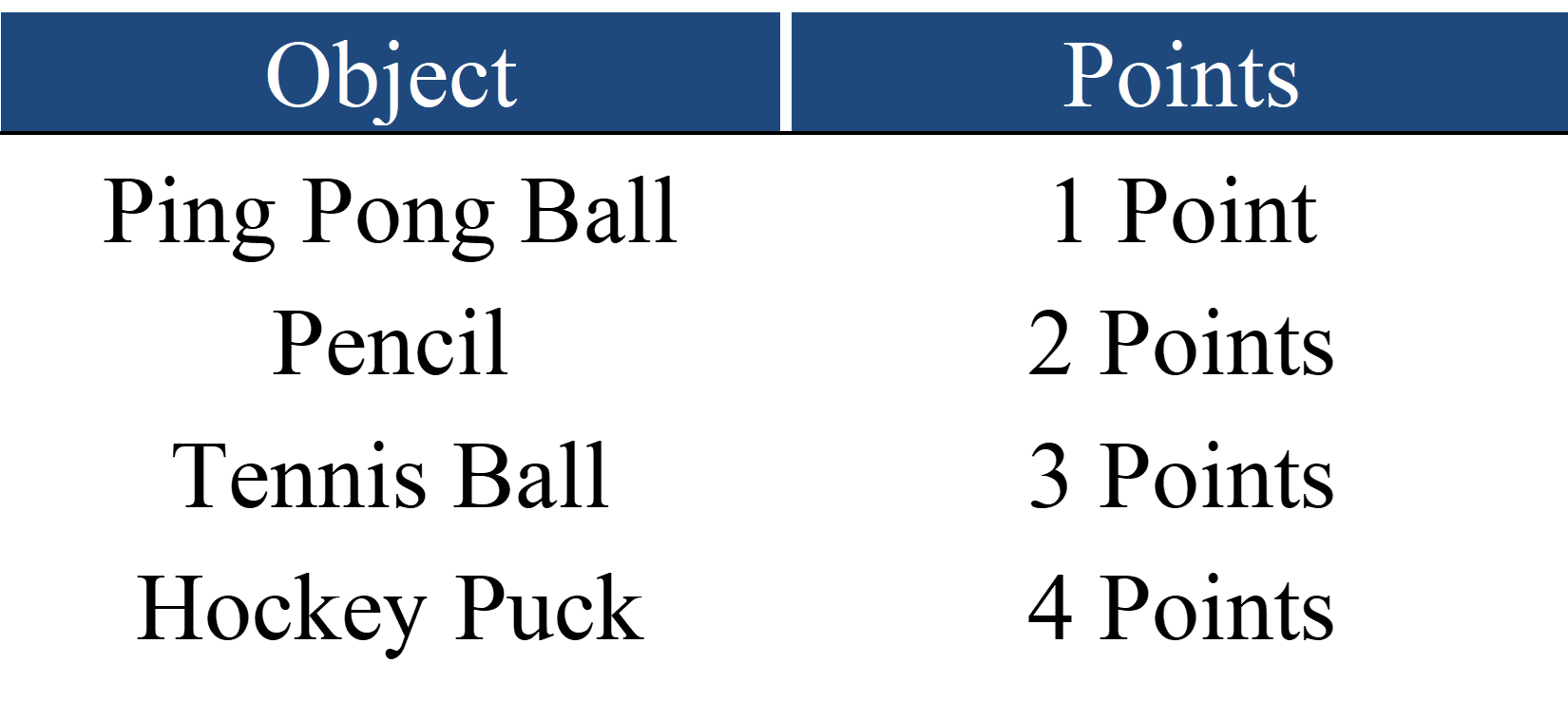
Scoring Formula
Points are awarded for each successfully transported object placed into the scoring tub.
Winning Criteria
- The team with the highest point total at the end of the 3-minute competition period will be declared the winner. Because heavier objects earn more points, teams must decide whether to focus on speed, object value, or a combination of both strategies.
ISTE & STEM Connections
- Innovative Designer
- Design and refine a mechanical system inspired by the human hand.
- Test and improve prototypes through iterative design.
- Computational Thinker
- Analyze how finger placement, leverage, and grip strength affect performance.
- Evaluate design tradeoffs between speed and reliability.
- Creative Communicator
- Explain how the hand operates and how design decisions improve performance.
- Present engineering solutions and design strategies.
- Global Collaborator
- Work together to brainstorm, build, test, and improve a functional mechanical device.
- Share responsibilities during both construction and competition.
-
Engineering Design Process
- Identify a real-world problem.
- Research how the human hand functions.
- Develop and test solutions.
- Improve performance through iteration.
- Evaluate results and communicate findings.