
Memphis native talent finds purpose through research at the Herff College of Engineering
March 30, 2026
University of Memphis senior Gerrell Dabbs didn't know exactly what he wanted to do in college when he graduated from high school. He just knew it had something to do with computers.
"I did not really know what I wanted to do in college besides that I wanted to work with computers," Dabbs said. "Originally, computer science was kind of the idea. But, as I read into it, computer engineering was kind of a more appealing choice, more hands-on and more practical."
He had options on where he could go to explore that field. Advisors and family told him to apply to Ivy League schools or private colleges like Vanderbilt. But, when considering his future, Dabbs said he wanted an education with limited distractions—a place that offered real-world experience with top-notch faculty in a pragmatic environment. Ultimately, the Memphis native decided to stay home and enroll at the Herff College of Engineering at the University of Memphis.
"In general, the University of Memphis as a whole is not only affordable, but there are a lot of opportunities at this school," Dabbs said. "You don't necessarily need to go out-of-state or anywhere in particular to get a good experience... There's a lot of good faculty here. If you have a course you're interested in, it's probably in the catalog and someone's probably doing research in it. I'd say that's the reason I chose here rather than many other places. Not only is the school good, but the actual department has a lot of different course offerings. You will get a good education.
"If it gets too flashy or the focal point isn't education anymore, it's not very appealing to me. I value education and the learning process more than anything and this school, this department, is very down to earth. It has people who want to educate future leaders rather than just pushing the engineering name for name's sake...I think there's a value to what an engineer is in this department more than what I've seen in a lot of different schools."
Dr. Chrysanthe Preza, Professor of Electrical and Computer Engineering and founding Director of Herff's Vertically Integrated Projects (VIP) program, was one of those faculty members who had an early impact on Dabbs engineering education. Though already a member of the Honor's College, Dabbs said Dr. Preza and the VIP program took his research to the next level.
"VIP is what took my research from kind of informal, because there was a lot I had to learn, to more formal," Dabbs said. "A lot of my ability to present, to write proper research documentation, to essentially understand things came from VIP. I think, if it weren't for VIP, I would certainly be much more lacking in my ability to present my work."
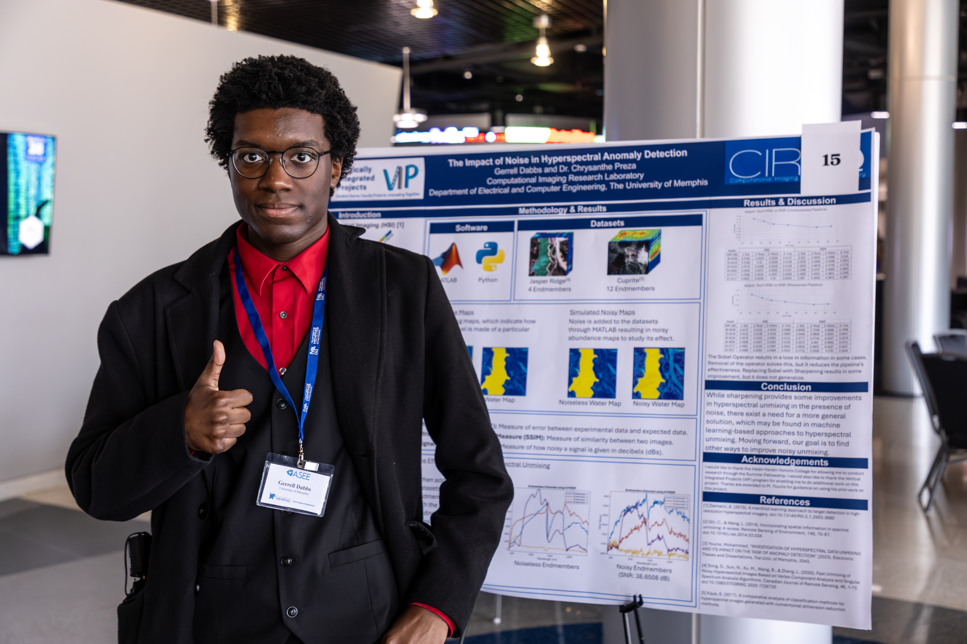
That work centers around hyperspectral imaging, the process of identifying and quantifying material composition in complex scenes where each pixel contains mixtures of multiple substances. Dabbs explained that each material in the world has its own signature of wavelength when photographed. By collecting images of materials and deconstructing the materials in those images through techniques like signal processing, data analysis, modeling and scientific computing, Dabbs and his fellow researchers are able to isolate the different materials that make up a subject. Dabbs has presented his research in the field at several conferences. He presented his work at the UofM WIPS, twice receiving third place honors for his talk, the UofM SRF, the NCUR 2024 and the ASEE-SE 2026 Conference at the University of Memphis, where he earned third place for his presentation. He also published his work in the University of Memphis Quaesitum journal, under Dr. Preza's supervision. Gerrell conducted his research by participating in the VIP program, and also over the summer funded by an Honors Summer Fellowship in 2024, and by external funding from the Army Research Laboratory (under Cooperative Agreement Number W911NF-21-2-0294) in summer 2025.
"VIP has structured my learning greatly, made a lot of things easier to understand, made me able to connect material so much better and, honestly, overall just made me a better student and researcher. I think VIP has been instrumental to my research, and I owe a lot to Dr. Preza."
But Dabbs doesn't work with blinders on. He said that, through the VIP program, he's been introduced to related fields and gained a better understanding of research areas closely related to his own, such as David Adaway's work in computational imaging.
"A really big thing, at least from Dr. Preza's team, is the intradisciplinary nature," Dabbs said. "Dr. Preza's group, for example, has two subteams. One is hyperspectral, which I do, and one is in microscopy. But just because I'm in hyperspectral doesn't mean that microscopy is black-boxed to me. I am aware of the ideas and somewhat of how it works. Even in her lab, between the graduate students, they constantly work together and communicate different ideas and try to apply ideas from one field to another. I think the intradisciplinary nature of it is very important... I think for students who are interested, it's a very good way to see how to link ideas between fields."
Dabbs began his college career focused on education and he holds the same mindset four years later, enrolled in Herff's Accelerated Bachelor's to Master's program, which allows him, as a senior, to earn up to 12 credit hours toward his eventual graduate degree. He said the opportunity to experience higher-level material and graduate courses as an undergrad greatly enhanced his research.
"I've always, even when younger, valued education," Dabbs said. "I've always really wanted to push forward my education... It's a good way to get into that material early rather than waiting. I think that's really the big reason why I did it. I wanted to learn more of the graduate-level classes and it also gives you a good way into research early, on top of programs like VIP."
Between the VIP program and his graduate-level classes, Dabbs carries a heavy courseload, one that he hopes will prepare him to be a high-impact researcher one day.
"I want to develop something that will change someone's life for the better," Dabbs said. "To that end, Herff has effectively pushed me toward that in all aspects. I came into college not really being aware of research, not having the most direction and things like that and Herff has given me structure that you don't get (in many other places.) It's taught me how to do research, how to manage time and how to communicate professionally. All aspects of being a professional, I have gotten from Herff... I would say that Herff has prepared me greatly for the future."
Dabbs ends his undergraduate years with a full academic plate, and he encouraged anyone with similar goals to fearlessly embrace all of the opportunities offered at the Herff College of Engineering.
"Don't be afraid to do something that you're interested in and don't hold yourself back because of that either," Dabbs said. "It's okay to make mistakes. You truly should just go after something that interests you because you will grow during that process. Don't be afraid of growing. Be willing to try new things and be willing to grow with them, stick with them and learn from them."
Dabbs will graduate in May 2026 with honors, earning a bachelor's degree in computer engineering and another in mathematical sciences.