
From the track to the lab: How Memphis long jumper Jean Yves Thiemele-Marco is accomplishing his goals on the field and in the classroom
September 9, 2026
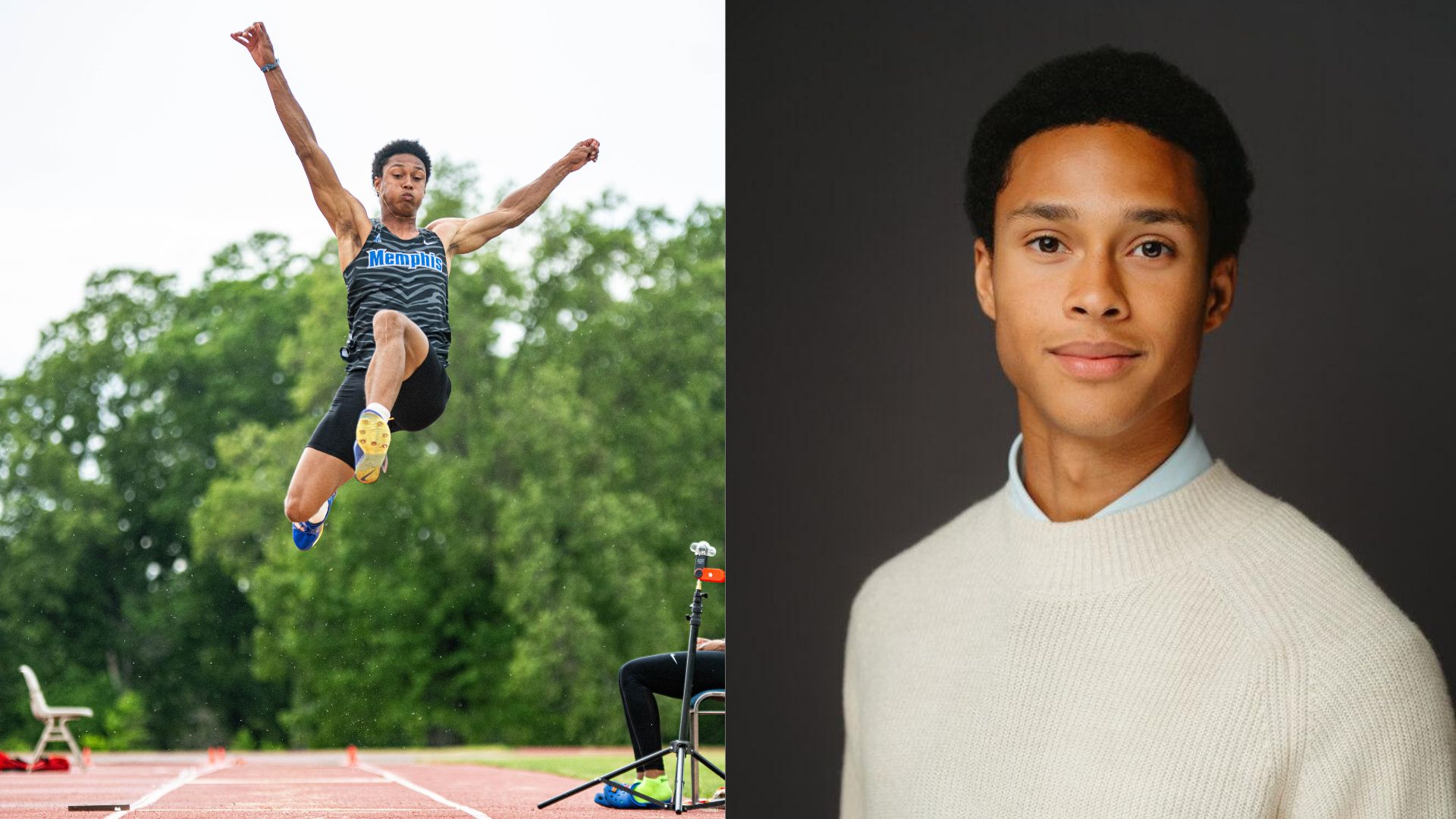
As the new academic year settles in, students' calendars are quickly filling up with different colors boxing out times of their day for class, research and study. Jean Yves Thiemele-Marco, a 21-year-old junior in the Herff College of Engineering Department of Biomedical Engineering, accomplishes all of those tasks while also devoting much of his time to the University of Memphis Track and Field team.
His academic and athletic prowess has led him around the world, from running track in his home country of Spain to studying biomedical engineering in Memphis. While the two may not seem connected, Thiemele-Marco said both require tremendous focus and a willingness to learn.
“In track, you can be very talented, but if you don’t put your mind and body into it, if you don’t have that discipline to keep coming into practice every day, then it’s very rare, unless you’re someone who is extremely talented, that you’re going to very far,” Thiemele-Marco said. “In engineering, I feel like you can see a similar thing. You can be very bright, but if you are not putting that into practice, whatever you’re learning in class, it’s going to be very hard for you to move on or to become a great engineer in the future.”
Thiemele-Marco ran track in Spain, which eventually led him to Livingstone College in North Carolina. Realizing that Livingstone College didn’t offer his preferred major, he started looking for a new college home that would push him harder in the classroom and on the field.
“They didn’t have my major. So, I entered the transfer portal and Memphis was one of the opportunities that attracted me most, especially because of their engineering program and their track team,” Thiemele-Marco said.
Thiemele-Marco specializes in the long jump and relished the opportunity to compete against D1 athletes by joining the University of Memphis. Once here, he fell in love with the innovative approach his coaches brought.
“My Coach here (Xavier Kennedy) is very young, very innovative,” Thiemele-Marco said. “He likes to incorporate new and challenging methods into our training. He likes to read a lot and incorporate different training techniques into his training methods. I liked the project they were building. It was a project built on family, built on trust and built on creating a culture.”
He soon found that innovative approach in the classroom through Herff’s Department of Biomedical Engineering, and specifically through Herff’s Vertically Integrated Projects (VIP) program.
“They shocked me in the way that they were approaching things in a practical way. They were encouraging students to take on hands-on opportunities, obtaining not only theoretical knowledge but working knowledge in their fields…I liked the projects they were doing and I was especially attracted to the VIP program. I found it fascinating, especially coming from Spain, to see programs that encourage students to participate in research while actually gaining credit for it. Back home, you don’t often see students actually participating in research or taking hands-on experience. You don’t see that practical application of what you’re learning,” Thiemele-Marco said.
Thiemele-Marco credits that focus on real-world application of skills for his success in track and field and in research.
“Jumps are a very technical part of track,” Thiemele-Marco said. “You can know the technique, you can know the specific movements you need to do, but you need to be able to transmit that knowledge to your body and put it into practice. In biomedical engineering, I’d say it’s the same thing. You can know a lot of theory, but once it comes to actually applying it to real-life problems and problem-solving, that’s the tricky part.”
Over the summer, Thiemele-Marco demonstrated those real-world skills through an internship at the Spanish National Cancer Research Institute. During the 10-week internship in his home country, Thiemele-Marco worked in the structural biology unit, learning how to understand cancer as cells that divide uncontrollably.
“It’s interesting to study nucleosomes, as we can understand cancer as cells that are divided uncontrollably,” Thiemele-Marco said. “Understanding how DNA is repaired, specifically in cancer cells, is very interesting for understanding cancers and processes in general and how cancer develops.”
Along with memories of celebrating a World Cup victory with his friends and family in Spain, Thiemele-Marco brought back a new understanding of skills he originally learned through the Herff’s Horizons Program and Herff VIP program.
“I learned how to communicate and work in a lab environment,” Thiemele-Marco said. “Not only by getting the hands-on experience, which is very useful, but also by learning how to effectively work and communicate with other people, especially people working on different projects that might indirectly have to do with your project. And how to communicate as a group and how to organize a lab unit or a lab group. I learned how a lab operates, especially a high-level lab, in terms of how to organize different people and how to communicate with each other.”
As the semester moves on, Thiemele-Marco’s calendar once again resembles a rainbow with all of his appointments marked. Between track and field practice four or five days a week and two classes per day, he admits he often has to sacrifice time with his friends to complete his work and training. Still, he encourages all of his fellow students to jump feet first into research at Herff, especially through opportunities like the VIP program.
“If I could say anything to other students, I would encourage them to take active participation in programs like that, because they really help you get hands-on experience,” Thiemele-Marco said. “Especially coming from other countries that don’t provide students with such opportunities to get live experience, or research and lab experience, I would just encourage that opportunity to students.”