
Dr. Russell J. Deaton
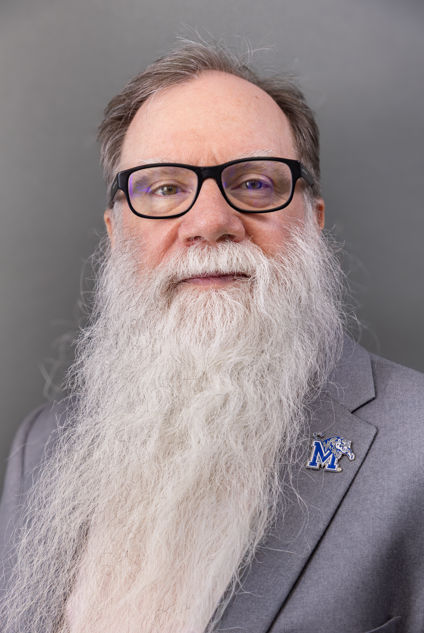
Executive Director of the Polytechnic@UofM
Chair, Department of Engineering Technology
Professor of Electrical and Computer Engineering
Herff College of Engineering
Phone: 901.678.3258
Email: rjdeaton@memphis.edu
Fax Office: 205 Engineering Science
Dr. Russell J. Deaton
Dr. Russell Deaton is the executive director of The Polytechnic@UofM, which is an academic unit at the University of Memphis that is focused on workforce preparation, innovative academic programs, and improving access to education in applied technology. He is also a professor of electrical and computer engineering and chair of the Department of Engineering Technology. He is the former chair of Electrical and Computer Engineering and associate dean of the Herff College of Engineering. He has a BA in English from the University of North Carolina, a BS in electrical engineering from the University of Memphis, and an MS and PhD from Duke University. His research is in the self-assembly of new materials and recently has focused on circuit analysis of self-assembled structures with possible implications for axonal networks and topological insulators.
Learn more about Dr. Russell Deaton
- Ph.D., Electrical Engineering, Duke University, May 1992
- MS, Electrical Engineering, Duke University, December 1988
- BS Summa Cum Laude, Electrical Engineering, Memphis State University, May 1984
- BA with Honors, English, The University of North Carolina - Chapel Hill, May 1981
- Professor, Executive Director of the Polytechnic@UofM, Chair of Engineering Technology,
Herff College of Engineering, The University of Memphis, 7/25-present - Professor and Associate Dean for Academic Affairs and Administration, Herff College
of
Engineering, The University of Memphis, 1/16-12/24 - Professor and Interim Dean of the Herff College of Engineering, Herff College of Engineering,
The University of Memphis, 7/22-12/22. - Professor and Department Chair, Electrical and Computer Engineering, The University
of Memphis, 8/12-7/17. - Professor, Computer Science and Computer Engineering, The University of Arkansas,
9/03-8/12. - Associate Professor, Computer Science and Computer Engineering, The University of
Arkansas, 9/00-8/03. - Associate Professor, Electrical and Computer Engineering, The University of Memphis,
9/98-8/00. - Assistant Professor, Electrical Engineering, The University of Memphis, 8/92-8/98.
- Member of the Technical Staff, IPSD, General Electric Corp., Research Triangle Park,
NC, 8/87-9/88. - Process Engineer, CICD, General Electric Corp., RTP, NC, 9/85-8/87.
- Process Engineer, Fab 5, UTC-Mostek, Dallas, TX, 6/84-8/85.
- Kanuri Professor of Engineering, University of Memphis, 2015-2017
- Ring Professor of Engineering, University of Memphis, 2012-2014
- Korean Brainpool Award that allowed a 3 month residence at Seoul National University
IEEE Senior Member - Computer Science and Engineering Teacher of the Year, University of Arkansas, 2009-
2010. - Computer Science and Engineering Researcher of the Year, University of Arkansas, 2005-
2006. - Computer Science and Engineering Researcher of the Year, University of Arkansas, 2003-
2004. - Computer Science and Engineering Service Award, University of Arkansas, 2002-2003.
- Computer Science and Engineering Researcher of the Year, University of Arkansas, 2001-
2002. - ECI Professor of Engineering-Endowed Chair, University of Memphis, 1999-2000.
- Eta Kappa Nu, University of Memphis, 1995.
- Herff and Distinguished Herff Scholar, Memphis State University, 1982-1984.
- National Dean’s List, Memphis State University, 1983.
- Golden Key, Memphis State University, 1983.
- Phi Kappa Phi, Memphis State University, 1983.
- Tau Beta Pi, Memphis State University, 1983.
- Phi Beta Kappa, University of North Carolina - Chapel Hill, 1980.
- Phi Eta Sigma, University of North Carolina - Chapel Hill, 1978.
- IEEE, IEEE Computer Society, ASEE.
- R. Deaton, M. Garzon, R. Yasmin, and A. Garth, “Self-assembling families of LC ladder
circuits with frequency-controlled growth,” IEEE Access, vol. 13, pp. 136062–136072,
2025.
M. Garzon and R. Deaton, “Self-Assembly of generative heterogeneous electric circuits,”
Sci. Rep., vol. 15, p. 15401, 2025.
R. Yasmin and R. Deaton, “Logical computation with self-assembly electric circuits,”
PLoS ONE, vol. 17, p. e0278033, 2022.
R. Deaton, M. Garzon, and R. Yasmin, “Systems of axon-like circuits for self-assembled
and self-controlled growth of bioelectric networks,” Sci. Rep., vol. 12, p. 13371, 2022.
R. Yasmin, M. Garzon, and R. Deaton, “Model for self-replicating, self-assembling electric
circuits with self-controlled growth,” Phys. Rev. Research, vol. 2, p. 033165, Jul 2020.
R. Deaton, M. Garzon, R. Yasmin, and T. Moore, “A model for self-assembling circuits
with voltage-controlled growth,” International Journal of Circuit Theory and Applications,
vol. 48, no. 7, pp. 1017–1031, 2020.- Y. Yan, M. Garzon, and R. Deaton, “Self-assembly of 2-d resistive electric grids,”
IEEE
Transactions on Nanotechnology, vol. 18, pp. 562–566, 2019. - Y. Yan, M. Garzon, and R. Deaton, “Harmonic circuit self-assembly in cTAM models,”
IEEE Transactions on Nanotechnology, vol. 18, pp. 195–199, 2019. - T. G. Moore, M. H. Garzon, and R. J. Deaton, “Probabilistic analysis of pattern formation
in monotonic self-assembly,” PLoS ONE, vol. 10, p. e0137982, 09 2015. - J. Lee, J. Chen, R. Deaton, and J. Kim, “A DNA-based pattern classifier with in vitro
learning and associative recall for genomic characterization and biosensing without explicit sequence knowledge,” Journal of Biological Engineering, vol. 8, p. 25, 2014. - J. Lee, J. Song, R. Deaton, and J. Kim, “Assessing the detection capacity of microarrays
as Bio/Nanosensing platforms,” BioMed Research Internatinal, vol. 2013, p. 310461, 2013.
- R. Deaton, “Axon-like circuits: self -assembled -controlled bioelectric networks growth.”
https://community.wolfram.com/groups/-/m/t/2714011, 2023. Wolfram Community
Staff Pick. - R. Deaton, R. Yasmin, T. Moore, and M. Garzon, “Self-assembled DC resistive circuits
with self-controlled voltage-based growth,” in Unconvential computation and natural
computation: 16th international conference, UCNC 2017 (M. Patitz and M. Stannett,
eds.), vol. LNCS 10240, (Berlin), pp. 129–143, University of Arkansas, Fayetteville, AR,
June 2017, Springer-Verlag, 2017. - T. Moore, M. Garzon, and R. Deaton, “Probabilistic analysis of pattern formation in
tile
self-assembly,” 2015. Abstract and Poster Presentation at DNA 21, Boston, MA. - T. Moore, R. Deaton, and M. Garzon, “One-dimensional noncooperative tile assembly
with one dissolvable glue,” 2015. Abstract and Poster Presentation at DNA 21, Boston,
MA. - J. Fathi, E. Jacobs, and R. Deaton, “How errors affect the optical properties of a metamaterial made of gold nano-spheres,” in IEEE 14th International Conference on Nanotechnology (IEEE NANO), IEEE, 2014. Poster, Toronto, Canada.
- T. Slack and R. Deaton, “The effect of tile rotation on tile set size,” in IEEE 14th
International Conference on Nanotechnology (IEEE NANO), IEEE, 2014. Poster, Toronto,
Canada. - J. Lee, C. Baek, H. Chun, J. Ryu, R. Deaton, and B. Zhang, “Use of symmetric internal
loops for molecular pattern classification,” 2014. Abstract and Poster Presentation at
DNA 20, Kyoto, Japan. - T. Moore, R. Deaton, and M. Garzon, “Directed percolation in DNA tile self-assemblies,”
2014. Abstract and Poster Presentation at Unconventional Computation and Natural
Computation Conference, London, Ontario. - T. Moore, M. Garzon, and R. Deaton, “Approximating probabilistic pattern formation
by deterministic elementary cellular automata in tile self-assembly,” 2014. Abstract and
Poster Presentation at Unconventional Computation and Natural Computation Conference, London, Ontario. - T. Moore, R. Deaton, and M. Garzon, “Tiling simulation of directed percolation,” 2013.
Abstract and Poster Presentation at DNA 19, Tempe, AZ.
- R. Deaton, “Engineering of nano-building block toolboxes for programmable selfassembly
of nanostructures with arbitrary shapes and functions,” 2012. co-PI, National Science Foundation (NSF), subcontract from University of Arkansas, J. W. Kim, PI, $73,116. - R. Deaton, “Self-assembly of complex systems,” 2011. PI, National Science Foundation
(NSF), $200,000. - R. Deaton, “A workshop on undergraduate education in EMT,” 2009. PI, National
Science Foundation (NSF), $8,000. - R. Deaton, “Speakers for DNA 15 computing confernce,” 2009. PI, Air Force Office of
Scientific Research (AFOSR), $18,800. - R. Deaton, “DNA 15 invited spearker,” 2009. PI, Arkansas Science and Technology
Authority (ASTA), $2000. - J. Lusth and R. Deaton, “Preparing at risk students for CS1 and calculus,” 2007-2009.
coPI, National Science Foundation, $149,181). - J. Kim and R. Deaton, “Exploration of DNA-based nanoscale building block (DNAn-
BLOCK for controllable and scalable fabrication of active nanostructures,” 2007-2008.
coPI, National Science Foundation, $129,965). - R. Deaton, “Classifying buisnesses with minimal decision trees from small-world networks,”
2006-2007. PI, Acxiom Corporation, $50,413. - R. Deaton, “Two-dimensional DNA matrix based biomolecular computing and memory
architecture,” 2006-2007. Air Force Research Lab-Subcontract from SUNY Research
Foundation, $67,965 (UA part). - R. Deaton, J. Kim, and J. Chen, “BIC: Large-scale DNA associative memories,” 2005-
2008. PI, National Science Foundation, $316,419. - J. Kim, S. Tung, and R. Deaton, “Engineering ultrasensitive, electrically addressable
nanotube-wire nanosensors through controlled DNA-nanotube interfacing,” 2005-2007.
coPI, USDA, $157,000.
- R. Deaton, “Self-Assembly of Statistical Patterns,” IEEE International Conference
on
Nano/Micro Engineered and Molecular Systems (IEEE NEMS), Honolulu, HI, April 2014.
R. Deaton, “The design of DNA-guided self-assembled nanostructures,” IEEE International
Conference on Nano/Molecular Medicine and Engineering (IEEE Nanomed),
Bangkok, Nov. 2012. - R. Deaton, “Understanding the design of self-assembled nanostructures by mapping to
Ising models,” IEEE Nanotechnology Materials and Devices Conference (IEEE NMDC),
Honolulu, Oct. 2012. - R. Deaton, “Thermodynamic constraints on DNA computation and nanotechnology,”
DNA Word Design Conference, SUNY-Geneseo, Geneseo, NY, April 2004. - R. Deaton, “Challenges and Solutions in DNA Word Design,” DNA Word Design Conference,
SUNY-Geneseo, Geneseo, NY, April 2004. - R. Deaton, “DNA Computation: The Secret of Life as Non-Living Technology,” DNA
Word Design Conference, SUNY-Geneseo, Geneseo, NY, April 2004. - R. Deaton, “Tutorial on DNA computing,” at GECCO-2001, San Francisco, CA, July,
2001. - R. Deaton, “Tutorial on DNA computing,” at GECCO-2000, Las Vegas, NV, July, 2000.
- R. Deaton, “Tutorial on DNA computing,” at GECCO-99, Orlando, FL, July, 1999.
- R. Deaton, “Tutorial on DNA computing,” at Genetic Programming 98, University of
Wisconsin-Madison, July, 1998. - R. Deaton, ”DNA Computing,” Invited talk to meeting of American Chemical Society,
Division of Chemical Education, Special Session on “DNA-The Molecule, State of the
Art”, Dallas, TX, March 29 - April 2, 1998. - R. Deaton, “Tutorial on DNA computing,” at Genetic Programming 97, Stanford University,
July 15, 1997. - R. Deaton, “Current Status of DNA Computing in The United States,” University of
Tokyo, October 1999. - R. Deaton, IEEE Computer Society, Memphis Section, Invited Talk on “DNA Based
Computing,” December 1996.
- J. Kim, R. Deaton, and V. P. Zharov, “Near-infrared (NIR) responsive concentric gold
nanotube (gCNT) rods,” November 2012. US Patent No. 8313773. - J. Kim, R. Deaton, and J. Kim, “DNA-linked nanoparticle building blocks for nanostructure
assembly and methods of producing the same,” November 2011. US Patent
Application No. 61/564,959. - R. Deaton and J. Kim, “Self-assembled quantum computers and methods of producing
the same,” November 2012. US Patent Application No. 61/724,258. - R. Deaton and J. Kim, “Nanofabrication platform (nFAB) for site-directed nanometer
assembly (sdna) of structures and circuits,” June 2005. University of Arkansas Invention
Disclosure. - R. Deaton, J. Kim, J. Chen, and M. Garzon, “DNA-based associative memories with in
vitro semantic processing,” June 2005. University of Arkansas Invention Disclosure. - R. Deaton, J. Kim, J. Chen, M. Garzon, and D. H. Wood, “Large libraries of noncrosshybridizing
- Co-Founder, GeneFab (small business for bionanotechnology innovation).
- 8 Undergraduate Projects
- 11 Undergraduate Honors Theses
- 28 Masters Projects
- 22 Masters Theses
- 7 Doctorates
- Pavan Shah, MS, Computer simulation of percolation on a feed forward network, 1994,
University of Memphis, Conference Publication - Chetan Ramanna, MS, Construction and analysis of one-dimensional objects using iterated
function systems, 1994, University of Memphis - Li Tang, MS, Fractal feature analysis and classification in magnetic resonance imaging,
1994, University of Memphis, Conference Publication - T. P. Mou, MS, A comparative study of STFT and Wavelet Transform of non-stationary,
speech-like signals, 1994, University of Memphis - Jinyu Sun, MS, Self-organized classification and segmentation of magnetic resonance
images,1994, University of Memphis, Conference Publication - Harish Kakde MS, An X windows image processing tool for magnetic resonance images,
1995, University of Memphis - Jonathon Williams, MS, Neural Network Optimization of Pumping Stations, 1995, University
of Memphis - Houston Patrick, MS, Application of fuzzy logic control theory in controlling an elevator
door, 1996, University of Memphis
- University of Memphis, Department of Electrical and Computer Engineering, Undergraduate
Curriculum Committee, 1992-2000. - University of Memphis, Department of Electrical and Computer Engineering, Graduate
Curriculum Committee, 1992-2000. - University of Memphis, Department of Electrical and Computer Engineering, Undergraduate Curriculum Review Committee, 1993-1994.
- University of Memphis, Department of Electrical and Computer Engineering, Committee
to Develop Departmental Honors Program (Chair), 1994-1995. - University of Memphis, Department of Electrical and Computer Engineering, Director
of
Honors Program, 1995-2000. - University of Memphis, Department of Electrical and Computer Engineering, Faculty
Search Committee, 1996-1997. - University of Memphis, Department of Electrical and Computer Engineering, Faculty
Search Committee, 1999-2000. - University of Memphis, Department of Electrical and Computer Engineering, Chief Adviser
for Eta Kappa Nu, 1995-1999. - University of Memphis, Department of Electrical and Computer Engineering, Committee
to develop Computer Engineering Program, 1997-2000. - University of Memphis, College of Engineering, Chief Adviser for Tau Beta Pi, 1992-1997.
University of Memphis, College of Engineering, Engineering Core and Freshmen Retention Committee, 1999-2000. - University of Memphis, Information Technology Task Force (co-Chair), 1998-2000.
- University of Memphis, Honors Program Director Search Committee, 1998-1999.
- University of Memphis, University Honors Council, 1996-2000.
- University of Memphis, Interviewer for Top Scholarships, 1994-1998.
- Editorial Board, IEEE Transactions on Nanotechnology Letters.
- Councilor for Council on Undergraduate Research (CUR) ABET Program Evaluator for EAC.
Chair IEEE Computer Society, Memphis Section Secretary of Memphis IEEE. - Editor of Special Issue of Natural Computing Journal with selected papers from DNA
15
conference. - Chair of Organizing Committee for 15th International Conference on DNA Computing
and Molecular Programming. - Chair of Program Committee for 15th International Conference on DNA Computing and
Molecular Programming. - Chair and organizer of Special Session on DNA-based Computation at IEEE International
Conference on Evolutionary Computation, Indianapolis, IN, April 1997. - Co-Chair of tract on DNA Computing at Genetic Programming Conference (AAAI,
ACM), Palo Alto, CA, July 1997. - Program Committee for GECCO-1999, GECCO-2001, GECCO-2003, IEEE-IWCEC- 2001, DNA9-2003, IBE-2004, IBE-2005, DNA-14, DNA 16
- Organizing Committee DNA13-2007.
- Steering Committee, IEEE CYBER Conference, 2010-2012.
- Participant in Compact for Faculty Diversity as Mentor for Minority Scholars, 1994
and
1995. - Consultant for East High School, Memphis, TN pre-engineering program, 1995.
- NSF Faculty Workshop on Education of Women and Minorities in Science and Mathematics,
1995. - Shelby County, TN Science Olympiad, 1997, 1998, and 1999,
- Workshop on “In the Classroom and Beyond: Race, Gender, Class, and the Curriculum,”
1996. - ABET Assessment Workshop 2, 2004.
- Workshop on Assessment for NSF NUE Grantees, 2004.
- Presented work of digital art at Digital Graffiti 2011, Alys Beach, FL. Digital Art displayed at party fundraiser for the Regional Art Museum of Fort Smith, AR
- ABET Symposium, April 2013.
- ABET Program Evaluator Training, May 2013.
- Developed Honors Program for Department of Electrical and Computer Engineering at
the University of Memphis, 1994-1995. - On Team that developed Computer Engineering program for Department of Electrical
and Computer Engineering at the University of Memphis, 1997-2000. - Developed Honors Program for Department of Computer Science and Computer Engineering
at the University of Arkansas, 2003-2004. - Lead initial ABET accreditation of Computer Science program in the Department of
Computer Science and Computer Engineering at the University of Arkansas, 2004-2005. - Accelerated Bachelor to Masters program for Department of Electrical and Computer
Engineering at the University of Memphis, 2012-2013. - Online Graduate Certificate Program in Imaging and Signal Processing for Department
of Electrical and Computer Engineering at the University of Memphis, 2012-2013. - Innovation and Invention Learning Community for Freshmen for College of Engineering
at the University of Memphis, 2012-2013. - Streamlined scheduling for Department of Electrical and Computer Engineering at the
University of Memphis to maximize efficient use of faculty resources and reduce costs,
2012-2013. - Revised undergraduate curricula for Department of Electrical and Computer Engineering
at the University of Memphis to maximize efficient use of faculty resources and reduce
costs, and expedite student graduation rates, 2013-2014. - Revised graduate curriculum for Department of Electrical and Computer Engineering
at
the University of Memphis to emphasize preparation of graduate students for research
success, 2013-2014. - Engaged in Community Building through events, parties, discussion sessions, and competitions
for Department of Electrical and Computer Engineering at the University of
Memphis. - Promoted active learning and “flipped” classroom in classes for Department of Electrical
and Computer Engineering at the University of Memphis. - Instituted work order system for staff of Department of Electrical and Computer Engineering at the University of Memphis to maximize effective use of limited staff resources.