
The Polytechnic@UofM helps your future take flight with degrees in commercial aviation and aviation management
September 30, 2026
Have you ever been accused of having your head in the clouds? The Polytechnic@UofM may have just the program you need to get there.
The Polytechnic@UofM offers two degrees for the aviation industry: Commercial Aviation and Aviation Management.
First-time students, whether they be right out of high school or adult learners looking to change course in their professional life, can walk into the Polytechnic@UofM and earn pilot certifications and ratings within a few semesters.
Before they select Commercial Aviation as a major, Captain Kimberly P. Coryat, program coordinator and assistant professor, strongly recommends they take a Discovery Flight to see if flying is right for them. The Discovery Flight is crucial to ensure you can fly, want to fly and find flying inspiring. Flying is not easy, so you must have the passion for flight to drive you to success.
While freshmen students learn the fundamentals of physics and algebra, they also acquire a basic understanding of flying by logging hours on desktop flight simulators.
“You don’t have to be a physicist, but airplanes fly because ofthe laws of physics. Understanding how airplanes fly is crucial for understanding how to remain safe. The program also requires proficiency with algebra because you have to make a lot of calculations, quickly, when you’re flying,” Coryat said.
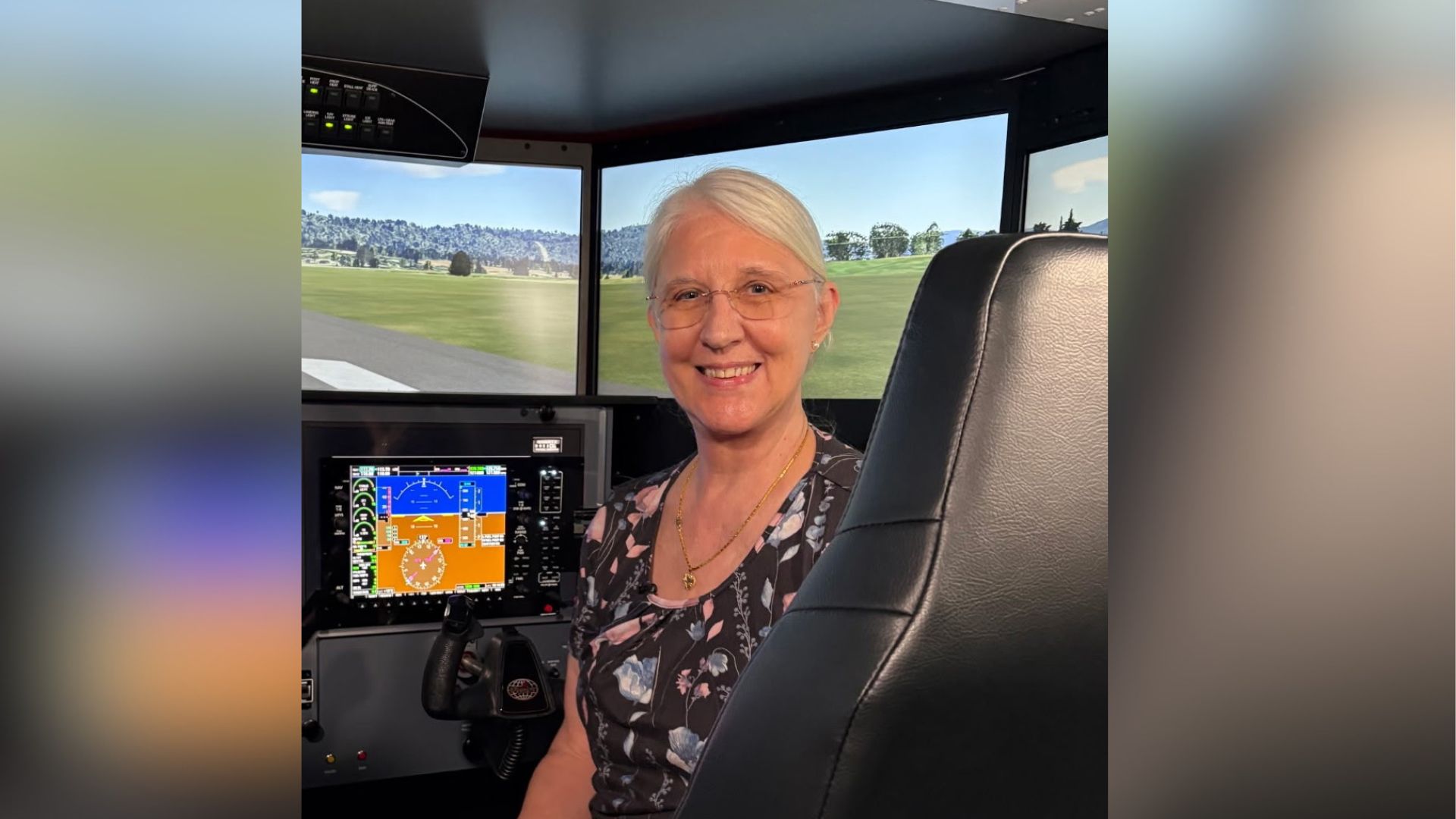
Students then move on to a more realistic flight simulator, allowing them to soar through the skies while never leaving the third floor of the Department of Engineering Technology building at the Herff College of Engineering.
“Simulators are great procedural trainers,” Coryat said. Simulators are also great for learning how to read and interpret the instruments so that your hands can make the airplane fly where you want to go.”
Once students master the simulator, they head down to Olive Branch Airport, typically in the spring semester of their freshman year for their first real flying lessons. Once flight lessons begin, students will log between 230 and 250 hours of flight time over several semesters on their way to earning a Bachelor of Science (BS) in Commercial Aviation. But that degree involves more than knowing how to take off and land.
“The strength of our UofM Commercial Aviation program is that you are able to earn a degree learning the things you love in far more depth than you learn at the airport,” Coryat said. Students learn subjects ranging from fuel management and navigation to weather and aeronautical decision-making. Coryat said pilots must combine knowledge from many disciplines while simultaneously managing an aircraft and responding to changing conditions. “An important skill you learn is prioritization,” she said.
The BS in commercial aviation from the Polytechnic@UofM allows pilots to walk away with the minimum entry-point qualifications to get a job as a commercial pilot. It’s an investment in an exciting career, but it's not cheap. Coryat emphasized that the flight lab fees alone cost about $82,000, and that doesn’t include tuition, equipment, the FAA standardized tests, or flight-testing fees.
But students at Collierville High School can bypass some of those financial burdens and walk into the Polytechnic@UofM ready to fly.
Coryat praised Collierville High School's aviation program because qualifying students can earn a private pilot certificate before entering college. CHS students start preparing for a future in flight as early as the seventh or eighth grade, taking classes that are prerequisites for the school’s aviation program and those students are able to take those classes and get dual-enrollment credit with the University of Memphis.
Coryat noted that as learning to fly is quite expensive, many students struggle to find the funds to pay for it. Aside from the fact that FAFSA takes into consideration the flight fees when determining financial aid, and the availability of scholarships available to all UoM students through Tiger Scholarship Manager, she said there are quite a few scholarships available to our student pilots once they earn their private pilot license. Most of those scholarships are listed in the University Aviation Association’s annual scholarship catalog.
Of course, pilots can earn their private pilot license on their own at any flight school in the area. Coryat actually recommends people to do that and then come to the Polytechnic@UofM ready to fly. “Come to us as a fully certified private pilot and we’ll enroll you in instrument training as a freshman in your first semester.” Coryat said.
Whereas other schools may make someone with a private pilot’s license wait a year for flight instrument training, students at the Polytechnic@UofM never miss a beat in their aviation education.
“I call this ‘First Fly’, and it’s a way for dedicated student pilots to keep up the momentum of flight training,” Coryat said.
Aviation Management offers another path into the aviation industry, one that lets people work in the field while keeping their feet firmly on the ground. The Polytechnic@UofM’s Bachelor of Professional Studies (BPS) degree in aviation management prepares students for high-consequence leadership roles across the commercial air transportation network without the costly flight training fees necessary to become a pilot.
“We’re redesigning the aviation management program now to have multiple tracks. They will provide more specific to skill sets highly valued within the industry,” Coryat said.
Students in aviation management get experience in most of those fields by studying areas such as management, information systems, supply chains, communications, business operations, analytics and organizational leadership in an aviation context. Based on their prior experience, students may even reach their new career destination faster than expected.
“One of the aviation management tracks we are going to have is aviation maintenance management, which is designed for both traditional students as well as adult learners who already have their FAA airframe and power plant mechanic certifications. For those entering with their A&P, we can provide Experiential Learning Credit (ELC) that will cut the time needed to earn their bachelor’s degree which will help them advance in their career,” Coryat said. “In the particular case of maintenance management, we can give them credit for having the A&P certificate, and even more credit if they have their avionics certification and experience. Veterans will also benefit from ELC. We are also looking at developing tracks that will provide block ELC credit for FAA certified commercial pilots, air traffic controllers and dispatchers. All of these Aviation Management tracks will help all these adult learners start off with up to a year’s worth of degree credit.”
By gaining technical expertise in carrier network operations, safety auditing and regulatory compliance, students can walk out of the Polytechnic@UofM and into a variety of professions within the aviation industry.