
How two skulls buried deep in a Herff lab could help stroke victims get better care
October 30, 2026
While skeletons and mummies roam Memphis streets this Halloween, something far more unsettling lurks on the third floor of the Herff College of Engineering's Engineering Technology building.
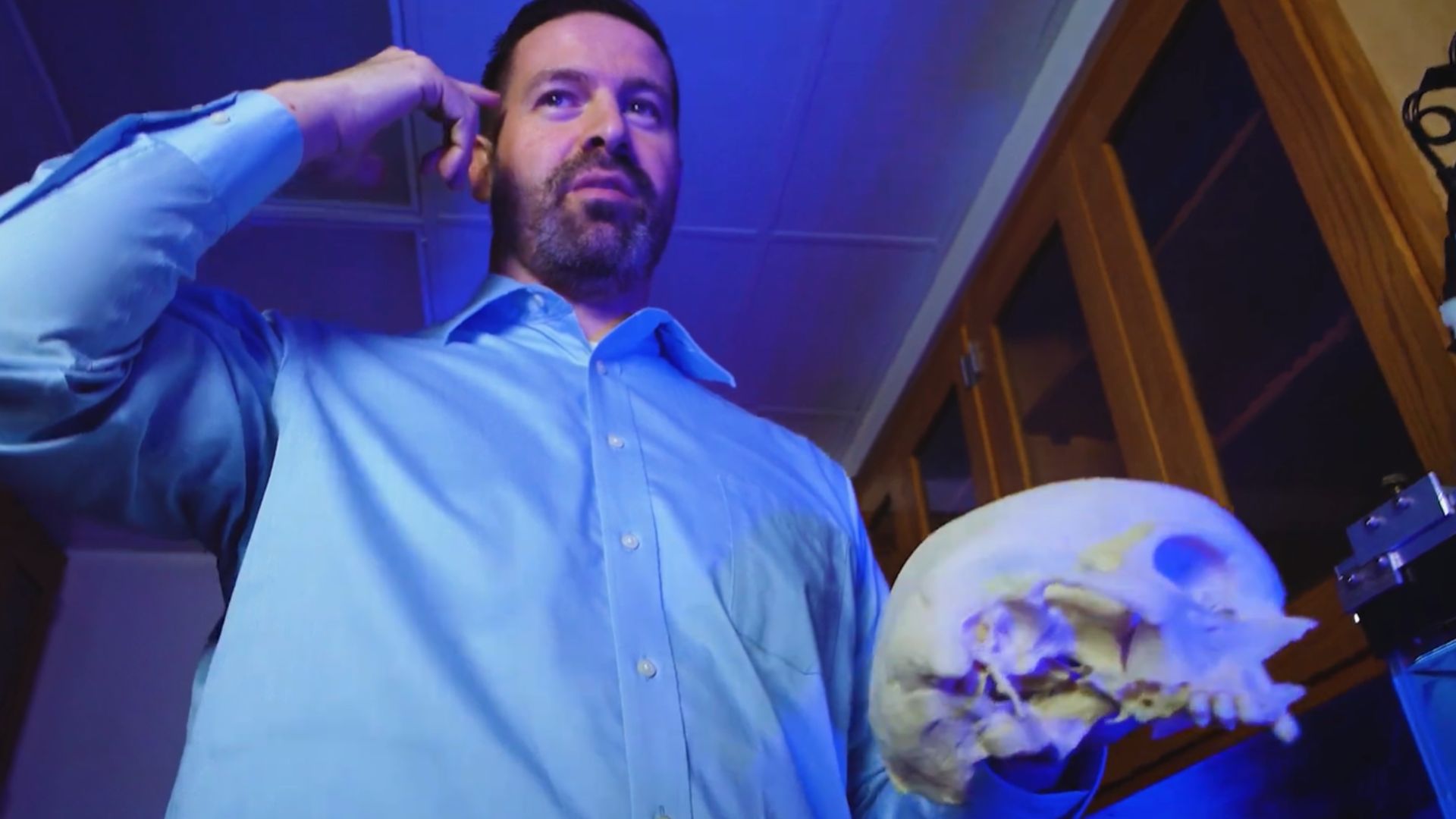
There, in Dr. Carl Herickhoff’s lab, two skulls split into halves sit locked away in a steel suitcase.
“It’s not uncommon in transcranial ultrasound research," Herickhoff said. “The name of the company that supplied the skulls is Skulls Unlimited. They mostly supply animal skulls, though they also carry some human skulls. It’s all ethically sourced.”
After placing a $4,000 order for two skulls bisected down the middle, Skulls Unlimited delivered the gothic research material.
The skulls certainly carry a morbid fascination about them, bringing to mind classic horror concepts such as mad scientists, graveyards and the undead. In reality, they are ethically sourced, harmless research tools. However, the topic Herickhoff uses them to study is indeed frightening.
They play a part in Herickhoff’s research on strokes, particularly in how to quickly and effectively analyze whether someone has suffered a minor stroke and therefore should be monitored at a nearby clinic, or whether the victim has suffered a severe stroke and should be taken to a more specialized hospital—even if it's further away.
“We have a project that is trying to develop a better way of detecting severe strokes rapidly at the point of first contact by a paramedic,” Herickhoff said. "The current practice is they have a sort of flowchart of symptoms that they use to qualitatively assess a person. That helps guide the paramedics through: is it a stroke, is it not and how bad is it? But, again, it’s very qualitative and in a stroke, time is of the essence. It’s critical to have a clear, tast and accurate assesment."
About 87 percent of all strokes, according to Johns Hopkins Medicine, are ischemic strokes. These are caused by a blockage inside a brain artery. A significant minority of those strokes are severe large-vessel occlusions, which are the most dangerous and deadly according to Herickhoff.
"That's when a large vessel upstream gets blocked, and that’s bad because everything downstream can’t get blood and oxygen either,” Herickhoff said. “So we want an ability to detect that because those are the most severe strokes, the ones people die from the most and have the worst morbidity if the victim does survive.”
In order to detect the severity of a stroke, paramedics and doctors need to be able to detect blood flow in and around your brain to determine whether and where a blockage is present. But it's a difficult process. The operatory first needs to find the thinnest part of your skulls then use ultrasound to "peer inside" to detect and measure blood flow.
Everyone's skull is different, and the thinnest part of the skull is going to allow the ultrasound to transmit through with the least distortion. But it’s like trying to find a keyhole in the dark, basically,” Herickhoff said.
Once doctors find that “keyhole” or ultrasound “window” into your brain, they still might not have a clear idea of where the obstructed vessel is. With only a general idea, they then have to attempt to align the ultrasound beam with the vessel to detect whether there is flow.
Herickhoff’s device, which intends to have a small screen like an Apple Watch would help first responders find the skull’s acoustic window and then explore the brain for the obstruction like a searchlight by testing sound transmission across the skull. If the sound can’t be detected or the signal is very weak on one side of the brain, that indicates a blockage.
"That's a red flag. Take that person right away to the top-level stroke center where they can effectively pull the clot out. A tool for rapid detection of severe stroke--that’s what we’re trying to develop,” Herickhoff said.
Currently, Herickhoff has only a primitive version of the device he envisions, but it's enough to scan a skull and tell a user whether they are near the acoustic window, or “keyhole.”
"It's a difficult task and a lot of people just give up,” Herickhoff said. “They say, ‘Oh, this person just doesn’t have an acoustic window.’ Maybe they don’t, but they don’t know that. They haven’t searched exhaustively. So, we want to make this more systematic and make sure that you are finding it, it it exists."
Many of the students working alongside Herickhoff are undergraduates. Funding through the National Institutes of Health made this research project possible. But the education and research award paying for the project specifically says that the research team must be made up of at least half undergraduate students.
“It’s not just a training grant where you come to learn about the techniques in our lab. It stipulates that undergraduates, you need to also accomplish milestones—and there have been a handful of different undergraduate students who have helped push this project forward,” Herickhoff said.
Though the research happening in Herickhoff’s lab currently addresses stroke analysis, it could also make other real-life horrors less scary for future generations.
By better understanding the skull and how ultrasound travels into the brain, Herickhoff said his research could benefit therapeutic ultrasound, the process of getting ultrasound through the skull and into the brain to treat conditions in the brain.
“There are compelling reasons why you would want to focus an ultrasound beam, through the skull and get as much energy there as you can,” Herickhoff said.
One reason is to treat people with essential tremor, a condition similar to Parkinson’s disease that causes uncontrollable shaking. One current treatment for central tremor involves focusing ultrasound into the brain. After treatment, a patient who previously could not hold a pencil or eat a sandwich can suddenly write their name and feed themselves. However, the non-invasive procedure doesn’t last forever and requires recurring treatment.
“So, this is very active research,” Herickhoff said. “In fact, there’s a focused ultrasound foundation that funds research related to that. So, would we eventually get into that? Yeah, we might—we’ll see.”