
School of Public Health
A Smartwatch-Sized Early Warning System for Lungs: UofM Lands $1.24 Million NIH Grant to Stop COPD Emergencies Before They Start
School of Public Health team will test an AI-powered wearable with 100 Memphis patients
Monday, 16 November 2026
The National Heart, Lung, and Blood Institute (NHLBI) of the National Institutes of Health has awarded the UofM School of Public Health a four-year, $1.24 million grant. With it, the team will develop and test an AI-powered wearable that warns patients and their doctors before a COPD flare-up becomes a medical emergency. Dr. Maryam Karimi, Director of Research and Associate Professor at the School of Public Health, leads the project. Karimi is also founder and Chief Technology Officer of CanAiry, LLC.
“Right now, most people with COPD find out they’re in trouble when they can’t breathe,” said Karimi. “We want to give patients and their doctors a warning hours or days earlier, while there is still time to act. This award lets us take that work into real clinics, starting with the communities in Memphis that need it most.”
A disease that hits Memphis hard
COPD affects about 16 million Americans. It is the fourth leading cause of death in the United States and costs the nation an estimated $50 billion a year. Flare-ups are among the most common reasons for hospital and emergency room visits in Memphis and Shelby County. Air pollution, heat, and limited access to care weigh most heavily on under-resourced neighborhoods.
How it works
At the center of the project is the CanAiry Wearable Sensing Unit, a miniaturized, low-power device that continuously tracks both a patient’s breathing and the air around them. The team will combine those readings with satellite and ground-based air quality data. Artificial intelligence models will then predict when a patient’s risk is rising and send clear, timely alerts to the patient and their physician.
The technology has already been tested once. Earlier support from the National Science Foundation’s I-Corps program and an NIH Small Business Technology Transfer (STTR) award funded its development and a first patient trial. The new grant takes a smaller, next-generation device into an expanded study with 100 COPD patients in Memphis.
“This is research built to leave the lab,” said Dr. Rouzbeh Nazari, co-founder and Chief Financial Officer of CanAiry, LLC, and Chair of the Department of Civil, Construction, and Environmental Engineering. “Every step, from the sensor design to the clinical study, is aimed at a device that patients can actually wear and doctors can actually use. This award is a major step toward bringing it to market.”
A Memphis team, from the lab to the clinic
The project brings together public health, engineering, computer science, and frontline medicine. Karimi is joined by co-principal investigators Dr. Rouzbeh Nazari, Chair of the Department of Civil, Construction, and Environmental Engineering; Dr. Fanta Gutema, Assistant Research Professor in the School of Public Health; and Dr. Arunava Roy, Research Assistant Professor in the Department of Computer Science. Dr. Babu George, Professor of Management in the Alcorn State University School of Business, also joins the team.
The team’s clinical partner is Memphis Lung Physicians, led by its president, Dr. Jeffrey G. Wright, MD, PhD, FCCP. The practice will help recruit patients and bring the device into everyday care. Its physicians see the toll of COPD daily, and they hope tools that catch exacerbations early and allow sooner treatment adjustments will keep patients out of the hospital and improve their quality of life.
Built in Memphis, designed for the nation
Memphis is the first test site, but the platform is designed to grow. The team plans to expand it to asthma and other lung conditions, and to communities across the country, especially those existing tools have left behind.
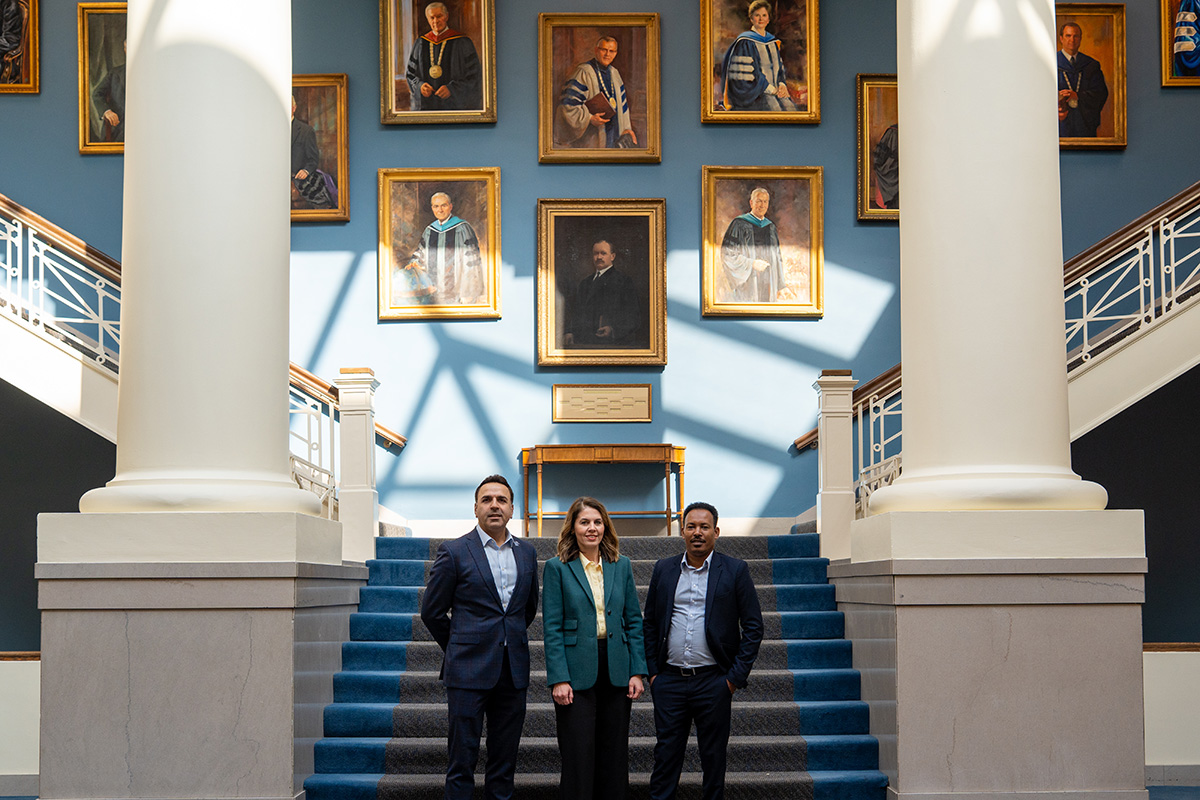
(L-R) Dr. Rouzbeh Nazari, Chair of the Department of Civil, Construction, and Environmental Engineering; Dr. Maryam Karimi, Director of Research and Associate Professor, School of Public Health; Dr. Fanta Gutema, Assistant Research Professor, SPH
The Office of Communications at The University of Memphis School of Public Health