
Music as Medicine: UofM-Led Network Advances the Science of Music and Pain
NIH-supported AudioAnalgesiA Research Network combines music, medicine, and emerging technology to uncover how music eases pain and help build more personalized, evidence-based approaches to care.

Music can calm, distract, energize, and comfort. For patients experiencing pain, its effects can be even more meaningful. For decades, patients, clinicians and music therapists have observed that music can reduce pain and distress. What scientists are still working to fully understand is why it works — and why certain music-based approaches may work better for some people than others.
At the University of Memphis, Dr. Debra S. Burns, dean of the College of Communication and Fine Arts, is leading a national effort to help answer those questions.
Burns is principal investigator of the AudioAnalgesiA Research Network, a national research network supported by the National Institutes of Health. The project, Music Mechanisms and Technologies Network: Integrative Models to Address Pain Through Music (U24AT012602), is funded by the NIH's National Center for Complementary and Integrative Health (NCCIH) and the National Endowment for the Arts (NEA). The network recently received continued funding for Year 4 of its five-year award.
"Understanding the mechanisms is what moves music from something that helps some people to treatments clinicians can personalize and prescribe with confidence," Burns said. "With growing demand for non-drug approaches to pain, that work has never been more timely."
Using Technology to Understand Music's Effect on Pain
AudioAnalgesiA is part of the NIH Music and Health Consortium, a collection of national research networks examining music-based interventions for pain from complementary perspectives.
While the Music4Pain network develops shared frameworks and research priorities and ENSEMBLE builds clinical partnerships and works to identify biological markers, UofM-led AudioAnalgesiA brings a technology-focused approach to the effort.
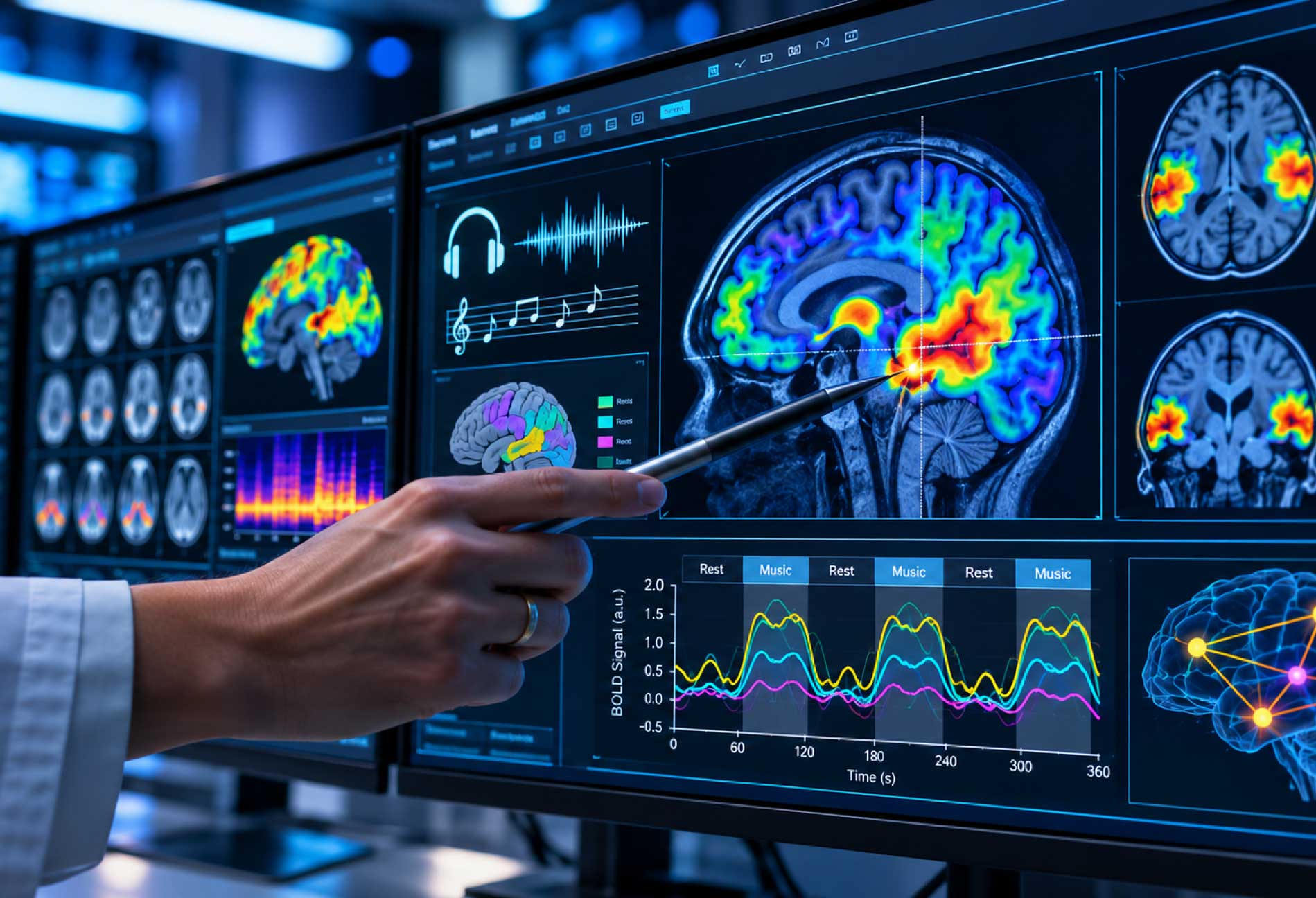
Researchers are using tools including wearable sensors, machine learning, and brain-body imaging to better understand what happens in the brain and body when people engage with music.
The goal is to move beyond simply determining whether music can help alleviate pain. Researchers want to understand the underlying mechanisms — knowledge that could ultimately help clinicians determine which approaches are most likely to benefit individual patients.
Burns also serves as chair of the Music Research Networks Steering Committee, coordinating strategy across the broader consortium.

Building the Science Behind Music-Based Care
The network's work is already helping establish a stronger scientific foundation for the field.
Burns was lead author of a December 2025 paper in Leonardo describing the consortium's collaborative research model. She also co-authored a 2026 review in Pain Reports examining 57 studies investigating how music relieves pain.
Researchers found evidence that several factors may contribute to music's pain-relieving effects, including positive emotions, a greater sense of control and the synchronization of movement with rhythm. The findings also suggest that music can influence both the early processing of pain signals and the way people ultimately perceive and interpret pain.
Burns also co-authored the new Music-Based Intervention Taxonomy, published in Frontiers in Psychology in 2026. Developed by researchers across the NIH music networks and validated against 200 studies, the taxonomy provides scientists with a common language for describing music-based interventions. That consistency can make it easier to compare findings across studies and build a stronger body of evidence.
Additional research is underway, including an analysis mapping more than 640 publications in the field and a study identifying research gaps and future opportunities for computational approaches to music, pain and dementia.
Investing in the Next Generation of Research
AudioAnalgesiA is also helping researchers test promising ideas that could develop into larger NIH-funded studies.
At Indiana University Indianapolis, Dr. Stephen L. Boehm II is working with Dr. Mark P. Jensen of the University of Washington to develop the first mouse model of a music-based intervention for pain. The model could give scientists a new way to investigate music's pain-relieving effects at the biological level.
At the Yale School of Nursing, Dr. Weizi Wu is leading another pilot study examining a music-based intervention for adults with irritable bowel syndrome, a common condition that can cause significant pain.
Participants practice at home using a study app while researchers monitor pain and other symptoms. The team is also examining brain activity using a wearable headband, monitoring heart rhythm and other physiological signals, testing pain sensitivity and analyzing the gut microbiome. Together, those measurements could help researchers identify biological pathways through which music may influence IBS-related pain.
Bringing New Disciplines into the Conversation
The network is also creating opportunities for students and researchers outside traditional music and health disciplines to contribute.
AudioAnalgesiA is launching a national student Data Analysis Challenge, offering up to $15,000 in prizes. Interdisciplinary teams from engineering, computer science, data science and music technology will work with real music-and-pain datasets to develop new analytical tools and approaches.
At UofM, the network is similarly creating connections across disciplines, bringing together expertise in music therapy and the arts with nursing, engineering, and computer science. Those relationships are generating new collaborations and research proposals while demonstrating how complex health challenges can benefit from perspectives that cross traditional academic boundaries.
As AudioAnalgesiA enters the final two years of its current award, the network plans to expand its publications, open-data resources, and research collaborations.
The long-term goal is ambitious but practical: to build the scientific evidence needed to make music-based pain care more accessible, personalized, and grounded in evidence — and to better understand how something as familiar as music could become an increasingly powerful tool for improving human health.
For more information on this initiative, contact Burns at dsburns@memphis.edu. Learn more at audioanalgesia.org.
Bradt, J., Hirsh, A., Jensen, M. P., Desbarats, E., Burns, D. S., Dusek, J. A., Garland,
E. L., Georgescu, R. D., Gumert, L., Hanson, K., Khawsar, J., Smit, T., & Roy, M.
(2026). A scoping review of music-based pain treatment mechanism research. Pain Reports, 11(4), e1467. https://doi.org/10.1097/PR9.0000000000001467
Robb, S. L., Harman, E., Burns, D. S., Dusek, J. A., Johnson, J. K., Rodgers-Melnick, S. N., Chémali, K. R., Schlesinger, J. J., Ramirez, M., Gumert, L., Biedka, S., Khawsar, J., Kiley, M., Loewy, J., & Bradt, J. (2026). A taxonomic framework of music-based intervention components to guide research: Recommendations from the NIH U24 music research networks. Frontiers in Psychology, 17, 1876240. https://doi.org/10.3389/fpsyg.2026.1876240
Burns, D. S., Bradt, J., & Dusek, J. A. (2025). A collaborative approach in mechanistic music-based intervention and pain research: NCCIH research networks. Leonardo, 58(6), 618–622. https://doi.org/10.1162/leon.a.2555