
NASA Award Supports UofM Research into Next-Generation Spacecraft Docking
Origami-inspired materials research could lead to lighter, more adaptable docking systems for small spacecraft while providing a UofM doctoral student with opportunities to collaborate directly with NASA researchers.
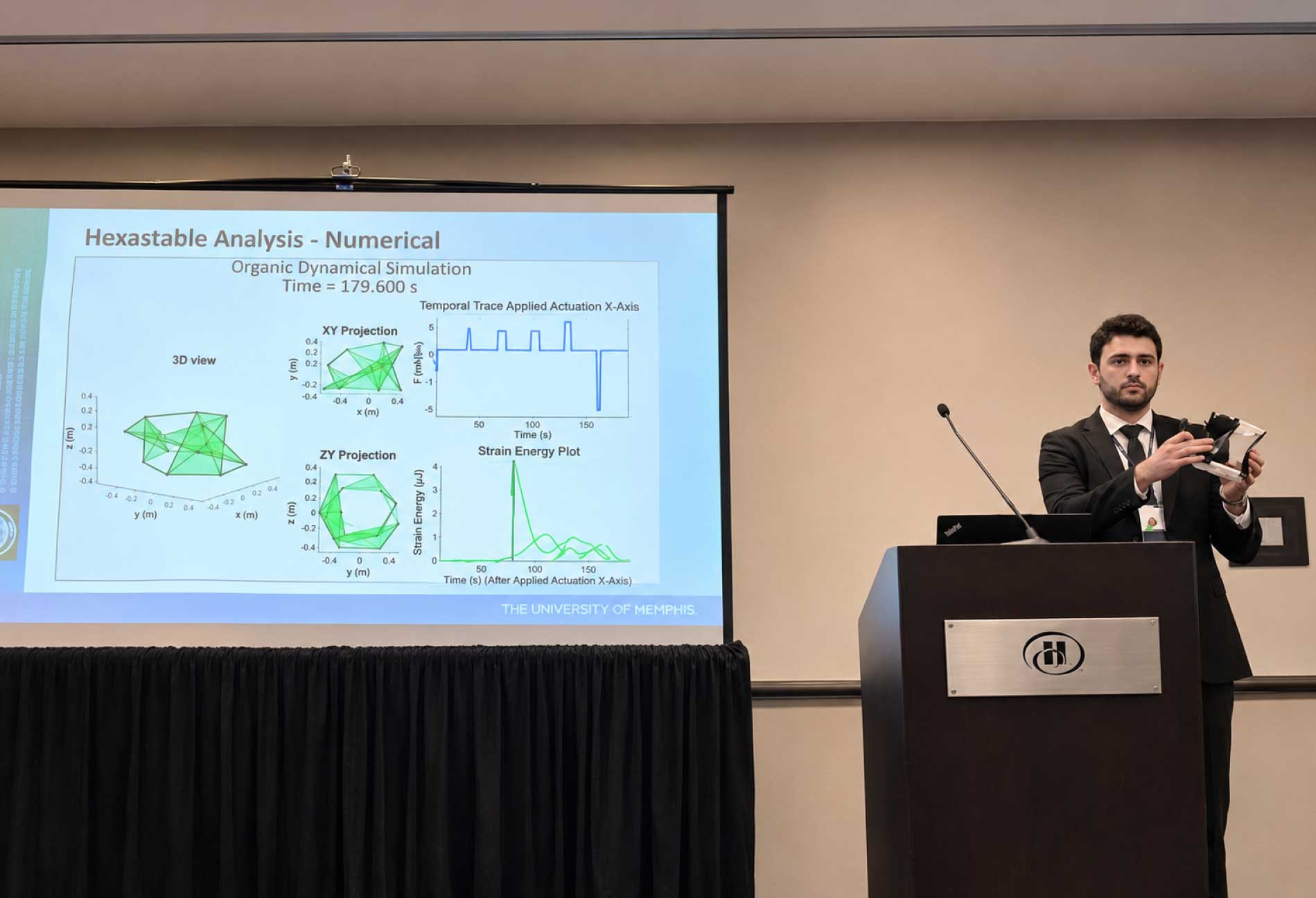
A recent award from the National Aeronautics and Space Administration (NASA) through its Space Technology Graduate Research Opportunities (NSTGRO) program will support the project, “Polycatenated Architected Materials (PAM) for Origami-Inspired Space Docking Ports.” The research will investigate a compact, lightweight docking interface designed to help small spacecraft connect while accommodating the constraints associated with space, mass, and power.
The NASA award supports mechanical engineering Ph.D. student Omar Haitham Alyousef, who is conducting the research in the University of Memphis Dynamics, Controls, and Computing Lab. Through NASA visiting technologist experiences, Alyousef will also have opportunities to work with agency researchers and connect his doctoral research directly with NASA's space technology needs. Dr. Vipin Kumar Agarwal is serving as the principal investigator.
Combining Origami and Advanced Materials
The project brings together two unusual concepts: origami-inspired engineering and polycatenated architected materials, or PAMs. PAMs are networks of interlocking elements that can be thought of as a form of three-dimensional chainmail. Individual components can be made from rigid materials, but their interconnected design allows the overall structure to move and deform as the elements shift in relation to one another. That flexibility could be particularly useful during spacecraft docking.
When two spacecraft attempt to connect, their alignment may not be perfect, and the docking mechanism must manage the forces generated when they make contact. The UofM team is investigating whether combining PAMs with origami-inspired geometry can create an interface capable of accommodating misalignment, absorbing contact energy and ultimately forming a strong, secure mechanical connection.
The approach could potentially achieve flexibility through the structure's geometry and movement rather than relying solely on soft materials, additional actuators or thin creases that must repeatedly bend.
Designing Structures That Work Smarter
The NASA project builds upon a broader area of research at UofM examining how the physical structure of a system can help it adapt, respond, and perform useful functions.
Researchers in the Dynamics, Controls, and Computing Lab combine nonlinear dynamics, control, and data-driven modeling to study systems capable of changing shape, switching between stable configurations or even using physical responses to process information. The work spans areas including origami-inspired structures, soft robotics, and mechanical computing.
At the center of that research is a deceptively simple question: Can geometry and motion be designed to perform tasks that would otherwise require more hardware or more complex control systems?
For spacecraft, where every addition can affect weight, power consumption, and mission complexity, finding ways for the structure itself to provide useful capabilities could have significant advantages.
From Computer Models to Physical Prototypes
The UofM team will use mathematical modeling, computational simulation, additive manufacturing, and laboratory testing to understand how the proposed docking interface behaves during contact and capture.
Ultimately, the researchers hope to establish design principles for docking mechanisms particularly suited to small spacecraft.
Reliable, lightweight docking capabilities could contribute to future missions involving spacecraft servicing, modular assembly and groups of smaller vehicles connecting to create larger systems.
The potential impact also extends beyond spacecraft docking. By developing a better understanding of interconnected structures that remain flexible during movement but become strong and stable when needed, the research could inform the design of other adaptable mechanical systems.
Through the NSTGRO award, the project also connects graduate education directly with NASA's future technology needs—giving a UofM doctoral researcher the opportunity to advance fundamental engineering knowledge while exploring solutions to challenges that could shape the next generation of space exploration.
For more information on this award, contact Agarwal at vkgarwal@memphis.edu.