
When the Ground Starts Moving, What Makes an Earthquake Stop?
New UofM research examines how earthquake ruptures come to an end—and what that could reveal about the forces that control earthquake magnitude
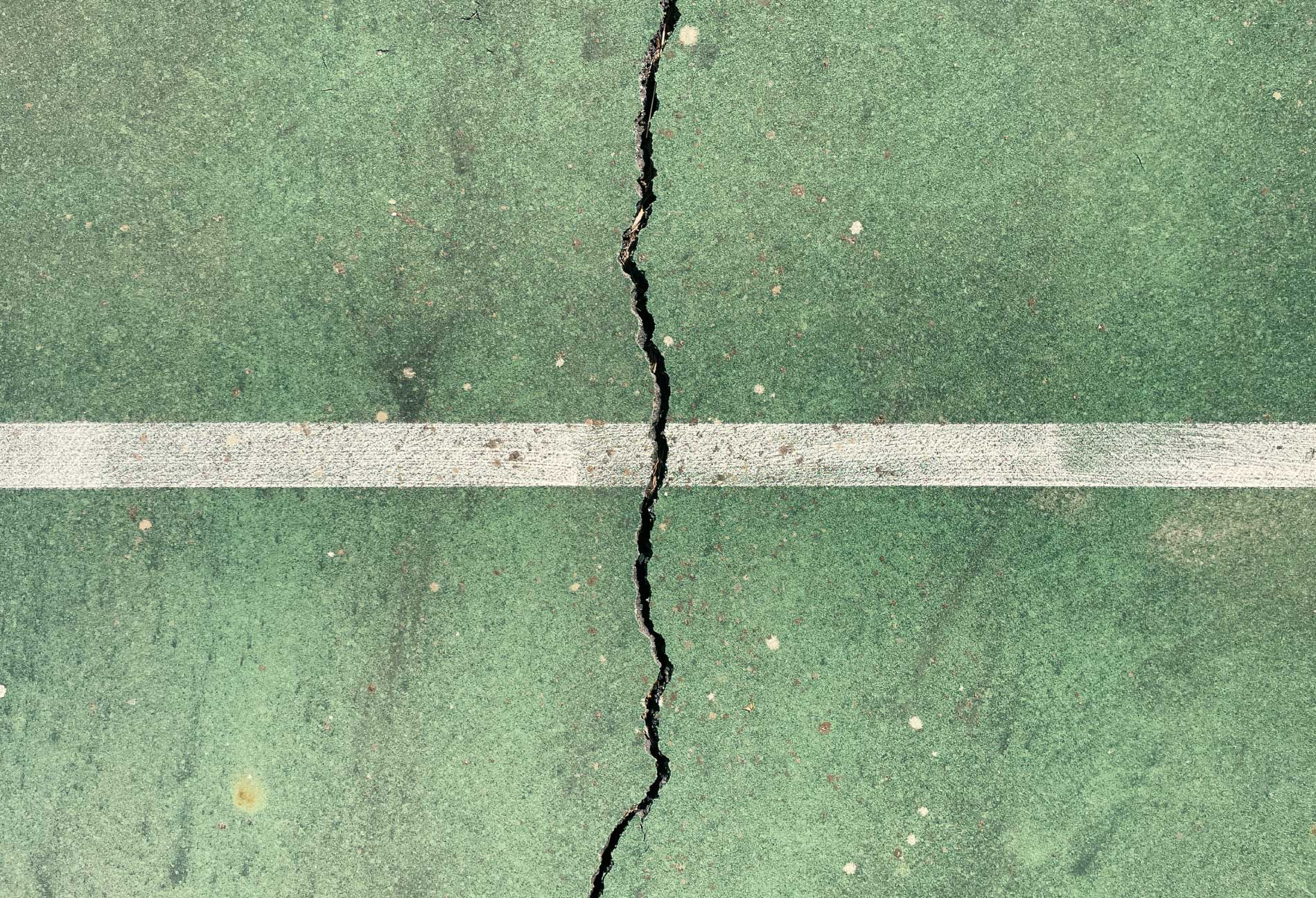
Scientists have spent decades trying to answer one of the most difficult questions in earthquake research: How do earthquakes begin? But there is another question that could be just as important: What makes them stop?
That question is at the center of a new U.S. Army Research Office (ARO)-funded research project at the University of Memphis. Through laboratory experiments, advanced imaging and numerical modeling, researchers will investigate the physical processes that cause an earthquake rupture to slow down and eventually stop.
The work has implications far beyond the laboratory. Understanding what controls where an earthquake ends could ultimately help scientists better understand what determines how large an earthquake can become in a particular area.
For Memphis, the question carries particular relevance. The region is located near the New Madrid Seismic Zone, one of the most significant areas of seismic activity in the central United States. Similar questions are important around the world, including along active fault systems such as the San Sebastian fault in northern Venezuela.
Looking at the Other End of an Earthquake
Much of earthquake science has understandably focused on nucleation—the processes that cause an earthquake to begin—and on identifying possible signals that occur before a rupture. The motivation is clear: a better understanding of how earthquakes start could improve scientists' ability to assess seismic hazards and, potentially, advance methods for anticipating earthquake behavior.
Far less attention has been devoted to what happens at the other end of the process. An earthquake occurs when accumulated stress causes sections of a fault to suddenly slip, releasing stored energy. Once that rupture begins, it can propagate along the fault. But it does not continue indefinitely. At some point, something causes the rupture to stop. Determining what controls that stopping point—or rupture arrest—could provide important clues about why some earthquakes remain relatively small while others grow much larger.
Recreating Fault Behavior in the Laboratory
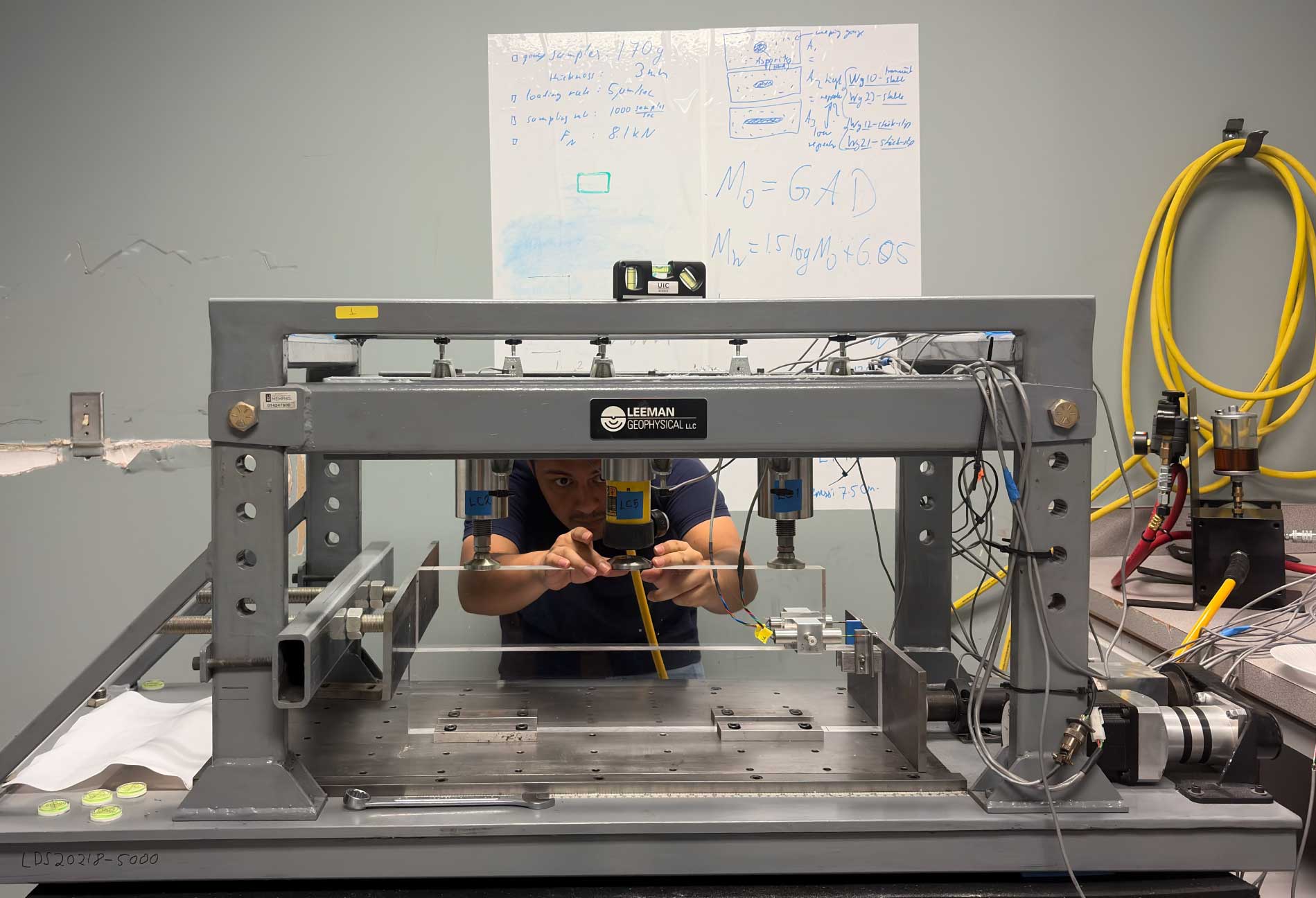
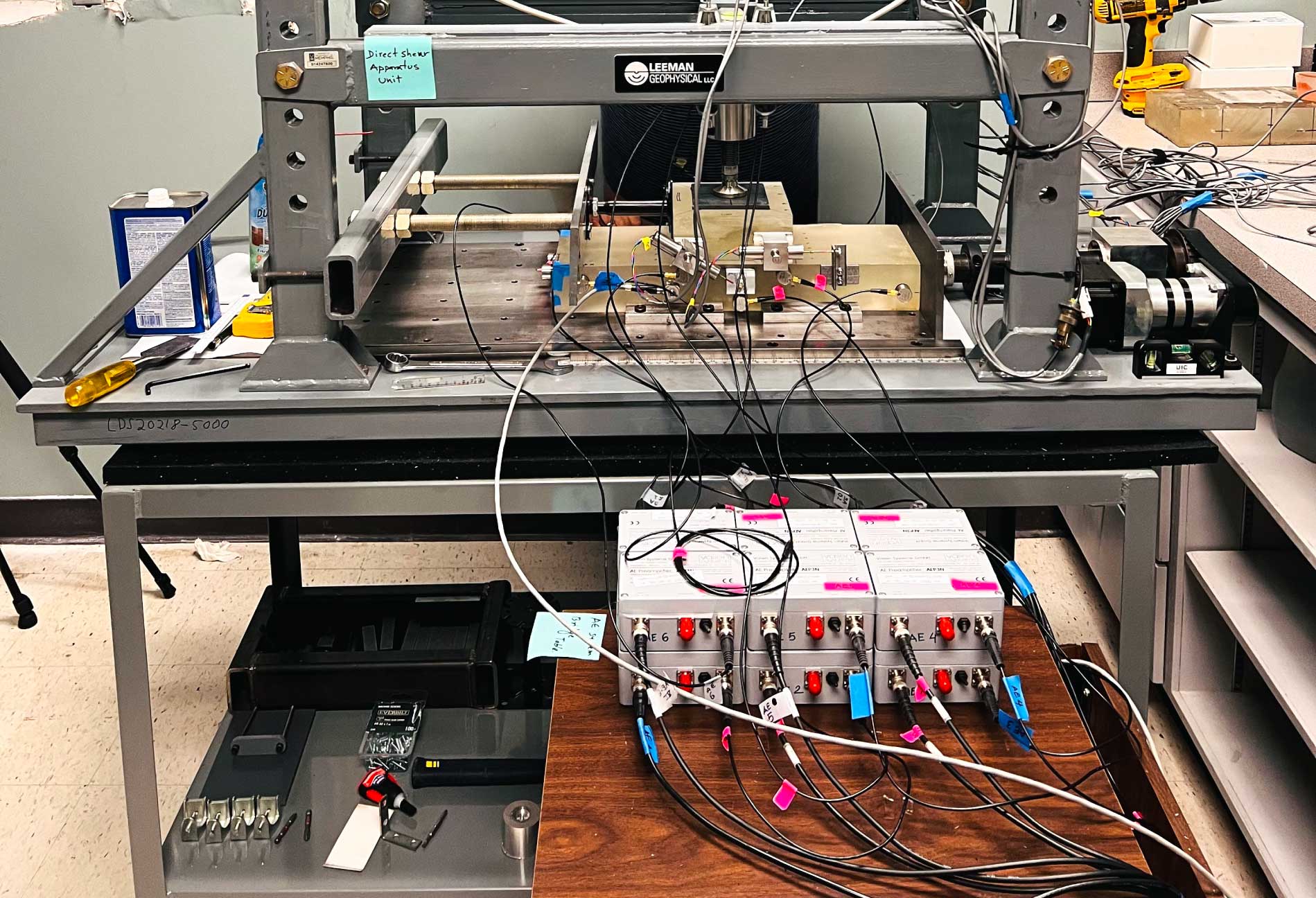
To investigate that process, UofM researchers will conduct controlled experiments at the University's Center for Earthquake Research and Information (CERI). Together with his PostDoc Roshan Koirala, and PhD student Diego Figueroa, Assoc. Prof. Goebel and his team at CERI will investigate dynamic ruptures along rough, frictional surfaces containing natural fault gouge—the crushed and ground rock material found within faults. Using a direct shear apparatus, researchers can apply forces to these materials and observe how surfaces slip against one another, creating laboratory-scale events that share important characteristics with earthquakes in nature. Advanced optical and seismic imaging will allow the researchers to examine the process across multiple scales, while numerical models will provide another way to investigate the forces and conditions that influence whether a rupture continues or stops.
These laboratory events offer researchers something that earthquakes occurring miles beneath the Earth's surface cannot: the opportunity to closely observe and measure the physical processes taking place as a rupture develops and arrests.
From Small-Scale Experiments to Real Faults
Understanding rupture arrest could have several important applications.
At the smallest scale, researchers want to better understand the microscopic mechanical processes occurring as a rupture stops. That knowledge could improve models of friction and help explain how irregularities along a surface affect its resistance to sliding—information relevant to both natural faults and engineered materials.
At a larger scale, laboratory ruptures can help researchers study how stress is transferred through a fault system as movement occurs. When one portion of a fault slips, the resulting changes in stress can influence surrounding areas.
Ultimately, however, one of the most significant questions is earthquake magnitude. How large an earthquake becomes is closely connected to the physical properties of the fault, its resistance to movement and how far a rupture is able to travel before it stops. A better understanding of those factors could improve scientists' ability to evaluate how faults may behave under different conditions.
The long-term goal of the research is to take what scientists learn from laboratory experiments and numerical simulations and apply those insights to natural fault systems. Researchers hope that work can eventually help identify locations along tectonic faults where earthquake ruptures may be more likely to stop.
Earthquakes will remain extraordinarily complex natural events, and no laboratory experiment can reproduce every condition present deep underground. But by examining a part of the earthquake process that has received comparatively less attention, UofM researchers are approaching seismic hazards from a different direction. Instead of asking only what causes the ground to start moving, they are also asking what an equally consequential question may be: Once an earthquake begins, what determines where it ends?
For more information on this award and research, contact Goebel at thgoebel@memphis.edu.