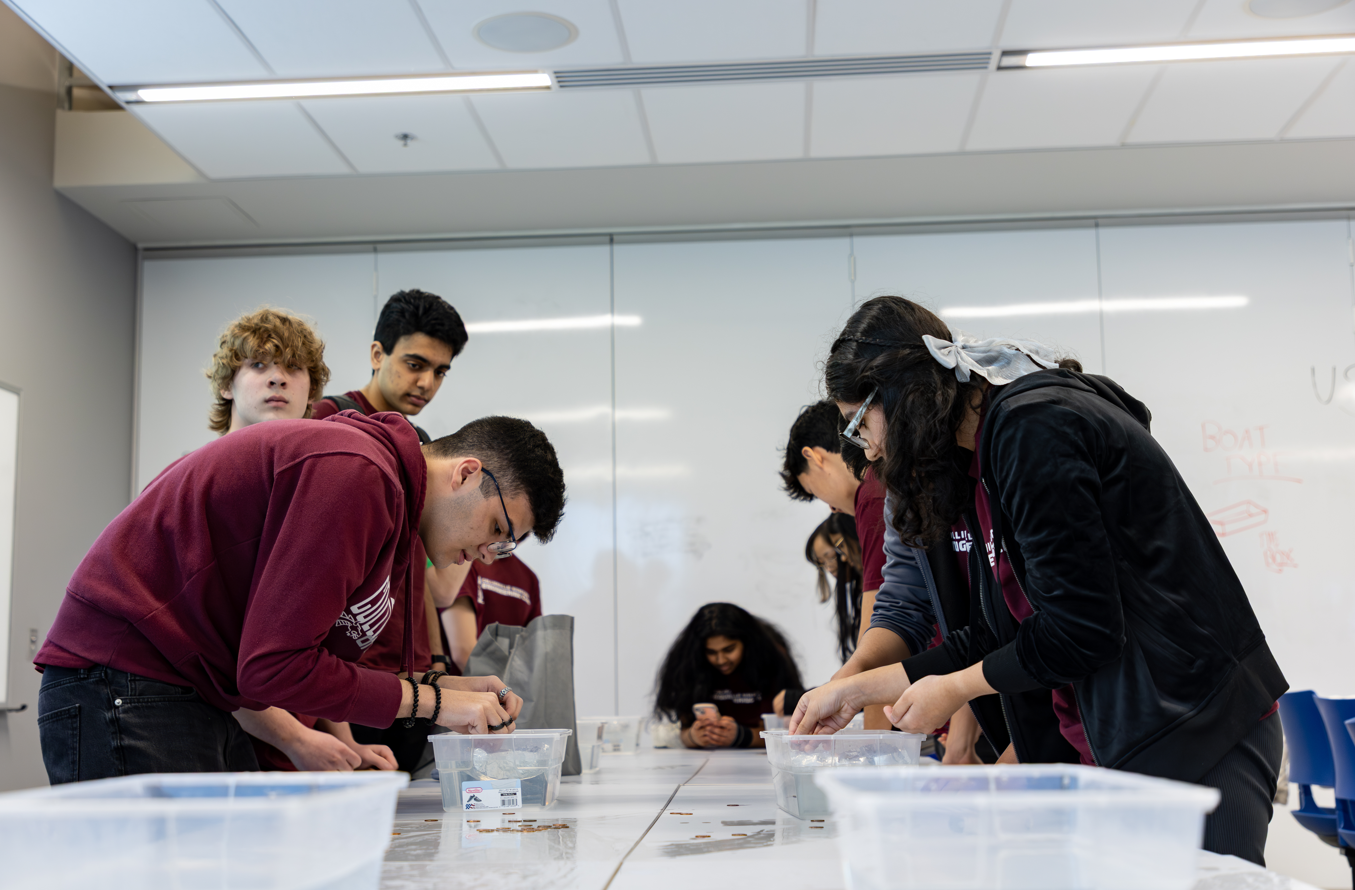
Penny Boat Challenge
Can you build a boat that holds the most cargo? In the Penny Boat Competition, students will design and construct a floating boat using only a single sheet of aluminum foil. The goal is to create a design that can support as many pennies as possible before sinking. Success requires creativity, testing, and an understanding of buoyancy and weight distribution.
Competition Overview
- Grade Levels: 3-8
- Team Size: 1-3 students
- Competition Setting: Classroom or laboratory water-testing station
- Materials Provided: Aluminum foil, pennies, and testing tub
- Skill Focus: Engineering design, problem solving, teamwork, creativity, and iterative testing
The Challenge
Using a single square of aluminum foil, competitors must design and build a boat capable of holding the greatest number of pennies without sinking. Teams are encouraged to brainstorm and sketch ideas before construction begins. The most successful designs will maximize flotation, stability, and weight distribution.
Design Requirements
- Each team receives one 12-inch × 12-inch square of aluminum foil.
- Only the provided foil may be used to construct the boat.
- Boats must be made from a single foil square.
- Additional materials, adhesives, or reinforcements are not permitted.
- Foil may be folded, bent, or reshaped as desired but may not be replaced if damaged during construction.
- The boat must float independently in the testing tub.
- The boat must remain intact throughout the testing process
Materials Provided
Each team will receive:
- One 12-inch × 12-inch square of aluminum foil
- Pennies for testing
- Access to a water-testing tub
Teams may also use sketches or design plans during the brainstorming process.
Competition Procedure
Design & Build Phase
- Teams will have 5 minutes to design and construct their boat.
- Teams may fold, shape, and modify the foil as desired during the build period.
- At the conclusion of the 5-minute build period, all construction must stop.
- Once submitted for testing, no modifications may be made to the boat.
Testing Phase
- The boat is placed in a tub of water.
- Pennies are added one at a time.
- After each penny is added, the boat must remain afloat for at least five seconds.
- If successful, the penny is counted toward the team's score.
- Additional pennies are added until the boat sinks.
Failure Conditions
A boat is considered sunk if:
- Water enters the boat.
- The boat touches the bottom of the testing tub.
When a boat sinks:
- The final penny added does not count toward the score.
- Testing immediately ends.
Scoring Formula
Score = Total Number of Successfully Supported Pennies
A penny is counted only if the boat remains afloat for at least five seconds after it is added.
Winning Criteria
-
The team whose boat successfully supports the greatest number of pennies before sinking will be declared the winner. Because every additional penny matters, successful teams must balance capacity, stability, and flotation efficiency.
ISTE & STEM Connections
- Innovative Designer
- Develop and test multiple boat designs to improve performance.
- Use creativity and experimentation to solve an engineering challenge.
- Computational Thinker
- Analyze how boat shape affects weight distribution and carrying capacity.
- Evaluate results and make evidence-based design improvements.
- Creative Communicator
- Share design ideas and explain why specific boat features were chosen.
- Communicate testing results and observations.
- Global Collaborator
- Work effectively with teammates to brainstorm, build, and test designs.
- Share responsibilities and contribute toward a common goal.