
Faculty Spotlight - Dr. Parul Yadav
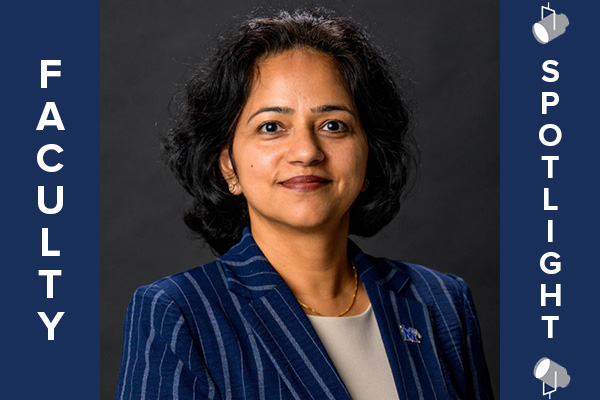
Q&A with Parul Yadav, PhD
Associate Professor
What brought you to the UofM School of Public Health?
I was drawn to the University of Memphis School of Public Health because of its strong
focus on improving health and well-being through interdisciplinary research, education,
and community engagement. My background is in computer science and engineering, but
my research has increasingly focused on applying artificial intelligence and data-driven
methods to meaningful problems in healthcare and public health.
The University of Memphis provides an exciting environment to bring together artificial
intelligence, health informatics, public health, and data science. Memphis also offers
an especially meaningful setting for this work because of the diverse health needs
of the community and the opportunity to develop research that can have a direct population-health
impact.
I was particularly attracted by the opportunity to build collaborative research at
the intersection of AI, health informatics, privacy, equity, and accessible healthcare
while mentoring the next generation of researchers.
What is your interest research and focus?
My research focuses on developing trustworthy, privacy-preserving, and inclusive artificial
intelligence for healthcare and public health.
I am particularly interested in how we can use AI when health data are distributed
across institutions, heterogeneous, sensitive, or difficult to share. My work brings
together several areas, including:
- Federated learning and decentralized healthcare AI
- Generative AI and large language models for health applications
- Synthetic health data
- Differential privacy and privacy-preserving machine learning
- Machine unlearning and responsible AI
- Health data analytics and clinical decision support
- Fairness, disparity, and robustness of AI across populations and institutions
- Accessible and inclusive AI, including AI-enabled sign-language technologies
A central question that motivates my work is: How can we make AI useful for healthcare
and public health without requiring organizations to compromise patient privacy, data
governance, equity, or trust?
What inspired you to pursue this particular area of research?
My research journey began in computer science and artificial intelligence, but over
time I became increasingly interested in the gap between what AI can technically accomplish
and what is actually appropriate and useful in real-world healthcare settings.
Healthcare data are among the most sensitive forms of information, yet they are also
highly valuable for developing better predictive models and decision-support systems.
Many organizations cannot simply combine their data because of privacy, regulatory,
ethical, institutional, and governance considerations. At the same time, differences
in patient populations, data quality, missingness, and clinical practices can cause
AI systems to perform differently across sites and populations.
These challenges inspired me to focus not only on developing accurate AI models, but
also on understanding privacy, utility, equity, robustness, and responsible deployment
together.
My work in accessible AI has also reinforced the importance of designing technology
around the people and communities it is intended to serve. This motivates my interest
in AI that can improve communication and access to healthcare for populations that
are often underserved by conventional technologies.
What is the most exciting project you are currently working on or planning to pursue?
I’m especially excited about my current research on the utilization of generative
AI in healthcare and public health. For example, one project asks whether large language
models can help reduce food insecurity. More broadly, I want to understand where AI
can improve access to information and decision support, where it may introduce new
risks or inequities, and how its value should be measured.
How does your research interest impact or benefit the broader community or public
health field? How do you envision your research evolving in the next few years?
The public-health value of my research lies in making advanced AI more usable, trustworthy,
equitable, and accessible in real-world health settings.
Many promising AI systems cannot be readily deployed because data cannot be centralized,
privacy requirements limit data sharing, or models do not perform consistently across
different populations and institutions. Privacy-preserving and federated approaches
can help organizations collaborate while maintaining stronger protections around sensitive
information.
Over the next several years, I envision expanding this work in three interconnected
directions.
First, I want to develop rigorous methods for privacy-preserving collaborative health
AI, particularly in settings involving heterogeneous and sensitive data.
Second, I want to investigate trustworthy and equitable generative AI and multimodal
AI for healthcare and public health, with attention to privacy, reliability, bias,
and responsible use.
Third, I want to develop inclusive AI technologies, including systems that can improve
communication and healthcare accessibility for people with communication barriers,
including sign-language users.
Ultimately, I hope to build interdisciplinary collaborations across public health,
health informatics, computer science, engineering, clinical and community partners,
and data science to translate these methods into solutions that can benefit Memphis
and communities beyond Memphis.
What is the coolest training or program you've been a part of, or your favorite conference
you've attended?
One of my favorite recent conference experiences was the 59th Hawaii International
Conference on System Sciences (HICSS-59) in Hawaii in January 2026. I presented my
work, “FedSDMU: A New Paradigm for Healthcare Data Privacy Compliance using Federated
Synthesis, Differential Privacy, and Machine Unlearning,” which brings together several
of my research interests in privacy-preserving AI, synthetic data, federated learning,
and machine unlearning.
The experience was especially meaningful because it connected my earlier work in synthetic
data generation with my emerging research focus in healthcare AI and privacy. I have
worked on synthetic data for both tabular data and multivariate time-series data,
including rigorous evaluation of data generated using TVAE and CTGAN and qualitative
and quantitative evaluation of multivariate time-series data generated using MTS-TGAN.
Presenting at HICSS also provided an opportunity to engage with researchers from different
disciplines and think about how these computational methods can be translated into
practical solutions for sensitive healthcare data.
What is your favorite self-authored manuscript?
Several of my publications are particularly meaningful because together they represent
the evolution of my research in synthetic data and privacy-preserving AI.
One of my recent favorites is “FedSDMU: A New Paradigm for Healthcare Data Privacy
Compliance using Federated Synthesis, Differential Privacy, and Machine Unlearning,”
presented at HICSS-59 in 2026. This work brings together federated learning, synthetic
data, differential privacy, and machine unlearning to address the challenge of using
sensitive healthcare data while maintaining privacy and data governance.
Two earlier publications provided an important foundation for this research direction.
My 2024 paper, “Rigorous Experimental Analysis of Tabular Data Generated using TVAE
and CTGAN,” examines the generation and evaluation of synthetic tabular data. My 2023
Applied Sciences paper, “Qualitative and Quantitative Evaluation of Multivariate Time-Series
Synthetic Data Generated Using MTS-TGAN: A Novel Approach,” extends this work to multivariate
time-series data and examines both qualitative and quantitative evaluation of synthetic
data.
I value these papers because they show the progression of my research from generating
and rigorously evaluating synthetic data to developing privacy-preserving AI frameworks
for healthcare. This trajectory now forms an important foundation for my research
program at the University of Memphis, where I am interested in developing trustworthy,
privacy-preserving, and equitable AI for health and public health.
What kind of research would you like to do that you haven't yet had the opportunity
to do?
I would like to develop and evaluate a real-world, multi-institutional privacy-preserving
health AI ecosystem involving healthcare organizations and public-health partners.
I am particularly interested in moving beyond proof-of-concept models toward longitudinal,
real-world studies that examine how federated learning, synthetic data, differential
privacy, machine unlearning, and generative AI perform under realistic healthcare
conditions.
I would also like to bring together these technologies with accessible AI—for example,
developing multimodal systems that can support healthcare communication across spoken
language, text, and sign language.
The long-term vision is to create AI systems that are not only accurate, but also
private, equitable, explainable, adaptable, and accessible.
Are there any publications, awards, or recognitions you would like us to include in
the spotlight?
Research and scholarly work
- 28+ peer-reviewed research publications in artificial intelligence, machine learning, health informatics, healthcare analytics, privacy-preserving AI, and related areas.
- Research contributions spanning federated learning, synthetic data, generative AI, privacy-preserving machine learning, and accessible/sign-language AI
- Patent pending with the U.S. Patent and Trademark Office: “Smart Tool for Realistic Communication between Sign Languages and Natural Languages,” filed January 2025.
- Principal Investigator on a Department of Science and Technology, Government of India-
funded research project
Selected recognition - Women in Research Excellence – Global Woman of Science Award, ElevateX Awards and International Conference on Artificial Intelligence and Networking, Dubai, 2025.
- International Educator of the Year Award, Fusion Awards and International Conference on Data-Processing and Networking, Czech Republic, 2025.
- Research Grant and Travel Grant recipient
- Service Award for academic leadership as Associate Dean, 2022
- Keynote speaker at ICICC-2026 and invited speaker at the University of Delaware AI4Health Industry Day 2026.