
MaX Lab Brings New Human-Centered Research Capabilities to UofM Faculty
New multimodal tools help researchers capture attention, engagement and human response to digital technologies and AI.

How do people experience the technology we put in front of them? Where do they focus
their attention? When do they hesitate, become engaged or encounter friction? And
how can researchers capture those responses beyond what participants report in a survey
or interview?
The new Multimodal AI eXperience (MaX) Lab at the FedEx Institute of Technology gives University of Memphis faculty new tools to explore those questions through
human-centered, evidence-driven research. Open to academic and industry partners,
MaX Lab supports researchers who want to better understand how people attend to, interact
with, and respond to digital technologies, AI systems, learning environments, and
other technology-enabled experiences. The lab combines traditional research approaches
with multimodal methods that capture what happens during an experience itself.
For faculty, that creates opportunities to add new dimensions to existing research, build pilot data for future proposals, develop collaborative studies, or explore methods that may not otherwise be available within their own departments.
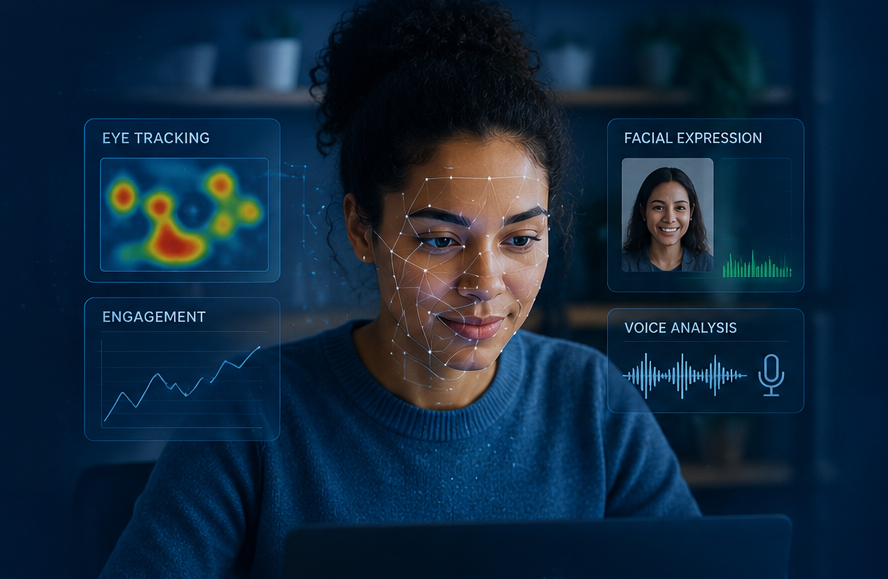
Surveys and interviews remain valuable tools for understanding participant experiences, but self-reported information can tell only part of the story. MaX Lab can complement those approaches with methods including eye tracking, facial expression analysis and voice affect analysis, alongside behavioral data, experiments, surveys and interviews. Eye tracking can help researchers understand what participants notice, overlook, revisit, or spend time processing. Facial expression and voice-based measures can provide additional information about affective responses and engagement as an interaction unfolds. Together, these methods can give researchers a more complete view of the human experience.
MaX Lab is designed to support research across disciplines rather than focus on a single type of technology or research question. Faculty can bring websites, mobile applications, software, digital platforms, AI systems, learning and training technologies, prototypes, multimedia content, and other digital experiences for evaluation.
A study might examine where users struggle with an interface, what information attracts their attention, how participants respond to a digital experience or whether one version of a design performs differently from another. The lab can also support prototype and feature comparisons, usability, and user experience studies, learning technology evaluation and independent assessment of digital products and platforms. Research does not have to take place entirely inside the lab. MaX supports in-lab, remote and hybrid research approaches, opening opportunities for studies involving participants across different locations and potentially broader participant populations.
That flexibility also makes MaX a potential resource at different stages of the research process. A faculty member might use the lab to test an early concept, strengthen a proposal with preliminary data, add multimodal measures to an existing study, or collaborate on a larger research project.
Faculty do not need to arrive with a fully developed MaX Lab study in mind. The starting point can be much simpler: What do you want to understand about the way people experience your technology, content, or digital environment? From there, MaX Lab can help explore which methods may provide the evidence needed to investigate that question.
Faculty interested in collaborative studies, grant partnerships, pilot projects or incorporating multimodal methods into their research are encouraged to start a conversation with the MaX Lab team.
Have something you want to test or study? Contact Dr. Jeya Amantha Kumar, MaX Lab Director, at jdvdpndy@memphis.edu to discuss a project.