K'NEX Transportation Challenge
Put your engineering, strategy, and logistics skills to the test in the K’NEX Transportation Challenge! Teams will design a K'NEX delivery vehicle capable of transporting loose penny packages from a warehouse to three destination cities. Successful designs will securely carry multiple pennies while maximizing delivery profits and minimizing operational costs.
Competition Overview:
- Grade Levels: 3-8
- Team Size: 1-4 students
- Build Time Limit: 15 minutes
- Delivery Mission Time: 4 minutes
- Competition Setting: Indoor floor-based transportation challenge
- For this competition, all competition entries must be completed before arrival at Engineering Day. Teams should arrive with their entry fully assembled and ready for inspection and competition.
- Skill Focus: Engineering design, transportation systems, logistics, teamwork, strategic planning, and problem solving
The Challenge:
Teams will design a K'NEX delivery vehicle capable of transporting packages from a warehouse to three destination cities. The goal is to maximize profit by successfully delivering packages while minimizing operational costs such as refueling and repairs. Teams must also assemble their vehicle quickly on competition day, as build time contributes to the final score. *Note: The K’NEX vehicle will need to be assembled prior to the day of the competition
Materials Provided:
Competition organizers will provide:
- Delivery zone
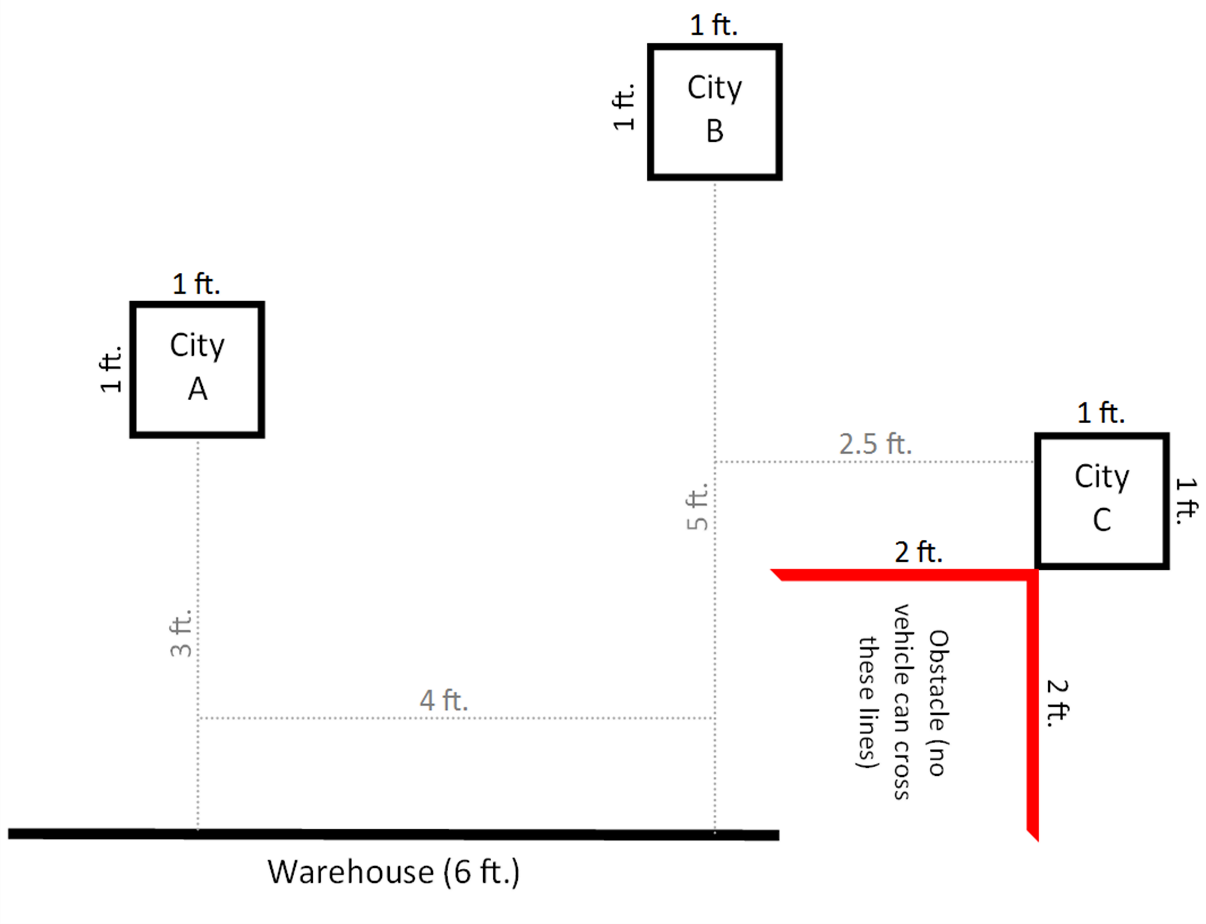
- Warehouse and city locations
- Obstacle course markings
- Judges and timers
- Pennies for deliveries
Teams are responsible for bringing:
- Their K'NEX vehicle components
- Approved package container
- Any sketches or illustrations used during assembly
Competition Procedure:
Build Phase
- Teams begin with all vehicle parts unassembled.
- All team members may participate in construction.
- Teams may use drawings or illustrations created by team members.
- Photographs or outside instructions are not permitted.
- Build time is officially recorded by assigned judges.
- The maximum build time recorded is 15 minutes.
Vehicle Completion
Once a team declares its vehicle complete:
- No modifications may be made.
- Any unauthorized adjustments during the delivery phase will result in repair penalties.
Delivery Mission
After the build phase, teams begin a 4-minute delivery mission.
Objective
Deliver as many packages as possible from the warehouse to:
- City A
- City B
- City C
Teams may choose:
- Which cities to visit
- How many packages to transport
- The order of deliveries
Delivery Rules
- All delivery runs begin at the warehouse.
- Packages may only be picked up at the warehouse.
- Packages may be dropped off once the vehicle touches or crosses a city boundary.
- Teams may return to the warehouse for additional packages throughout the mission.
- Teams may not leave and re-enter the same city without first returning to the warehouse.
Vehicle Operation
- Vehicles are powered using a single K'NEX Micro Power Spring Motor.
- Each time the vehicle is rewound and restarted, a refueling charge is assessed.
Penalties
Refueling Cost
A refueling fee is charged whenever:
- The vehicle begins a delivery run.
- The vehicle must be rewound during a delivery mission.
Penalty: $200 per refuel
Repair Cost
A repair fee is charged whenever:
- The vehicle is touched after the build phase.
- Packages fall off the vehicle during operation.
- Unauthorized adjustments are made.
Exceptions include:
- Picking up packages
- Delivering packages
- Refueling operations
Penalty: $500 per repair
Scoring Formula:
The final score is based on:
- Vehicle build time
- Delivery mission profit
Profit Calculation
Profit = (# Packages delivered to City A) *$50 + (# Packages delivered to City B) *$75 + (# Packages delivered to City C) *$150 – (# of refuels)*$200 – (# of repairs)*$500
The formula for computing the total score is as follows:
Total Score = Profit * (shortest build time)/(your build time)
Cities farther from the warehouse provide greater rewards but may require additional planning and vehicle performance to reach efficiently.
Winning Criteria
Teams are ranked according to their final competition score, which combines construction efficiency and delivery mission performance.
The most successful teams will balance:
- Fast assembly
- Reliable vehicle operation
- Efficient package transportation
- Strategic route planning
- Effective fuel and repair management
ISTE & STEM Connections:
- Innovative Designer
- Design and optimize a transportation system to meet specific performance goals.
- Evaluate multiple design approaches and improve solutions through testing.
- Computational Thinker
- Analyze tradeoffs between delivery routes, package value, and operational costs.
- Use data and strategy to maximize overall performance.
- Creative Communicator
- Explain vehicle design choices and delivery strategies.
- Share ideas and collaborate effectively with teammates.
- Global Collaborator
- Work as a team to assemble, operate, and improve transportation systems.
- Coordinate responsibilities during both construction and delivery phases.
Challenge Map