
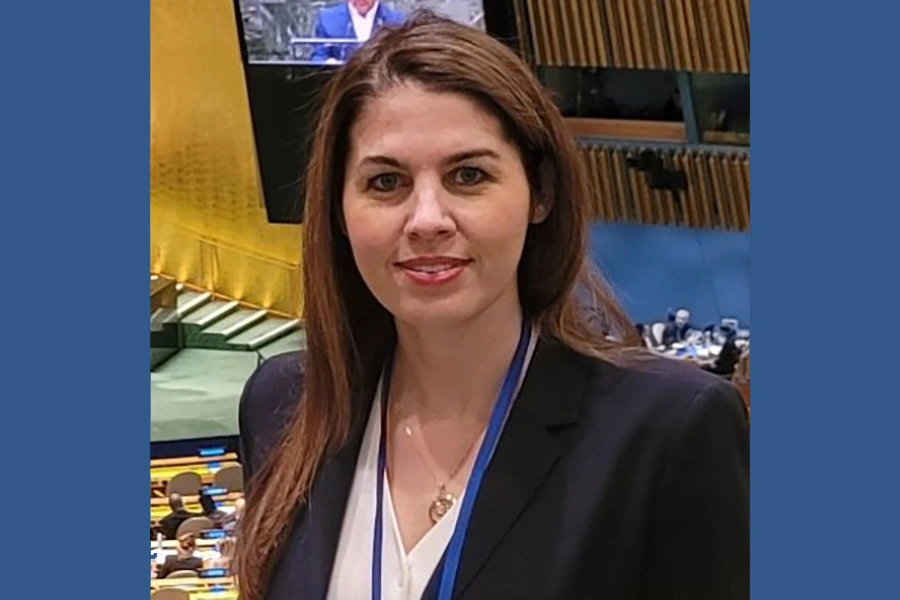
Maryam Karimi, PhD, MPA, MS
Director of Research, Associate Professor
901.678.4685214 Robison Hallmkarimi1@memphis.eduAbout
Dr. Maryam Karimi is the Director of Research and an Associate Professor in the School of Public Health. Before joining the University of Memphis, she served as an Assistant Professor in the Department of Environmental Health Sciences at the University of Alabama at Birmingham (UAB) and held a joint appointment in the School of Civil, Construction, and Environmental Engineering at UAB. Dr. Karimi earned her Ph.D. in Earth and Environmental Science from the City University of New York and completed her postdoctoral fellowship at the Mailman School of Public Health, Columbia University. In addition to her academic roles, Dr. Karimi served as the Associate Director of Public Health and Environmental Sustainability at the Sustainable Smart Cities Research Center within the School of Engineering at UAB. Her research specializes in environmental health within urban environments, leveraging her deep expertise in environmental science, public health, and urban resiliency. Her work has been funded by prestigious organizations, including NIH, EPA, USDA, NSF, NASA, and NOAA.
Education
Dr. Karimi holds a Postdoctoral Fellowship from Columbia University’s Mailman School of Public Health, a PhD and Master’s in Earth and Environmental Science from the Graduate Center of the City University of New York, and a Master’s in Public Administration from Baruch College, City University of New York.
Research Interest
I specialize in Public Health, Urban Resiliency, and the Built Environment, with a focus on creating Resilient Smart Cities. My work addresses challenges such as air quality, Urban Heat Island (UHI) effects, urban flooding, and the impact of urbanization on public health, particularly for at-risk populations with respiratory diseases like COPD and asthma. I also founded CanAiry, a wearable health monitoring device for respiratory patients. Through the integration of sustainable urban redesign, big data, and predictive modeling, my research supports the development of sustainable, resilient cities that prioritize health and better livings in cities.
Selected Publications
- Kaushal, A., Karimi, M., Nazari, R., Opare, K., Museru, M., & Nikoo, M. (2024). Beyond smoke and mirrors: Cross-sectional geospatial analysis of COPD prevalence and other factors in the vicinity of Toxic Release Inventory facilities using fuzzy analytic hierarchy process. Environmental Pollution. https://doi.org/10.1016/j.envpol.2024.124286
- Rabbani, F., Karimi, M., Nazari, R., & Nikoo, M. R. (2024). Modeling surface temperatures in urban settings using coupled Landsat data and NLDAS-based interpolation. Urban Science.
- Museru, M., Giglou, A., Opare, K., Nazari, R., & Karimi, M. (2024). Advancing flood damage modeling for coastal Alabama residential properties: A multivariable machine learning approach. Science of the Total Environment, 907, Article 167872. https://doi.org/10.1016/j.scitotenv.2023.167872
- Sabrin, S., Karimi, M., & Nazari, R. (2023). The cooling potential of various vegetation covers in a heat-stressed underserved community in the Deep South: Birmingham, Alabama. Urban Climate, 51, Article 101623. https://doi.org/10.1016/j.uclim.2023.101623
- Nazari Giglou, A., Jazaei, F., Nazari, R., & Karimi, M. (2023). Assessing the effects of increased impervious surface on the aquifer recharge through river flow network, a case study of Jackson, Tennessee, USA. Science of the Total Environment, 872, Article 162203. https://doi.org/10.1016/j.scitotenv.2023.162203
- Sabrin, S., Karimi, M., & Nazari, R. (2022). Modeling heat island exposure and vulnerability utilizing earth observations and social drivers: A case study for Alabama, USA. Building and Environment, 226, Article 109686. https://doi.org/10.1016/j.buildenv.2022.109686
- Rabbani, F., Zech, W., Nazari, R., & Karimi, M. (2022). Developing a geospatial framework for severe occupational injuries using Moran’s I and Getis-Ord Gi statistics for the Southern United States. Natural Hazards Review, 23(3). https://doi.org/10.1061/(ASCE)NH.1527-6996.0000566
- Karimi, M., Nazari, R., Rabbani, F., & Sabrin, S. (2022). Impact of the built environment on near surface temperatures in complex urban settings. SSRN. https://doi.org/10.2139/ssrn.4181530
- Fifolt, M., Mooney, S., Nabavi, M., Karimi, M., Nassel, A., & McCormick, L. (2022). Examining the built environment for healthy living via virtual street audits. Environmental Health Insights. https://doi.org/10.1177/11786302221104653
- Rabbani, F., Nazari, R., & Karimi, M. (2021). Developing a geospatial framework for coupled large scale thermal comfort and air quality indices using high-resolution gridded meteorological and station based observations. Sustainable Cities and Society. https://doi.org/10.1016/j.scs.2021.103204