Applied Biomechanics (PhD)
Study how the body moves — and build the research career that explains why.
On Ground
Format
72/36
Credit Hours
GRE
Not Required
6
Research Labs
Explore the program
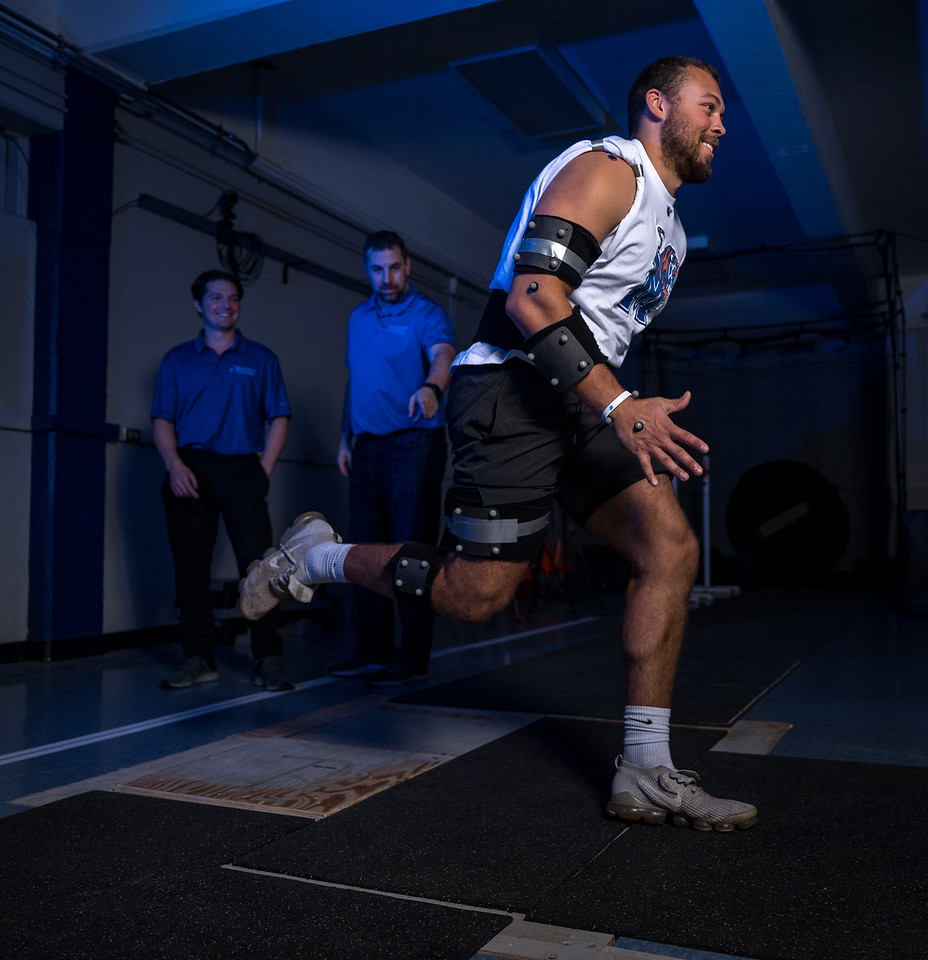
Applied Biomechanics (APBI) is a research-intensive doctoral concentration within the Applied Physiology and Neuromechanics program. You'll examine how body mechanics and structure influence human movement while building the expertise to contribute to a specialized area of biomechanics research.
About the Program
APBI is focused and deliberately research-heavy. The goal is not only that you understand the field, but that you become someone who advances it — a leader and collaborator in at least one research specialty area.
Throughout the program you contribute to research conducted in the laboratories supporting APBI, under the direction of a Full Graduate Faculty Mentor. That mentorship shapes your coursework, your dissertation and your professional network.
Research is at the center of the APBI experience. You work closely with a graduate faculty mentor from your first semester and contribute to active laboratory research throughout the program.
Admission
Applications are reviewed for fall admission. Submit your materials by the priority deadline for the strongest consideration — faculty mentors commit to students early, so applying by the official deadline may limit available placements.
| Priority deadline | May 1 |
|---|---|
| International applicants | April 1 |
| Official deadline | August 10 |
| Entry term | Fall |
Degree Requirements
APBI offers two entry points. If you enter after a bachelor's degree you complete both phases below and earn a master's degree along the way. If you enter with a master's degree you begin at the post-master's phase.
| Entry point | Minimum credit hours | Phases required |
|---|---|---|
| Post-bachelor's | 72 | Post-bachelor's phase, then post-master's phase |
| Post-master's | 36 | Post-master's phase only |
Post-Bachelor's Phase
The first phase for students entering with a bachelor's degree. Completing it awards an MS with a major in Health Studies and a concentration in Exercise, Sport and Movement Sciences.
- A minimum of 36 credit hours, including 8000-level courses when available
- 12 credit hours of designated research and statistics courses
- 12 credit hours of specified ESMS courses
- Six credit hours of electives approved by your doctoral committee
- Six credit hours of applied project or thesis
- Successful written and oral defense of the applied project or thesis
- Successful completion of the oral Master's Comprehensive Exam, taken as part of that defense
- Participation in fall and spring doctoral seminar
- An overall GPA of at least 3.00
Post-Master's Phase
The doctoral phase, completed by all students regardless of entry point.
- A minimum of 36 credit hours, including 8000-level courses when available
- Six credit hours of research and statistics beyond the initial 12
- 24 credit hours of doctoral committee-approved courses, including 12 credit hours of supervised research
- Six credit hours of dissertation, chaired by a Full Graduate Faculty member in the APBI program
- Successful written and oral Doctoral Comprehensive Exam, completed before the dissertation is proposed
- Successful written and oral defense of the dissertation
- Residency and professional scholarship
- Participation in fall and spring doctoral seminar until doctoral exams are passed
- An overall GPA of at least 3.00
If you enter with a master's degree, note two conditions.
Any research or statistics courses designated for the post-bachelor's phase that you have not already completed must be taken during your first year. These do not count toward the 36 credit hours in your program of study.
If you did not complete an applied project or thesis as part of your master's degree, you must formally complete and defend one before proposing your dissertation. Those six credit hours also do not count toward the 36.
Research Facilities
Advanced facilities and equipment support APBI research across biomechanics, physiology, molecular biology, body composition and exercise.
| Musculoskeletal Analysis Laboratory | Biomechanical analysis of human movement |
|---|---|
| Cardiorespiratory/Metabolic Laboratory | Cardiorespiratory and metabolic assessment |
| Biochemistry Laboratory | Biochemical analyses |
| Molecular Biology Laboratory | Molecular and cellular research |
| Bone Densitometry and Body Composition Laboratory | Bone density and body composition measurement |
| Exercise Instructional Laboratory | Applied exercise instruction and testing |
Lab Equipment Inventory > Faculty Research >
Program Details
| Degree | Doctor of Philosophy (PhD) |
|---|---|
| Major | Applied Physiology and Neuromechanics (APNM) |
| Concentration | Applied Biomechanics (APBI) |
| Credit hours | 72 post-bachelor's; 36 post-master's |
| Dissertation | Six credit hours, chaired by a Full Graduate Faculty member in APBI |
| Entry term | Fall |
Common Questions
For fall admission the priority deadline is May 1 and the official deadline is August 10. International applicants should submit materials by April 1. Applying by the priority deadline gives you the strongest consideration, since faculty mentors commit to students early.
If you enter after a bachelor's degree, a minimum of 72 credit hours across two phases — you earn an MS along the way. If you enter with a master's degree, a minimum of 36 credit hours.
Yes, throughout. You contribute to research in the laboratories supporting APBI under the direction of a Full Graduate Faculty Mentor, and your dissertation is chaired by a Full Graduate Faculty member in the APBI program.
Six laboratories support the program: Musculoskeletal Analysis, Cardiorespiratory/Metabolic, Biochemistry, Molecular Biology, Bone Densitometry and Body Composition, and Exercise Instructional.
Ready to Take the Next Step?
Review admission requirements, explore the doctoral faculty or reach out with questions.
Graduate Admissions PhD Program Overview Meet the Doctoral Faculty
Program Contact